|
FS9 (inactive) |
FSX (inactive) |
P3D (inactive) |
|
|
? |
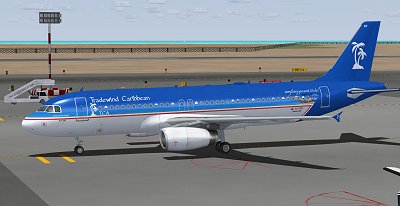
PJ-TXF 'Isla de Mustique'
Tradewind Caribbean
** Instruction within the zip **
|
Airbus A320 ~ feelThere/Wilco PA merge
Perhaps the most important contributor to Airbus Industrie's success as an airliner manufacturer, the four member A320 family is a significant sales success and a technological trailblazer. The 150 seat A320 is the foundation and best selling member of the family.
The A320 is perhaps best known as the first airliner to introduce a fly-by-wire flight control system - where control inputs from the pilot are transmitted to the flying surfaces by electronic signals rather than mechanical means. Apart from a small weight saving, the advantage of Airbus' fly-by-wire is that as it is computer controlled, an inbuilt flight envelope protection makes it virtually impossible to exceed certain flight parameters such as G limits and the aircraft's maximum and minimum operating speeds and angle of attack limits.
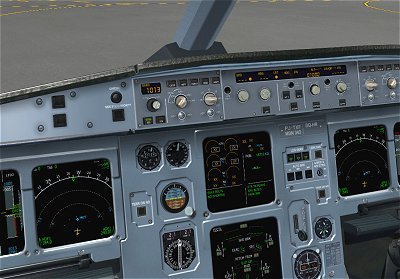
Also integral to the A320 is the advanced electronic flightdeck, with six fully integrated EFIS colour displays and innovative sidestick controllers rather than conventional control columns. The A320 also employs a relatively high percentage of composite materials compared to earlier designs. Two engines are offered, the CFM56 and IAE V2500.
The A320 program was launched in March 1982, first flight occurred on February 22 1987, while certification was awarded on February 26 1988. Launch customer Air France took delivery of its first A320 in March that year. The first V2500 engined A320 was delivered to Adria Airways in May 1989.
The initial production version was the A320-100, which was built in only small numbers before being replaced by the definitive A320-200 (certificated in November 1988) with increased max takeoff weight, greater range and winglets. The stretched A321 and shortened A319 and A318 are described separately. All four share a common pilot type rating. Mid 2000 A320 family production was at a monthly rate of 22, to be increased to 30 units a month by the end of 2002.
|
|
Other Essential Files:
The payware Airbus Series Evolution Vol.1 package
|
Repaint by JF
|
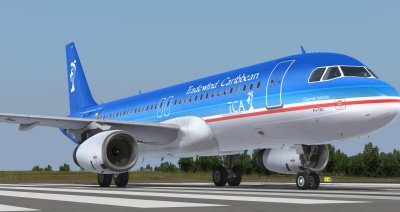
PJ-TXC 'Cayman Islands' A320
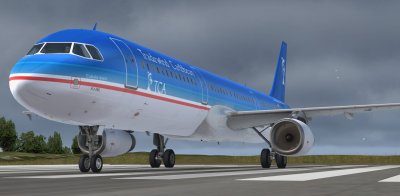
PJ-TXL 'Eustatia Island' A321
Tradewind Caribbean
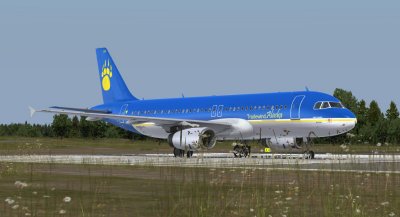
N320TA 'Jack London' A320
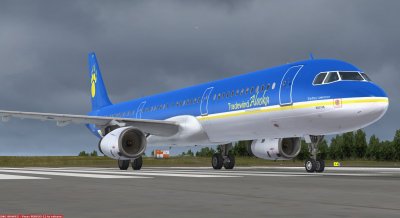
N321TA 'Sydney Lawrence' A321
Tradewind Alaska
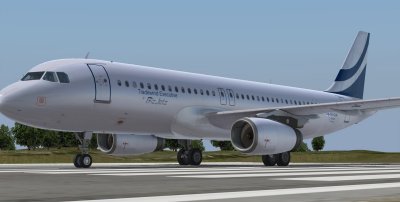
PJ-CJA A320 Prestige
Tradewind Executive Bizjetz
For v1.16 A320s A321s
For v1.30 A320s A321s
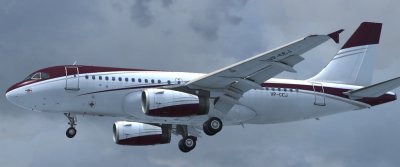
VP-CCJ A319
Tradewind Executive Bizjetz
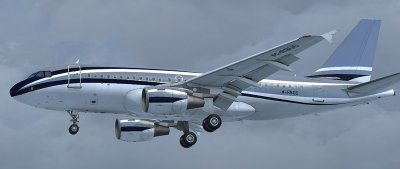
M-RBUS A319 CJ
Tradewind Executive Bizjetz
|
A320/A321 ~ Aerosoft Airbus
IAE NEO
(Based on v1.16 and v1.30)
Perhaps the most important contributor to Airbus Industrie's success as an airliner manufacturer, the four member A320 family is a significant sales success and a technological trailblazer. The 150 seat A320 is the foundation and best selling member of the family.
The A320 is perhaps best known as the first airliner to introduce a fly-by-wire flight control system - where control inputs from the pilot are transmitted to the flying surfaces by electronic signals rather than mechanical means. Apart from a small weight saving, the advantage of Airbus' fly-by-wire is that as it is computer controlled, an inbuilt flight envelope protection makes it virtually impossible to exceed certain flight parameters such as G limits and the aircraft's maximum and minimum operating speeds and angle of attack limits.
Also integral to the A320 is the advanced electronic flightdeck, with six fully integrated EFIS colour displays and innovative sidestick controllers rather than conventional control columns. The A320 also employs a relatively high percentage of composite materials compared to earlier designs. Two engines are offered, the CFM56 and IAE V2500.
The A320 program was launched in March 1982, first flight occurred on February 22 1987, while certification was awarded on February 26 1988. Launch customer Air France took delivery of its first A320 in March that year. The first V2500 engined A320 was delivered to Adria Airways in May 1989.
The initial production version was the A320-100, which was built in only small numbers before being replaced by the definitive A320-200 (certificated in November 1988) with increased max takeoff weight, greater range and winglets. The stretched A321 and shortened A319 and A318 are described separately. All four share a common pilot type rating. Mid 2000 A320 family production was at a monthly rate of 22, to be increased to 30 units a month by the end of 2002.
|
Can be used on non Neo aircraft
|
Other Essential Files:
The payware package
|
Repaints by JF
|
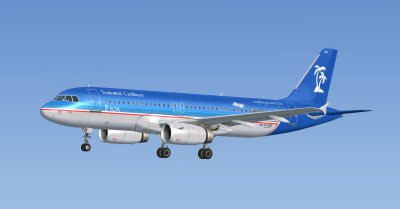
A320 IAE
PJ-TXB 'Saint Barthélemy'
Tradewind Caribbean
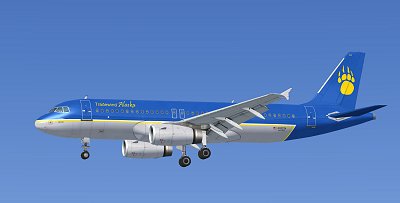
A320 IAE
N322TA 'Dillingham'
Tradewind Alaska
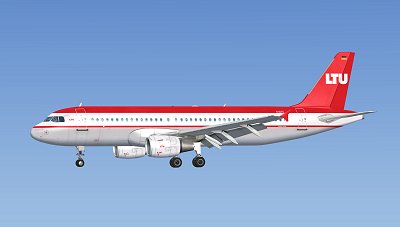
A320 CFM
D-ALTC LTU Retro Code Share
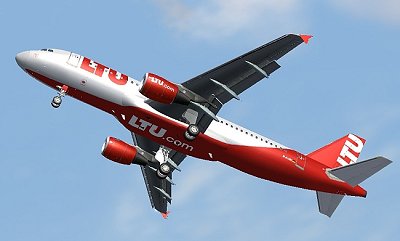
A320 CFM
D-ALTE LTU Retro Code Share
|
Airbus A320 ~ BlackBox Simulation
Perhaps the most important contributor to Airbus Industrie's success as an airliner manufacturer, the four member A320 family is a significant sales success and a technological trailblazer. The 150 seat A320 is the foundation and best selling member of the family.
The A320 is perhaps best known as the first airliner to introduce a fly-by-wire flight control system - where control inputs from the pilot are transmitted to the flying surfaces by electronic signals rather than mechanical means. Apart from a small weight saving, the advantage of Airbus' fly-by-wire is that as it is computer controlled, an inbuilt flight envelope protection makes it virtually impossible to exceed certain flight parameters such as G limits and the aircraft's maximum and minimum operating speeds and angle of attack limits.
Also integral to the A320 is the advanced electronic flightdeck, with six fully integrated EFIS colour displays and innovative sidestick controllers rather than conventional control columns. The A320 also employs a relatively high percentage of composite materials compared to earlier designs. Two engines are offered, the CFM56 and IAE V2500.
The A320 program was launched in March 1982, first flight occurred on February 22 1987, while certification was awarded on February 26 1988. Launch customer Air France took delivery of its first A320 in March that year. The first V2500 engined A320 was delivered to Adria Airways in May 1989.
The initial production version was the A320-100, which was built in only small numbers before being replaced by the definitive A320-200 (certificated in November 1988) with increased max takeoff weight, greater range and winglets. The stretched A321 and shortened A319 and A318 are described separately. All four share a common pilot type rating. Mid 2000 A320 family production was at a monthly rate of 22, to be increased to 30 units a month by the end of 2002.
|
|
Other Essential Files:
The payware Airbus Prologue or Xtreme
|
Repaint by JF
|
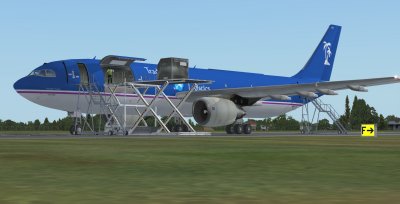
PJ-CFC 'Starlight Trader'
Tradewind Logistics
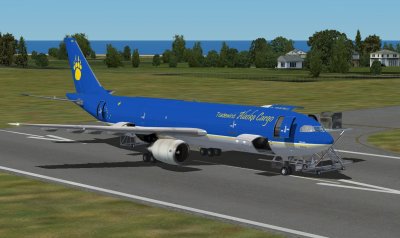
N306TA 'Nikiski'
Tradewind Alaska Cargo
DOWNLOAD
|
Airbus A300 ~ Simcheck
The Airbus A300 is significant not only for being a commercial success in its own right, but for being the first design of Europe's most successful postwar airliner manufacturer.
Aerospatiale of France, CASA of Spain and the forerunners of Germany's DaimlerChrysler Aerospace and British Aerospace formed the Airbus Industrie consortium in the late 1960s specifically to develop a twin engined 300 seat widebody `air bus' to fill an identified market gap.
The original 300 seat airliner design matured into a smaller 250 seater, the A300 designation gaining a `B' suffix to denote the change. Two prototype A300B1s were built, the first of these flying from Toulouse, France on October 28 1972, the second on February 5 the next year. The General Electric CF6 was the powerplant choice for initial A300s. Following the prototype A300B1s was the 2.65m (8ft 8in) longer A300B2, the first production version which first flew in April 1974. The B2 entered service with Air France on May 23 1974.
Subsequent versions included the B2-200 with Krueger leading edge flaps and different wheels and brakes; the B2-300 with increased weights for greater payload and multi stop capability; the B4-100 a longer range version of the B2 with Krueger flaps; and the increased max takeoff weight B4-200 which featured reinforced wings and fuselage, improved landing gear and optional rear cargo bay fuel tank. A small number of A300C convertibles were also built, these featured a main deck freight door behind the wing on the left hand side. Late in the A300B4's production life an optional two crew flightdeck was offered as the A300-200FF (customers were Garuda, Tunis Air and VASP).
Production of the A300B4 ceased in May 1984, with manufacture switching to the improved A300-600.
Older A300s are now finding a useful niche as freighters, with a number of companies, in particular DaimlerChrysler Aerospace Airbus, offering conversion programs.
|
|
Other Essential Files:
The payware package
|
Repaint by JF
|
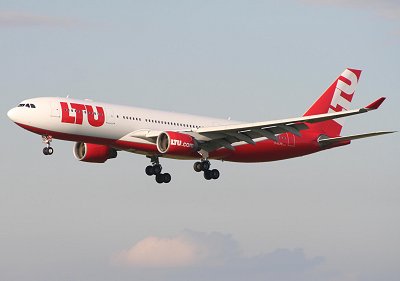
Airbus A330-200 PW
D-ALPA LTU Retro Code Share
Version=0.81 Version=0.85
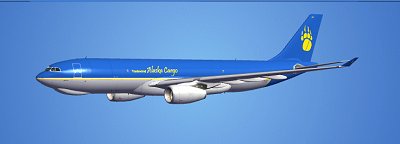
Airbus A330-200F RR
N332TA Tradewind Alaska Cargo
Version=0.81 Version=0.85

Airbus A330-200 RR
N338TA 'Alaskan Treasure'
Version=0.85
|
Airbus
A330-200 - BlackBox Simulation
The
A330-200 is the newest member of Airbus' widebody twinjet
family and is a long range, shortened development of the
standard A330, developed in part as a replacement for
the A300-600R and a competitor to the 767-300ER.
Airbus launched development of the A330-200 in November
1995, followed by the first customer order, for 13 from
ILFC, placed in February 1996. First flight was on August
13 1997, with certification and first customer deliveries,to
ILFC/Canada 3000, in April 1998.
The A330-200 is based on the A330-300 and shares near
identical systems, airframe, flightdeck and wings, the
only major difference being the fuselage length. Compared
with the 300 the A330-200 is 10 frames shorter, and so
has an overall length of 59.00m (193ft 7in), compared
with 63.70m (209ft 0in) for the standard length aircraft.
This allows the A330-200 to seat 256 passengers in a three
class configuration, or alternatively 293 in two classes.
Because of its decreased length the A330-200 features
enlarged horizontal and vertical tail services (to compensate
for the loss of moment arm with the shorter fuselage).
Another important change is the addition of a centre fuel
tank, which increases the A330-200's fuel capacity over
the 300's, and results in the 200's 11,850km (6400nm)
range.
Like the A330, engine options are the GE CF6-80, Pratt
& Whitney 4000 series and the RollsRoyce Trent 700.
The A330-200 has sold quite strongly since its launch.
Among the initial A330-200 customers are, apart from ILFC,
Canada 3000, Korean Air, Austrian, Air Transat, Emirates,
Swissair, Sabena, Monarch, Asiana, TAM, and Air Lanka.
|
|
Other Required Files:
The payware Airbus A330 Prologue or Xtreme
|
Repaint by JF
|
|
|
ATR
72-500 ~ Flight 1
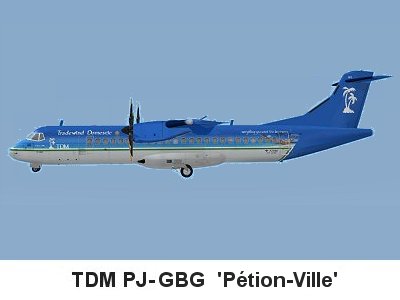
TDM PJ-GBG 'Petion-Ville'
|
The
ATR-72 is a stretched development of the popular ATR-42
and was launched in January 1986.
The
first of three ATR-72 development aircraft flew for the
first time on October 27 1988, followed by the awarding
of French and then US certification in late 1989. Entry
into service was on October 27 1989 with Kar Air of Finland.
Some other early operators are Foshing Airlines, NFD (later
Eurowings), CSA, American Eagle, TAT, Air Littoral, LOT,
and Olympic Aviation.
Significant
differences between the ATR-72 and the smaller and older
ATR-42 include a 4.50m (14ft 9in) fuselage stretch and reworked
wings. The ATR-72's wings are new outboard of the engine
nacelles and with 30% of it made up of composite materials,
comprising composite spars and skin panels and a carbon
fibre wing box.
Aside
from the baseline ATR-72-200, two developments have been
offered, the ATR-72-210, and the ATR-72-500 (previously
ATR-72-210A). The ATR-72-210 is optimised for operations
in hot and high conditions. It has more powerful PW-127
engines for better takeoff performance.
The
ATR-72-500 (renamed from ATR-72-210A on May 18, 1998) further
improved hot and high model was certificated in early 1997.
It features PW-127Fs driving six blade composite Hamilton
Sundstrand propellers.
The
ATR-52C is an as yet unlaunched derivative with a redesigned
tail to incorporate a rear loading ramp, intended for military
and commercial operators. As with the ATR-42, a military
maritime patrol version, known as the Petrel 72, has also
been offered.
The
ATR-72 would have formed the basis for the ATR-82, a 78
seat stretched development. The ATR-82 would have been powered
by two Allison AE-2100 turboprops (ATR studied turbofans
for a time) and would have a cruising speed as high as 610km/h
(330kt). The ATR-82 was suspended when AI(R) was formed
in early 1996
|
|
|
Other Essential Files:
The payware Flight1
ATR 72-500 package
|
Repaint by JF
|
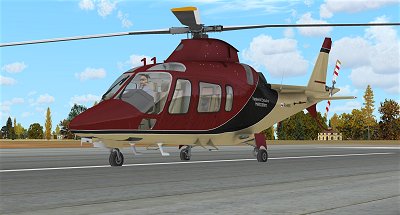
PJ-AWI - Tradewind Executive Helicopters
|
Agusta-Westland AW109 ~ Nemeth
for FSX
The A-109 is a high performance twin helicopter, one of the most successful in its class during the course of its 25 year history.
The first of four A-109 prototypes flew on August 4 1971. VFR certification was awarded on June 1 1975 although series production had already begun in 1974. First production deliveries took place in late 1976. The helicopter was originally named Hirundo, but this name was later dropped. Single pilot IFR certification was granted in January 1977.
The base A-109A was superseded by the upgraded A-109A Mk.II from September 1981. Improvements incorporated in the Mk.II included a greater transmission rating, redesigned tailboom and a new tail rotor driveshaft, improved rotor blade life and modern avionics. The Mk.II is also available in widebody configuration with increased internal volume courtesy of bulged fuselage side panels and reshaped fuel tanks under the cabin floor. The Mk.II Plus has the more powerful 250-C20R1 engines, as does the A-109C. The 109C also has composite rotor blades.
The A-109K first flew in April 1983 and is powered by two 470kW (640shp) max continuous operation rated Turboméca Arriel 1K1 turboshafts. The latest A-109 model is the PW-206C powered (477kW/640shp takeoff rated) A-109E Power, which first flew on February 8 1995 and was certificated in August 1996. Based on the A-109K-2 it also features a strengthened landing gear and improved main rotor. The engines feature FADEC.
The A-109 has been developed into a number of mission specific configurations. Aside from executive transport it is used widely in medevac, police and patrol roles worldwide. Previously medevac configured A-109As were based on the standard airframe, but modifications engineered by the US firm Custom Aircraft Completions resulted in the A-109 Max, with transverse stretcher stowage and bulged side door transparencies. |
|
Other Essential Files:
The payware Nemeth Designs package
|
Repaint by JF
|
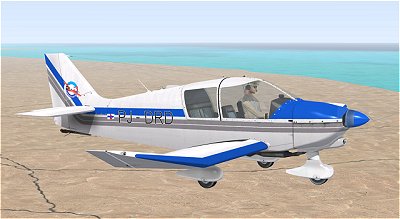
PJ-DRD - Tradewind Flying Club
|
Avions Pierre Robin DR400-140B ~ Aerosoft
for FSX
The Robin DR-400 series of light aircraft owes its origins to the Jodel series of wooden construction light aircraft.
Avions Pierre Robin was formed by Pierre Robin and the principle designer of Jodel Aircraft, Jean Delemontez, in October 1957 as Centre Est Aeronautique. The company's initial production was of developments of the basic Jodel series of tail draggers, and it was these aircraft that evolved into the DR-400 series. Initial production was of the DR-100 and the DR-1050/1051, while the DR-220, DR-221 and DR-250 featured the Jodel's basic wing with a four seat fuselage. The final links between the Jodels and the DR-400 were the DR-253 and DR-300 series, tricycle developments of the DR-220 series.
First flight of the DR-400 occurred during June 1972, both a DR-400-125 and a DR-400-180 taking flight that month. Essentially, the DR-400 was an improved DR-300 with a forward-sliding canopy replacing the doors of the previous model.
Since that time a number of developments have been offered. The least powerful version is the DR 400-120, and it remains in production today as the DR-400-120 Dauphin 2+2. Powered by an 84kW (112hp) O-235, the DR-400-120 is really a two seater, although it can seat two children on a rear bench seat. The DR-400-125I has a 93kW (125hp) fuel injected IO-240 and was revealed in 1995. The DR-400-140 Dauphin is powered by a 120kW (160hp) O-320 and is a full four seater. The four seat DR-400-160 Chevalier meanwhile also features a 120kW (160hp) Lycoming O-320 and seats four. It first flew in June 1972. With a different prop, more fuel capacity and slightly different wing it became the DR-400-160 Major from 1980.
The four/five seat DR 400-180 Regent and DR-400-180R Remo 180 are powered by the 135kW (180hp) (Textron) Lycoming O-360, the Remo being optimised for glider towing. Also optimised for glider tug work is the DR-400-200R Remo 200, the most powerful DR-400 model (powered by a 150kW/200hp IO-360, driving a constant speed prop).
The DR-500 President was unveiled at the 1997 Paris Airshow as the DR-400-200I. It features a 150kW (200hp) IO-360 driving a constant-speed prop and widened and taller cabin. Deliveries began in 1998. |
|
Other Essential Files:
The payware Aerosoft package
|
Repaint by JF
|
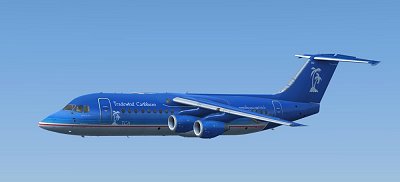
PJ-TQQ 'Guardalavaca' Tradewind Caribbean
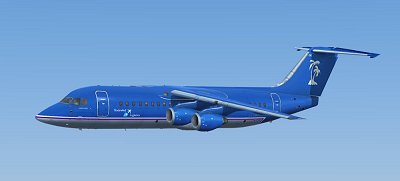
PJ-TQC 'Whisper' Tradewind logistics
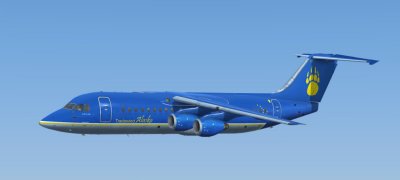
N100TA 'Pakadlangitok' Tradewind Alaska
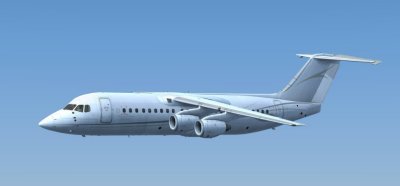
PJ-RAZ Tradewind BizJetz
FSX
ONLY
|
Avro
Regional Jet 100 ~ QualityWings
The
Avro RJ series are upgraded developments of the BAe-146
family (see separate entry), and like the 146 was built
in three fuselage length variants, the RJ70, RJ85 and
RJ100.
In
1990 British Aerospace first offered the improved RJ70
and RJ80, both of which were based on the 146-100. They
would have seated 70 and 80 passengers respectively, but
these two designs matured in the Avro RJ70 (officially
Avro 146-RJ70) with improved FADEC equipped LF-507 engines
and digital avionics.
The
146-200 based Avro RJ85 was the first member of the new
family to fly, on March 23 1992. The biggest member of
the family, the 146-300 based RJ100, first flew on May
13 1992. The 146-100 based RJ70 was delivered from late
1993 but due to low customer interest, only 12 were sold.
RJ
improvements over the 146 include more reliable and efficient
FADEC equipped AlliedSignal (now Honeywell) LF-507 engines,
new "Spaceliner" cabin interior and a digital
flightdeck. Weight and drag savings were introduced in
1996.
The
RJ100 was also offered as the RJ115 with extra emergency
exits to seat 116 to 128 in a high density six abreast
configuration. None were built however. The RJ was also
offered as the Avro Business Jet, but also none of these
were built.
The
RJ series was originally manufactured and marketed by
Avro International Aerospace, a separate British Aerospace
company, so named as RJ production was undertaken at the
former Avro factory near Manchester (most 146s were built
at Hatfield). Subsequent plans for a partnership with
Taiwan Aerospace, which would have seen the RJ series
built in Taiwan fell through and Avro subsequently became
part of AI(R) to handle marketing, sales and support of
British Aerospace (Avro and Jetstream) and ATR commercial
aircraft. However, AI(R) disbanded in mid 1998 and the
Avro RJ range became again a British Aerospace (later
BAE Systems) product.
The
last RJ was delivered in 2002. A modernised development
became the Avro RJX, for which see the separate entry.
|
|
Other Suggested Files:
|
Repaint by JF
|
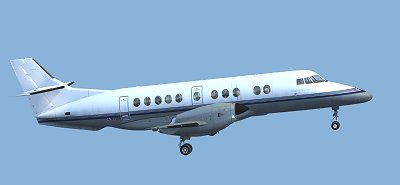
PJ-JDA - Tradewind BizJetz
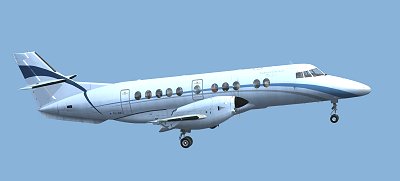
PJ-JDD - Tradewind BizJetz
|
British Aerospace Jetstream 41 ~ PMDG
for FSX
The Jetstream 41 is a stretched and modernised development of the 19 seat Jetstream 31, designed to compete in the 29 seat commuter airliner class alongside such types as the Brasilia, Dornier 328 and Saab 340.
The Jetstream 41 (or J41) is based on the J31, but features a 4.88m (16ft) fuselage stretch, consisting of a 2.51m (8ft 3in) plug forward of the wing and a 2.36m (7ft 9in) stretch rear. The increased span wing (with reworked ailerons and flaps) is mounted lower on the fuselage so that it does not carry through the fuselage and interrupt the interior cabin aisle, unlike on the Jetstream 31. Other airframe modifications included a new reprofiled six piece windscreen and extended wing root fairing with greater baggage capacity. More powerful AlliedSignal TPE331 turboprops, mounted in new nacelles with increased ground clearance, drive advanced five blade McCauley propellers. The flightdeck has modern EFIS glass displays.
Development work on the J41 was announced in mid 1989, resulting in the type's first flight on September 25 1991. Three further aircraft were also used in the flight test program, with European JAA certification being awarded on November 23 1992. The first delivery occurred two days later on November 25.
From mid 1994, all aircraft delivered benefited from various payload and range performance improvements, resulting from uprated engines and a higher maximum takeoff weight.
The J41 was initially known as the BAe Jetstream 41, but BAe's establishment of a separate Jetstream Aircraft division in mid 1993 saw the name simplified to just Jetstream 41. From January 1996 the J41 became part of the Aero International (Regional) stable, but in May 1997 BAe announced that it was terminating J41 production.
Field Aircraft of the UK and Pilatus of Switzerland were risk sharing partners, while Gulfstream was to build 200 wingsets. |
|
Other Essential Files:
The payware PMDG package
|
Repaints by JF
|
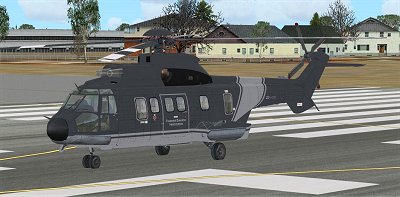
PJ-CCB - Tradewind Executive Helicopters
|
Aerospatiale Eurocopter Super-Puma MKII AS332 ~ Nemeth
for FSX
A larger development of the Puma (described under Aerospatiale), the Super Puma is a practical and proven medium lift twin helicopter, particularly popular for offshore oil rig support work.
The original SA 330 Puma, on which the Super Puma is based, flew for the first time in April 1965. The first Super Puma first flew in September 1978 and was essentially a more powerful version of the Puma, featuring 1270kW (1700shp) Turboméca Makila turboshafts, new avionics, composite rotor blades and an enlarged fuselage. For a time Aerospatiale planned to fit the Super Puma with a Fenestron shrouded tail rotor, but testing revealed no significant performance benefits. Commercial versions were designated AS 332Cs.
The AS 332L (or SA 332L before 1980) Super Puma introduced a stretched fuselage (by 76.5cm/2.5ft), first flew on October 10 1980 and was certificated in 1983. The updated AS 332L1 with Makila 1A1 engines appeared in 1986. Bristow Helicopters ordered 31 specially customised AS 332Ls for its North Sea offshore oil rig work, and these are named Tiger.
The AS 332L remains in production but is progressively being replaced by the AS 332L2. The L2 Super Puma Mk II (known as the Cougar in military guise) features a further fuselage stretch permitting a further row of seats, EFIS flight instrumentation, spheriflex rotor heads and longer main rotor blades with parabolic tips. It was certificated in 1992. |
|
Other Essential Files:
The payware Nemeth Designs package
|
Repaint by JF
|
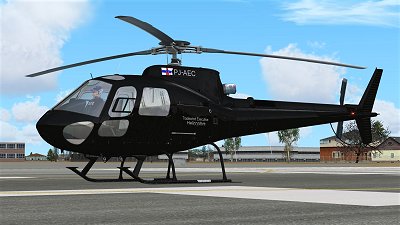
PJ-AEC - Tradewind Executive Helicopters
|
Aerospatiale AS350B3 (Squirrel) ~ Nemeth
for FSX
Europe's most successful civil helicopter, the Ecureuil (= Squirrel) is in extensive civil and military use worldwide undertaking a variety of wide ranging missions.
Aerospatiale's development of the AS-350 Ecureuil in the early 1970s culminated in the first flights of the Avco Lycoming LTS-101 powered prototype on June 27 1974 and the Turbomeca Arriel powered prototype on February 14 1975. These aircraft were followed by eight preproduction examples, the first of which flew in late 1977.
Customer deliveries began in April 1978. Initial models offered were the Arriel powered AS-350B, which was marketed outside North America, and the LTS-101 powered AS-350C AStar sold in the USA. The AS-350C was soon replaced by the D, with a more powerful engine.
Subsequent developments include the hot and high AS-350B-1 with a 510kW (684shp) Arriel 1D; the AS-350BA which was certificated in 1991 and was in production through to 1998 and is fitted with the larger main rotors of the AS-350B-2 (AS-350Bs can be retrofitted to BA standard); and the AS-350B-2 (marketed in North America as the SuperStar) with a more powerful Arriel 1D1 turboshaft, and the main and tail rotors developed for the twin engine AS-355F Ecureuil 2 (described separately) and certificated in April 1989. The AS-350B-3 first flew on March 4 1997 and is a hot and high optimised model. Its most important change is a more powerful Arriel 2D engine. Deliveries began in January 1998.
In January 1992, Aerospatiale's helicopter division was integrated into Eurocopter.
Later production military Ecureuils are marketed as the AS-550 Fennec. The Ecureuil is also built under licence in Brazil as the HB-350 Esquilo, and a look-a-like is built in China as the Changhe Z-11. |
|
Other Essential Files:
The payware Nemeth Designs package
|
Repaint by JF
|
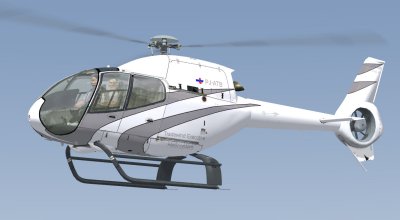
PJ-ATB - Tradewind Executive Helicopters
|
Aerospatiale Eurocopter EC-120 Colibri ~ Nemeth
for FSX
Eurocopter's solution to develop a new light helicopter lay in forming a partnership with CATIC (Harbin) of China and Singapore Technologies Aerospace of Singapore.
Eurocopter (then Aerospatiale), CATIC and STA launched definition development of a new light helicopter, then designated P-120L, in February 1990. The teaming arrangements for the helicopter saw Aerospatiale/Eurocopter take a 61% program share and leadership, CATIC with 24% and STAe with 15%. A development goahead contract for the new aircraft was signed in October 1992 (by which time Aerospatiale's helicopter activities had been merged into Eurocopter) and the EC-120 designation was announced in January 1993 (the Colibri [Hummingbird in English] name came later). Design definition was completed in mid 1993.
Within the Eurocopter/CATIC/STAe partnership, Eurocopter is responsible for the design and manufacture of the rotor system and transmission, final assembly (at Marignane in France), flight testing and certification. CATIC builds the EC-120's fuselage, landing gear and fuel system, while STAe's areas of responsibility covers the tailboom, fin and doors.
Notable Colibri design features include a three blade main rotor with a Spheriflex hub integrated with the driveshaft and transmission, composite main and tail rotor blades and skid landing gear, a metal construction fuselage and a new eight blade Fenestron shrouded tail rotor. The Turboméca TM-319 Arrius 1F turboshaft was selected to power at least the first 300 Colibris. The Colibri's cabin features standard seating for five including the pilot.
The first of two EC-120 prototypes first flew on June 9 1995 from Eurocopter France's Marignane facility. French DGAC certification was awarded in June 1997, while the first production Colibri first flew in December that year. |
|
Other Essential Files:
The payware Nemeth Designs package
|
Repaint by JF
|
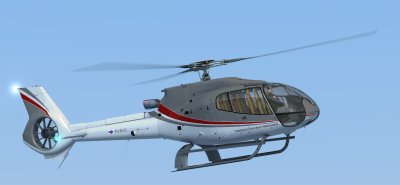
PJ-ECC - Tradewind Executive Helicopters
|
Aerospatiale Eurocopter EC-130 B4 ~ Nemeth
for FSX
The EC130 is a wide body variant of the AS350 B3 and was first flown on 24 June 1999 by Australian test pilot, Steven Page. The EC130 features an enclosed tail fan rather than the traditional tail rotor found on the older AS350. This Fenestron has unevenly spaced blades which has the advantage of reducing outside noise by 50% compared to a tail rotor, resulting in an FAA Appendix H fly-over noise signature of 84.3 EPNdB, 8.5 dB below stage two limits. The EC130 was designed in close cooperation with tour operators, Blue Hawaiian Helicopters being the launch operator, and features a spacious cockpit with excellent external visibility, capable of accommodating seven tourists. The EC130 entered service with Blue Hawaiian Helicopters in 2001, and is now a common sight in Hawaii and the Grand Canyon.
The EC130 is also quickly becoming popular within the air medical services (AMS) community, due to its large cabin (capable of accommodating one or two stretchers), wide side door and enclosed Fenestron anti-torque device.
In 2012, Eurocopter received orders for 50 EC130T2 from Maverick Helicopters, and other customers such as Papillon and Blue Hawaiian took the total to 105.
|
|
Other Essential Files:
The payware Nemeth Designs package
|
Repaint by JF
|
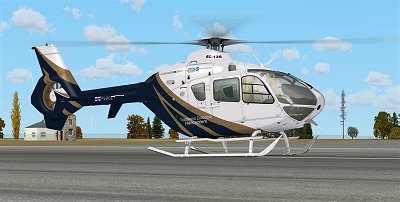
PJ-ACE - Tradewind Executive Helicopters
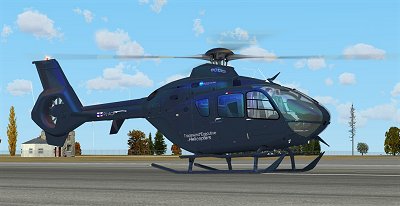
PJ-ACF - Tradewind Executive Helicopters
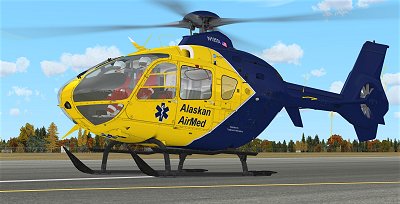
N135TA - Alaskan AirMed op by Tradewind Helicopters
|
Aerospatiale Eurocopter EC-135 ~ Nemeth
for FSX
The EC-135 is intended as a replacement for Eurocopter's successful BO-105 light twin, and is developed from the BO-108 technology demonstrator.
The original MBB BO-108 was intended as a high technology helicopter demonstrator, and as such incorporated a range of high technology features including a hingeless main rotor (Sikorsky and Boeing adopted this design for their military RAH-66 Comanche), all composite bearingless tail rotor, shallow transmission (allowing greater cabin height) with special vibration absorbers, composite structures, improved aerodynamics, modern avionics and EFIS instrumentation. The first BO-108 was powered by Allison 250-C20R3 turboshafts and flew on October 15 1988.
The success of the BO-108 test program led to MBB's announcement in January 1991 that it would develop a production 108 with Arrius or PW-206 engines as a replacement for the BO-105, with certification planned for 1994 and deliveries in 1995. However the formation of Eurocopter (in January 1992) gave the program access to Aerospatiale's Fenestron shrouded tail rotor technology which was then incorporated into the design.
The combination of the BO-108 and the Fenestron led to the definitive EC-135 flying for the first time on February 15 1994. German certification was granted on June 14 1996, while US approval was given on July 31 that year, the same day as the first customer delivery. The PW-206 powered model is designated EC-135P-1, the EC-135T-1 has the Arrius 2B1.
The designation for dedicated military versions is EC-635. |
|
Other Essential Files:
The payware Nemeth Designs package
|
Repaint by JF
|
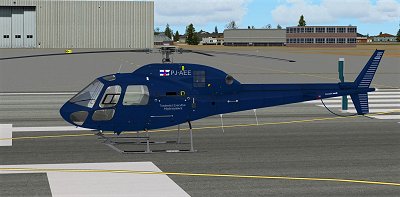
PJ-AEE - Tradewind Executive Helicopters
|
Aerospatiale Eurocopter AS355 Ecureuil 2 (Twin Squirrel)
~ Nemeth
for FSX
Europe's most successful civil helicopter, the Ecureuil (= Squirrel) is in extensive civil and military use worldwide undertaking a variety of wide ranging missions.
Aerospatiale's development of the AS-350 Ecureuil in the early 1970s culminated in the first flights of the Avco Lycoming LTS-101 powered prototype on June 27 1974 and the Turbomeca Arriel powered prototype on February 14 1975. These aircraft were followed by eight preproduction examples, the first of which flew in late 1977.
Customer deliveries began in April 1978. Initial models offered were the Arriel powered AS-350B, which was marketed outside North America, and the LTS-101 powered AS-350C AStar sold in the USA. The AS-350C was soon replaced by the D, with a more powerful engine.
Subsequent developments include the hot and high AS-350B-1 with a 510kW (684shp) Arriel 1D; the AS-350BA which was certificated in 1991 and was in production through to 1998 and is fitted with the larger main rotors of the AS-350B-2 (AS-350Bs can be retrofitted to BA standard); and the AS-350B-2 (marketed in North America as the SuperStar) with a more powerful Arriel 1D1 turboshaft, and the main and tail rotors developed for the twin engine AS-355F Ecureuil 2 (described separately) and certificated in April 1989. The AS-350B-3 first flew on March 4 1997 and is a hot and high optimised model. Its most important change is a more powerful Arriel 2D engine. Deliveries began in January 1998.
In January 1992, Aerospatiale's helicopter division was integrated into Eurocopter.
Later production military Ecureuils are marketed as the AS-550 Fennec. The Ecureuil is also built under licence in Brazil as the HB-350 Esquilo, and a look-a-like is built in China as the Changhe Z-11. |
|
Other Essential Files:
The payware Nemeth Designs package
|
Repaint by JF
|
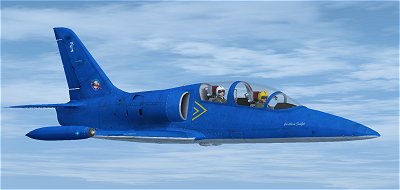
PJ-LCI - 'Caribbean FunJet'
Tradewind Fying Club
|
Aero Vodochody L-39 Single Engine Jet Trainer
~ Lotus Simulation
for FSX
Originally designed as a combat training aircraft, the Aero Vodochody L-39 Albatros is now finding new life among owner, operator and modelling enthusiasts around the world. This website serves as a discussion forum and information respository for this fine aircraft.
The Aero Vodochody L-39 aircraft is a low-wing, tandem seating, all metal turbofan powered aircraft designed for basic and advanced training, including weapon delivery practicing, as well as for light attack tasks.
History:
The Czechoslovakian L-39 was built as the successor to their earlier trainer, the L-29 Delfin. Design work began in 1966, and the first prototype made its initial flight on 4 November 1968. The idea of the design was to marry an efficient, powerful turbofan engine to a sleek, streamlined fuselage, resulting in a strong, economical performer which would become the next standard jet trainer for the Warsaw Pact. Full-scale production was delayed until late 1972 due to apparent problems with the design of the air intakes, but these difficulties were overcome and the type went on to be a great success with the Soviet, Czech and East German air forces, among others.
Four variations of the L-39 Albatros were produced:
- L-39C Aircraft for basic and advanced jet training
- L-39V Single-seat aircraft for target towing
- L-39ZO Training aircraft with extended weapon practice capabilities-four underwing hardpoints
- L-39ZA Training and multipurpose light attack aircraft with underfuselage gun pod with four underwing hardpoints.
L-39 features:
- Excellent handling characteristics within the whole flight envelope
- Operation capability on grass strips and semi-prepared airstrips
- Excellent visibility from both cockpits
- Easy to maintain and service
- Low operational cost
- High reliability
- The practical suitability of L-39 aircraft for training tasks is demonstrated daily in military service of more than 30 Air Forces in Europe, Asia, Africa and America. The entire L-39 fleet, covering more than 2,800 delivered L-39 aircraft worldwide, has accumulated over 4,000,000 flying hours.
Specifications:
- Engine: One 3,792-lb thrust Ivchenko AI-25-TL
- Weight: Empty 7,340 lbs., Max Takeoff 11,618 lbs. (L-39ZO with four rocket pods)
- Wing Span: 31ft. 0.5in. Length: 40ft. 5in. Height: 15ft. 5.5in.
- Performance:
- Maximum Speed at 19,600 ft: 485 mph (Trainer version, clean)
- Maximum Speed at Sea Level: 435 mph
- Ceiling: 37,730 ft. (Trainer, clean)
- Range: 528 miles with internal fuel; 995 miles with external tanks
- Armament (L-39ZO): Up to 2,425 pounds of weapons on four underwing hardpoints, including bombs, 57- or 130-mm rocket pods, gun pods, a five-camera reconnaissance pod, or two fuel drop-tanks. Centerline point carried a pod-mounted 23-mm twin-barrel GSh-23 cannon with 180 rounds.
Number Built: 2800+
Number Still Airworthy: Unknown number in military service. Approximately 300 flying in private ownership.
* Note: Another variant of the L-39, known as the L-39MS, was produced in very limited numbers and served as a development platform for the L-59. Although it appears externally like an L-39, the airframe, engine, aircraft control, APU and other equipment is different than the L-39. L-39MS models can be recognized by a “4″ in the second digit of the 6-digit aircraft serial number.
|
|
Other Essential Files:
The payware Lotus Simulation package
|
Repaint by JF
|
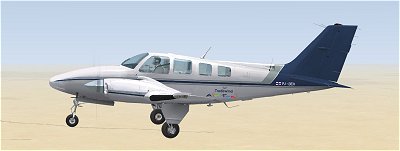
Tradewind Air Taxis PJ-BEH
For FSX ONLY
|
Beech B58 Baron ~ Carenado
The Beechcraft Baron is a light-medium twin-engine piston aircraft originally developed by Beech Aircraft Corporation and currently manufactured by the Beechcraft Division of Raytheon Aircraft. The Baron is a variant of the Beechcraft Bonanza, and was first introduced in 1961. Oddly, Beech also offered a Twin Bonanza line of airplanes which featured some design commonality with the Bonanza but in all respects were entirely different airplanes and could not be considered to be true "twin bonanzas".
As of 2006, a new Baron costs over $1.2 million. Since its inception, the Baron has always been near the top of the light airplane hierarchy. Expensive as it is to buy and to operate, the 'next step up' from a Baron is a very big one. Faster aircraft, with greater range and more load-carrying capability are generally turbine-powered and far more expensive.
Barons come in two basic types: the Baron 55 (short body) and Baron 58 (long body), with several subtypes.
Introduced in 1970, the more powerful Baron 58 has club seating, double aft doors, and a gross weight of 5400–5500 lb (2450–2500 kg), and is fitted with either the Continental IO520 or IO550 300 hp (224 kW) engine. The Baron 58 can cruise at 200 knots (370 km/h) at 7000 ft (2100 m), and is equipped with either 166 or 190 US gallon (628 or 719 L) fuel tanks.
In 1976, the turbocharged Baron 58TC and pressurized Baron 58P were introduced. These variants were powered by Continental TIO520 turbocharged engines of 310–325 hp (230–240 kW) and had an increased 6100–6200 lb (about 2800 kg) gross weight, and were certified under FAR23 with a new type certificate. The Baron 58P/58TC models were capable of cruising at 200 knots (370 km/h) at 8000 ft (2400 m) and 220 knots (410 km/h) at 20000 ft (6100 m), and were typically equipped with 190 US gallon (719 L) fuel tanks.
A big change in panel/system layout on 58/58TC/58P occurred in 1984, including relocating throttle, gear, flap, propeller and mixture controls to industry-standard positions.
Although the turbocharged 58TC/58P variants were discontinued in 1985, the normally aspirated Baron 58 is still in production as of 2006
|
|
Other Essential Files:
The payware Carenado
|
Repaints by JF
|
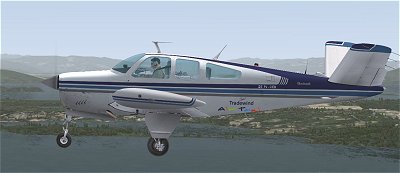
Tradewind Air Taxis PJ-CEB
For FSX ONLY
|
Beech V35B Bonanza ~ Carenado
The distinctive Model 35 Bonanza is one of general aviation's most famous and prolific types, and enjoyed a production life spanning four decades.
The Bonanza first flew on December 22 1945. Featuring metal construction, retractable undercarriage and high performance, it heralded a new class of high performance GA aircraft. The design also featured the distinctive Vtail, incorporated for aerodynamic efficiency and reduced weight. Deliveries of production aircraft began in 1947.
Subsequent development led to a significant family of subtypes. Briefly these are the A35 of 1949 with a greater max takeoff weight; the B35 with a 146kW (196hp) E1858 engine; the 153kW (205hp) E18511 powered C, D and E models through to 1954; the F and G35 with third cabin window and 170kW (225hp) E2258 of the mid fifties; the 180kW (240hp) Continental O470G powered H35 of 1957; the fuel injected 187kW (250hp) powered J35; 1960's M35 with larger rear windows; and the N35 and P35 with a 195kW (260hp) IO470N and greater max takeoff weight.
Then followed the redeveloped S35 of 1964 with six seats and redesigned rear cabin, optional three blade prop, 215kW (285hp) IO520B engine and yet greater weights; the heavier V35 of 1966; and turbocharged V35TC; V35A and V35ATC of 1968 with more raked windscreen; and the V35B and V35BTC (just seven built) from 1970. The V35B remained in production until 1982 and underwent a number of detail changes in that time.
|
|
Other Essential Files:
The payware Carenado
|
Repaints by JF
|
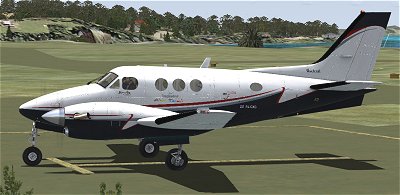
Tradewind Air Taxis PJ-CXC
For FSX-P3D ONLY
|
Beechcraft
C90B King Air ~ Carenado
The Beechcraft King Air family is part of a line of twin-turboprop aircraft produced by the Beech Aircraft Corporation (now Beechcraft Division of Hawker Beechcraft). The King Air line comprises a number of models that have been divided into two families; the Model 90 and 100 series are known as King Airs, while the Model 200 and 300 series were originally marketed as Super King Airs, with "Super" being dropped by Beechcraft in 1996 (although it is still often used to differentiate the 200 and 300 series King Airs from their smaller stablemates).
The King Air was the first aircraft in its class and has been in continuous production since 1964. It has outsold all of its turboprop competitors combined. It now faces competition from jet aircraft such as the Beechcraft Premier I and Cessna Citation Mustang as well as newer turboprop aircraft including the Piaggio P180 Avanti, and single-engine Piper Malibu Meridian and Socata TBM.
General characteristics
Performance
- Maximum speed: 311 mph TAS (270 knots TAS, 500 km/h TAS)
- Cruise speed: 260 mph TAS (226 kts TAS, 416 km/h TAS)
- Stall speed: 90 mph (78 knots, 145 km/h) IAS (flaps down)
- Range: 1,530 miles (1,321 nm, 2,446 km)
- Service ceiling: 30,000ft (9,144 m)
- Rate of climb: 2,000 ft/min (10.2 m/s)
- Wing loading: 34.3 lb/ft² (170 kg/m²)
- Power/mass: 0.099 hp/lb (179 W/kg)
|
|
Other Essential Files:
The payware Carenado
|
Repaints by JF
|
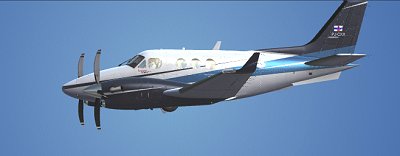
Tradewind Air Taxis PJ-CXX
For FSX-P3D ONLY
|
Beechcraft
C90 GTX King Air ~ Carenado
The King Air® C90GTx is a whole new world of flying that offers the impressive King Air qualities of performance combined with comfort. This versatile workhorse has great range and payload due to its features like composite winglets, swept-blade propellers and dual aft strakes. The King Air C90GTx is sure to become your new favorite aircraft.
|
|
Other Essential Files:
The payware Carenado
|
Repaints by JF
|
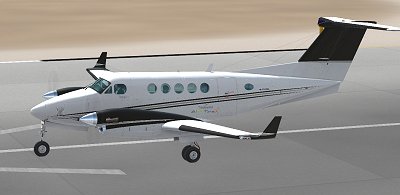
Tradewind Air Taxis PJ-XXA
For FSX ONLY
|
Beechcraft
B200 King Air ~ Carenado
The King Air 200 is a continuation of the King Air line, with new features including the distinctive Ttail, more powerful engines, greater wing area and span, increased cabin pressurisation, greater fuel capacity and higher operating weights compared to the King Air 100.
Beech began design work on the Super King Air 200 in October 1970, resulting in the type's first flight on October 27 1972. Certificated in mid December 1973, the King Air 200 went on to be the most successful aircraft in its class, eclipsing such rivals as the Cessna Conquest and Piper Cheyenne. Today the King Air 200 is the only one of the three in production.
The improved B200 entered production in May 1980, this version features more efficient PT6A42 engines, increased zero fuel max weight and increased cabin pressurisation. Sub variants include the B200C with a 1.32m x 1.32m (4ft 4in x 4ft 4in) cargo door, the B200T with removable tip tanks, and the B200CT with tip tanks and cargo door. The Special Edition B200SE was certificated in October 1995 and features an EFIS avionics suite as standard.
Various special mission King Air 200s and B200s have been built, including for navaid calibration, maritime patrol and resource exploration. In addition several hundred Super King Airs have been built for the US military under the designation C12. C12s perform a range of missions from electronic surveillance to VIP transport.
The 1500th commercial King Air 200 was built in 1995. In 1996 Raytheon dropped the `Super' prefix for all 200, 300 and 350 model King Airs.
|
|
Other Essential Files:
The payware Carenado
|
Repaints by JF
|
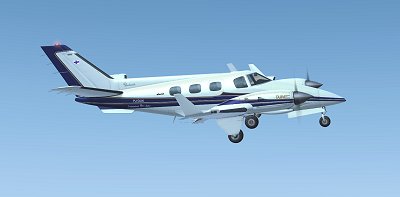
Tradewind BizJetz PJ-DUK
For FSX ONLY
|
Beechcraft Duke B60 V2 ~ RealAir
Between the Beech Baron and Queen Air in size, performance and general capabilities, the Duke was a pioneer in the pressurised high performance light business twin class.
Beechcraft began design work on its new Model 60 in early 1965, with the first flight of the prototype occurring the following year on December 29. US FAA Certification was awarded on February 1 1968.
Design features of the Duke include turbocharged Lycoming TIO541 engines driving three blade propellers and a 0.32 bars (4.6psi) cabin pressure differential. The airframe was based loosely on the Baron's wing and undercarriage, plus a new fuselage employing bonded honeycomb construction. Optional fuel tanks in the wings were offered, increasing range.
Deliveries of the initial 60 model began in July 1968. Further development led to the improved A60. Appearing in 1970 it introduced an enhanced pressurisation system and longer life yet lighter turbochargers which increased the maximum altitude at which the engine could deliver maximum power, thus improving performance.
The definitive model of the Duke family is the B60. New interior arrangements and more improvements to the turbochargers were the main changes to this model, which first appeared in 1974. Production ceased in 1982.
Since its appearance the Duke has been regarded as something of a hot ship, with its high performance in a relatively small package the main attraction. However, this image did not translate into anything other than modest sales because of the Duke's relatively complex systems (turbochargers and pressurisation among them) and high operating costs.
|
|
Other Essential Files:
The payware RealAir
|
Repaints by JF
|
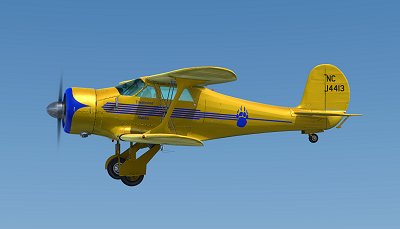
NC14413 Tradewind Alaska
op by HFG
|
Beechcraft Model 17 Staggerwing ~ Alabeo
At the height of the Great Depression, aircraft executive Walter H. Beech and airplane designer T. A. "Ted" Wells joined forces to collaborate on a project to produce a large, powerful, and fast cabin biplane built specifically for the business executive.
The Beechcraft Model 17, popularly known as the "Staggerwing" was first flown on November 4, 1932. During its heyday it was used as an executive aircraft, much as the private jet is now, and its primary competition were the Waco Custom Cabin and Waco Standard Cabin series of biplanes.
The Model 17's unusual negative stagger wing configuration (the upper wing staggered behind the lower) and unique shape maximized pilot visibility while negligibly reducing interference between the wings.[1] The fabric-covered fuselage was faired with wood formers and stringers over a welded, steel tube frame.[1] Construction was complex and took many man-hours to complete.
The Staggerwing's retractable conventional landing gear, uncommon at that time, combined with careful streamlining, light weight, and a powerful radial engine helped it perform well.
In the mid-1930s, Beech undertook a major redesign of the aircraft, to create the Model D17 Staggerwing.
The D17 featured a lengthened fuselage that improved the aircraft's handling characteristics by increasing control leverage and the ailerons were relocated to the upper wings, eliminating interference with the flaps. Braking was improved with a foot-operated brake linked to the rudder pedals. |
|
Other Essential Files:
Payware Aircraft
|
Repaint by JF
|
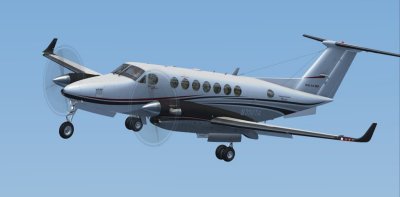
N350TA Tradewind BizJetz Alaska
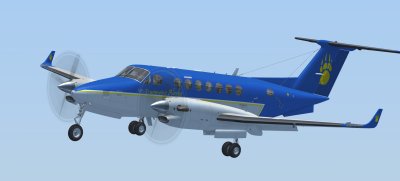
N351TA Tradewind Alaska
|
Beech King Air 350i ~ MilViz
Representing new heights of power and durability, the King Air 350i delivers truly inspiring performance!
With unparalleled versatility, the King Air 350i can take off from major airports or short gravel runways, and operates effortlessly from high–altitudes and under extreme weather conditions.
Inside, the King Air 350i’s redesigned cabin and collection of cutting-edge amenities creates a experience that is second to none, offering class leading comfort and unsurpassed interior styling.
On the flight deck, the Pro Line 21 integrated avionics suite leads the way in providing a truly intelligent avionics package that has put the King Air 350i at the top of every pilot’s wish list!
Max Cruise: 313 kts (360 mph, 580 km/h)
Engines: PT6A-60A - 1,050 shp
Max Range: 1606 nm (2974 km)
Service Ceiling: 35,000 ft (10,668 m)
Rate of Climb: 2,730 ft/min
Take-off Field Length: 3,300 ft (1,006 m)
|
|
Other Essential Files:
MilViz Payware aircraft
|
Repaint by JF
|
|
Essential
- Aircraft.cfg
text file (needed if downloaded before 2 Jan
07)
|
Beechcraft
B1900C Freighter ~ PMDG
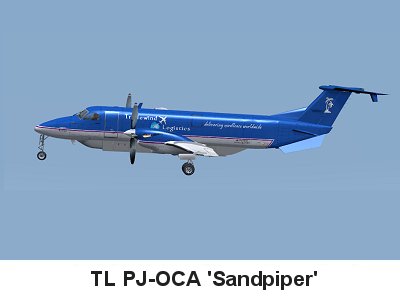
TL PJ-OCA 'Sandpiper'
|
The
Beech 1900 19 seat commuter was chosen along with the smaller
1300, both developments of the King Air 200, and the C99
for Beech's reentry into the regional airliner market in
1979.
The most obvious
change from the King Air 200 to the 1900C is the substantially
lengthened fuselage (17.63m/57ft 10in compared to 13.34m/43ft
9in). Other changes include more powerful engines, a modified
tail with tailets, and stabilons on the lower rear fuselage.
Development of
the 1900 commenced in 1979, with first flight occurring
on September 3 1982. US FAA certification was awarded in
November 1983, prior to the 1900C's entry into service in
February the following year. The first ExecLiner corporate
transport version was delivered in mid 1985.
During the course
of 1900C production a wet wing was introduced increasing
fuel capacity by 927 litres (204Imp gal/245US gal), while
military transport, maritime patrol and electronic surveillance
versions were offered.
Beech announced
the improved 1900D at the US Regional Airlines Association
meeting in 1989, with the prototype, a converted 1900C,
first flying on March 1 1990. Production switched to the
improved model in 1991, with first deliveries (to Mesa Air)
that November. The main change introduced on the 1900D was
the substantially deeper fuselage with standup headroom.
In addition it also introduced larger passenger and freight
doors and windows, twin ventral strakes and auxiliary horizontal
fixed tails, while more powerful engines and winglets improve
hot and high performance.
The 1900D has
sold particularly well. For example the 1900D's biggest
customer is Mesa Airlines, a United Airlines feeder, which
has placed total firm orders for 118. A 1900D delivered
to Impulse Airlines in Australia in March 1997 was the 500th
1900 built.
|
|
|
Other Essential Files:
The payware PMDG
Express B1900C package
|
Repaint by JF
|
|
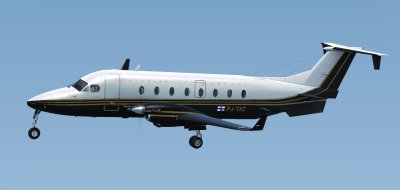
PH-TAT Tradewind Executive Bizjetz
|
Beechcraft
B1900D ~ Carenado
|
The
Beech 1900 19 seat commuter was chosen along with the smaller
1300, both developments of the King Air 200, and the C99
for Beech's reentry into the regional airliner market in
1979.
The most obvious
change from the King Air 200 to the 1900C is the substantially
lengthened fuselage (17.63m/57ft 10in compared to 13.34m/43ft
9in). Other changes include more powerful engines, a modified
tail with tailets, and stabilons on the lower rear fuselage.
Development of
the 1900 commenced in 1979, with first flight occurring
on September 3 1982. US FAA certification was awarded in
November 1983, prior to the 1900C's entry into service in
February the following year. The first ExecLiner corporate
transport version was delivered in mid 1985.
During the course
of 1900C production a wet wing was introduced increasing
fuel capacity by 927 litres (204Imp gal/245US gal), while
military transport, maritime patrol and electronic surveillance
versions were offered.
Beech announced
the improved 1900D at the US Regional Airlines Association
meeting in 1989, with the prototype, a converted 1900C,
first flying on March 1 1990. Production switched to the
improved model in 1991, with first deliveries (to Mesa Air)
that November. The main change introduced on the 1900D was
the substantially deeper fuselage with standup headroom.
In addition it also introduced larger passenger and freight
doors and windows, twin ventral strakes and auxiliary horizontal
fixed tails, while more powerful engines and winglets improve
hot and high performance.
The 1900D has
sold particularly well. For example the 1900D's biggest
customer is Mesa Airlines, a United Airlines feeder, which
has placed total firm orders for 118. A 1900D delivered
to Impulse Airlines in Australia in March 1997 was the 500th
1900 built.
|
|
|
Other Essential Files:
|
Repaint by JF
|
|
Beechcraft
B1900D ~ PMDG
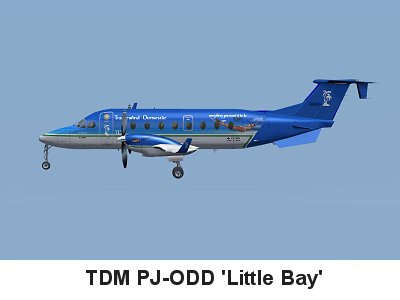
TDM PJ-ODD 'Little Bay'
The
Beech 1900 19 seat commuter was chosen along with the smaller
1300, both developments of the King Air 200, and the C99
for Beech's reentry into the regional airliner market in
1979.
The most obvious
change from the King Air 200 to the 1900C is the substantially
lengthened fuselage (17.63m/57ft 10in compared to 13.34m/43ft
9in). Other changes include more powerful engines, a modified
tail with tailets, and stabilons on the lower rear fuselage.
Development of
the 1900 commenced in 1979, with first flight occurring
on September 3 1982. US FAA certification was awarded in
November 1983, prior to the 1900C's entry into service in
February the following year. The first ExecLiner corporate
transport version was delivered in mid 1985.
During the course
of 1900C production a wet wing was introduced increasing
fuel capacity by 927 litres (204Imp gal/245US gal), while
military transport, maritime patrol and electronic surveillance
versions were offered.
Beech announced
the improved 1900D at the US Regional Airlines Association
meeting in 1989, with the prototype, a converted 1900C,
first flying on March 1 1990. Production switched to the
improved model in 1991, with first deliveries (to Mesa Air)
that November. The main change introduced on the 1900D was
the substantially deeper fuselage with standup headroom.
In addition it also introduced larger passenger and freight
doors and windows, twin ventral strakes and auxiliary horizontal
fixed tails, while more powerful engines and winglets improve
hot and high performance.
The 1900D has
sold particularly well. For example the 1900D's biggest
customer is Mesa Airlines, a United Airlines feeder, which
has placed total firm orders for 118. A 1900D delivered
to Impulse Airlines in Australia in March 1997 was the 500th
1900 built.
|
|
Other Essential Files:
The payware PMDG
Express B1900D package
|
Repaint by JF
|
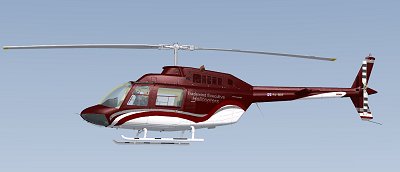
PJ-BOF - Tradewind Executive Helicopters
|
Bell
206B ~ Dodosim
for FSX
The JetRanger series has become the definitive turbine powered light utility and corporate helicopter of the past three decades.
The JetRanger can trace its lineage back to an unsuccessful contender for a US Army competition for a light observation helicopter, which was won by the Hughes 500. This first Model 206 made its first flight on December 8 1962, while the following civil 206A, powered by a 235kW (317shp) Allison C18A, followed, flying on January 10 1966. Deliveries of the first production JetRangers began late in that same year.
In the early 1970s production switched to the Model 206B JetRanger II with a 300kW (400shp) 250C20 turboshaft, while conversion kits to upgrade earlier As to the new standard were made available. The third major variant of the JetRanger is the 315kW (420shp) 250C20B powered JetRanger III, with first deliveries commencing in late 1977. Once again Bell offered a conversion kit to update earlier JetRangers to the new standard. Other features introduced on the JetRanger III were a larger and improved tail rotor and minor modifications.
JetRanger production was transferred from Texas to Mirabel in Canada in 1986, where the current production model remains the 206B3 JetRanger III.
The JetRanger was also accepted by the US Army as an observation helicopter as the OH58 Kiowa, and variants of the Kiowa remain in production in the USA. Military 206Bs were also built in Australia for the Australian Army, where plans were also held to build civilian 206Bs for the Australian market under license, but these fell through. |
|
Other Essential Files:
The payware Dodosim package
|
Repaint by JF
|
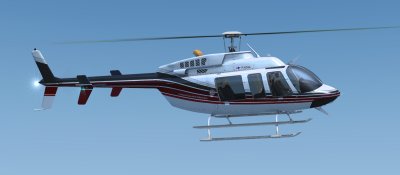
PJ-DXA - Tradewind Executive Helicopters
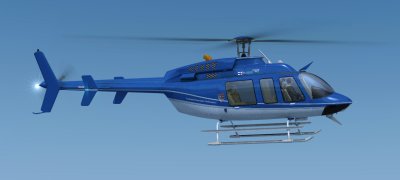
PJ-DXD - Tradewind Executive Helicopters
FSX
There is a known issue with repaints that causes instruments to mis- function. This can be resolved in the configuration manager by switching the settings away from the current for the helo, then saving, then resetting.
|
Bell
407 ~ MilViz
for FSX
Bell's already popular 407 is the long awaited successor to its JetRanger and LongRanger light singles.
Development work on Bell's New Light Aircraft replacement for the LongRanger and JetRanger dates back to 1993. The end result was the 407, an evolutionary development of the LongRanger.
A modified 206L3 LongRanger served as the concept demonstrator 407 and first flew in this form on April 21 1994, while the 407 was first publicly announced at the Las Vegas HeliExpo in January 1995.
The 407 concept demonstrator mated the LongRanger's fuselage with the tail boom and dynamic system of the military OH58D Kiowa (which has a four blade main rotor). Fake fairings were used to simulate the wider fuselage being developed for the production standard 407. The first preproduction 407 flew in June 1995, the first production 407 flew in November 1995. Customer deliveries commenced the following February.
Compared with the LongRanger, the 407 features the four blade main rotor developed for the OH58, which uses composite construction, and the blades and hub have no life limits. Benefits of the four blade main rotor include improved performance and better ride comfort.
Another big change over the LongRanger is the 18cm (8in) wider cabin, increasing internal cabin width and space, plus 35% larger main cabin windows. Power is from a more powerful Allison 250C47 turboshaft fitted with FADEC, allowing an increase in max takeoff weight and improving performance at hotter temperatures and/or higher altitudes. The tail boom is made from carbonfibre composites, while Bell has studied fitting the 407 with a shrouded tail rotor.
Bell looked at the 407T twin 407 for a time, but opted instead to develop the substantially revised twin PW206D powered 427. |
|
Other Essential Files:
The payware MilViz package
|
Original Repaints by Jerrod Corey TEH decals added by JF
|
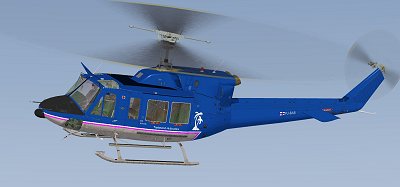
PJ-BAB - Tradewind Helicopters
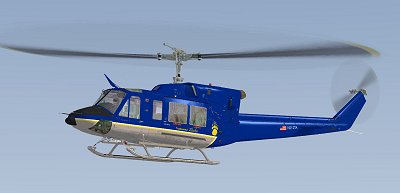
N212TA - Tradewind Alaska
|
Bell
212 ~ Cera Simaircraft
for FSX
The Model 212 is a twin engined development of Bell's earlier and highly successful Model 204 and 205 series.
Bell announced its decision to develop the Model 212 in early May 1968 in large part in response to a Canadian Armed Forces requirement for a twin engined development of the CUH1H (Model 205) then entering military service in that country, and following successful negotiations with Pratt & Whitney Canada and the Canadian government. Development of the Model 212 was a joint venture between Bell, Pratt & Whitney Canada and the Canadian government, the latter providing financial support. The resulting helicopter (designated CUH1N in Canadian and UH1N in US military service) first flew in 1969 and was granted commercial certification in October 1970. The first Canadian CUH1Ns were handed over in May 1971.
The most significant feature of the Twin TwoTwelve is the PT6T Twin-Pac engine installation. This consists of two PT6 turboshafts mounted side by side and driving a single output shaft via a combining gearbox. The most obvious benefit of the new arrangement is better performance due to the unit's increased power output. However, the Twin-Pac engine system has a major advantage in that should one engine fail, sensors in the gearbox instruct the remaining operating engine to develop full power, thus providing a true engine out capability, even at max takeoff weight.
Aside from the twin engines, the 212 features only minor detail changes over the earlier Model 205 and UH1H, including a slightly reprofiled nose. The 212 is also offered with a choice of IFR or VFR avionics suites. Production was transferred to Bell's Canadian factory in August 1988. |
|
Other Essential Files:
The payware Cera Simaircraft package
|
Repaint by JF
|
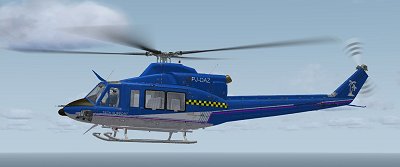
PJ-DAZ - Tradewind Helicopters
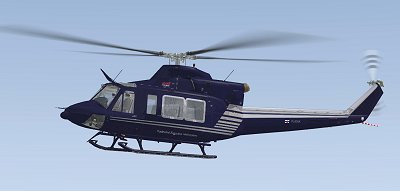
PJ-DAX - Tradewind Executive Helicopters
|
Bell
412EP ~ Cera Simaircraft
for FSX
The 412 family is a development of the 212, the major change being an advanced smaller diameter four blade main rotor in place of the 212's two blade unit.
Development of the 412 began in the late 1970s and two 212s were converted to the new standard to act as development aircraft for the program. The first of these flew in August 1979, and the 412 was awarded VFR certification in January 1981. That same month the first delivery occurred. Subsequent development led to the 412SP, or Special Performance, with increased fuel capacity, higher takeoff weight and more optional seating arrangements. The 412HP, or High Performance, superseded the 412SP in production in 1991. Features include improved transmission for better hovering performance.
The current standard production model is the 412EP, or Enhanced Performance. The 412EP features a PT6T3D engine and a dual digital automatic flight control system fitted as standard, with optional EFIS displays. Fixed tricycle landing gear is optional.
Meanwhile in Indonesia, IPTN has a licence to build the 412SP, which it calls the NBell412. IPTN has a licence to build up to 100 NBell412s.
Like the 212, the 412 is in widespread use for a number of utility roles, including EMS and oil rig support, its twin engine configuration being an asset, particularly in the latter role. It too is in military service, Canada once again being a major customer (including 100 recently delivered 412EP based CH-146 Griffons).
|
|
Other Essential Files:
The payware Cera Simaircraft package
|
Repaint by JF
|
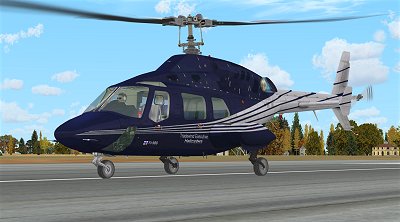
PJ-BBB - Tradewind Executive Helicopters
|
Bell
222B ~ Cera Simaircraft
for FSX
Bell announced development of the all new 222 twin in 1974, following the positive response generated by a mockup proposal displayed at that year's Helicopter Association of America convention.
Having taken note of potential customers' preferences and suggestions, Bell modified its design accordingly, and the subsequent development effort led to the Model 222's first flight in August 1976. A number of advanced features were designed into the 222, including the Noda Matic vibration reduction system developed for the 214ST, stub wings housing the retractable undercarriage, provision for IFR avionics, and dual hydraulic and electrical systems.
The 222 was awarded FAA certification in December 1979. Production deliveries commenced in early 1980. Subsequent development led to the more powerful 222B with a larger diameter main rotor, introduced in 1982, and the essentially similar 222UT Utility Twin, which features skid landing gear in place of wheels.
The Bell 230 is a development of the 222 with two Allison 250 turboshafts instead of the 222's LTS 101s plus other refinements. First flight of a 230, a converted 222, took place on August 12 1991, and Transport Canada certification was awarded in March 1992. The first delivery of a production 230 occurred that November and customers had a choice of skid or wheel undercarriage. Production ceased in 1995. The 230 has been replaced by the stretched, more powerful 430, described separately. |
|
Other Essential Files:
The payware Cera Simaircraft package
|
Repaint by JF
|
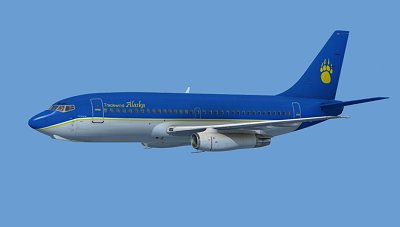
N7321T 'Nakkersartok' Tradewind Alaska Combi
|
Boeing
737- 200 ~MilViz
The 737-100 and 200 are the first generation production models of the world's most successful jet airliner family, Boeing's 737 twinjet.
The 737 was conceived as a short range small capacity airliner to round out the Boeing jet airliner family beneath the 727, 720 and 707. Announced in February 1965, the 737 was originally envisioned as a 60 to 85 seater, although following consultation with launch customer Lufthansa, a 100 seat design was settled upon. Design features included two underwing mounted turbofans and 60% structural and systems commonality with the 727, including the same fuselage cross section (making it wider than the competing five abreast DC-9 and BAC-111).
The 737-100 made its first flight on April 9 1967 and entered service in February 1968 with Lufthansa, while the last of 30 built was delivered to Malaysia-Singapore Airlines in October 1969.
By this time however the larger capacity 1.93m (6ft 4in) stretched 737-200 was in service after it had made its first flight on August 8 1967. First delivery, to United, was that December.
Developments of the -200 include the -200C convertible and quick change -200QC, while an unprepared airfield kit was also offered. The definitive Advanced 737-200 appeared in 1971, featuring minor aerodynamic refinements and other improvements.
Sales of the 737-200 far exceeded that of the shorter -100 and the 737-200 remained in production until 1988, by which time it had been superseded by the improved 737-300, after 1114 had been built. Many have been fitted with Stage 3 engine hushkits, and a number of passenger aircraft have been converted with cargo doors.
The USAF ordered 19 as navigation trainers, and some were later converted to standard transport aircraft as CT-43A. A few other air forces received 737-200s to serve in general transport, surveillance or VIP transport tasks.
|
|
Other Required Files:
The payware milViz package
|
Repaint by JF
|
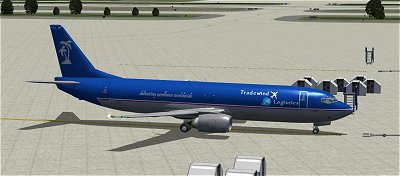
PJ-WBF Tradewind Logistics 737-400F
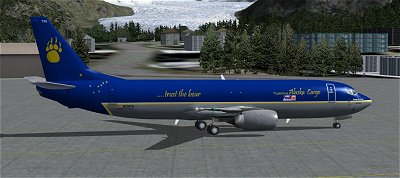
N734TA 'Benny Benson' Tradewind Alaska Cargo 734SF
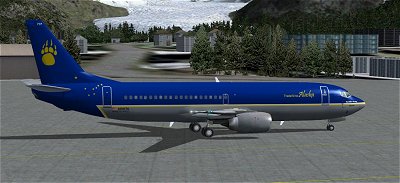
N737TA 'Big Mike Heney' Tradewind Alaska Cargo 734QC
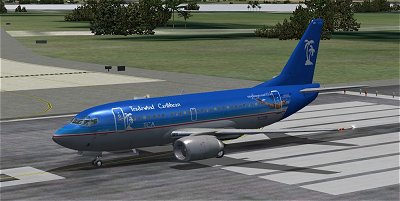
PJ-WBE 'Peter Island' Tradewind Caribbean 737-500
B734s B735
All for FS9, will work in FSX but the VC
and lighting aren't good at night
|
Boeing
737-400/500 ~ Feelthere/Wilco
NOT the Evolution version
Boeing announced it was developing a new higher capacity version of the fast selling 737-300 in June 1986.
The new aeroplane, the 737-400, was developed as a 150 seat class 727 replacement. Although Boeing had initially developed the 180 to 200 seat 757 to replace the successful 727, there still existed a considerable market for a near direct size replacement for the popular trijet. By developing the 737-400 as a minimum change stretch of the 737-300, Boeing was also able to offer considerable commonality, and thus cost, benefits to operators already with the 737-300, and to a lesser extent, the 737-200 in their fleets.
The major change of the 737-400 over the smaller 300 is a 3.05m (10ft 0in) fuselage stretch, consisting of a 1.83m (6ft 0in) stretch forward and a 1.22m (4ft 0in) plug rear of the wing. The stretch increases maximum passenger seating to 188. To cope with the increased weights, more powerful CFM56s are fitted. Other changes are minor, such as a tail bumper fitted to protect against over rotation at takeoff, something that could have become a problem due to the increased fuselage length.
A higher gross weight longer range version is offered. It features increased fuel capacity, and strengthened undercarriage and structures, but is otherwise identical to the standard 737-400.
The first flight of the 737-400 occurred on February 19 1988 and it entered airline service in October that year with Piedmont. Of the 737-300/-400/-500 family the 400 has proven the most successful member behind the 300, its larger capacity and transcontinental US range meaning it has found a very useful market for Boeing as a 727 replacement. However the 737-400 does face stiff competition from the similar size Airbus A320, which has higher levels of technology, longer range and is faster (but is also heavier).
The 737-500 is the shortest and smallest member of the second generation 737-300/-400/-500 family, and the last to be developed.
When the new stretched 737-300 first appeared it was intended to supplement, rather than replace, the 737-200. However the evolution of the 737-300 into a family of models led to the development of a new model comparable in size to the 737-200, but offering better fuel economy and extensive commonality with the 737-300 and -400 models. This was the 737-500, known before its May 1987 formal launch as the 737-1000.
Like the preceding 737-300 and 737-400, the 737-500 is powered by CFM International CFM56s turbofans, in this case either 82.3kN (18,500lb) CFM563B1s or 89.0kN (20,000lb) CFM56-3C-1s. All three second generation 737 models share extensive systems and structure commonality, and a common aircrew type rating. These benefits offer real cost savings to an airline with two or more variants of the family in its fleet.
The 737-500 is 31.01m (101ft 9in) in length, comparable to the 737-200's 30.53m (100ft 2in) length, and as such is a viable direct replacement for the earlier type. Like the 300 and 400, a higher gross weight longer range version is offered, featuring auxiliary fuel tanks and uprated engines.
The 737-500's first flight occurred on June 30 1989, FAA certification was awarded on February 12 1990, with service entry later that same month.
The 737-500's main appeal is for operators of large 737-400 and 737-300 fleets, as because the 500 is a shortened development of the 300, it still carries much of the structural weight needed for the higher weight models. This makes it less efficient than if it was designed specifically for its size category, however for operators of large 737-300/400 fleets, the extensive commonality benefits more than compensate for this.
|
|
Other Required Files:
The payware Feelthere/Wilco package
|
Repaints by JF
Includes VC
and 2D Panel
|
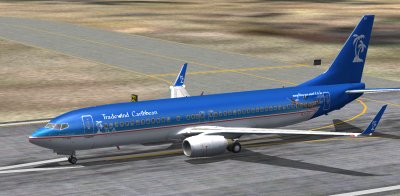
PJ-GCK 'Bocas del Dragon' Tradewind Caribbean 738
FS9 FSX
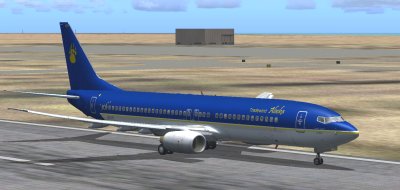
N73802 'Puffin Island' Tradewind Alaska 738
FS9 FSX
Update for both FS9 TCA and TA repaints
|
Boeing
737-800 ~ iFly
Boeing's
Next Generation 737-800 and 737-900 are the largest members
of the strong selling 737 family. Unlike the other Next
Generation 737s, the -800 and -900 introduce new fuselage
lengths, extending 737 single class seating range out
to 189, compared with 100 in the original 737-100.
Like the -600 and -700, the -800 and -900 feature the
Next Generation improvements including more efficient
CFM56-7B turbofans, the new wing with greater chord, span
and wing area, larger tail surfaces and the 777 style
EFIS flightdeck with six flat panel LCDs which can present
information as on the 777 or as on the 737-300/400/500
series, the latter allowing a common pilot type rating
for the two 737 families. A HUD is optional. BBJ style
winglets are offered as an optional feature for the -800
|
|
Other Required Files:
The payware iFly package
|
Repaint by JF
Includes VC
and 2D Panel
|
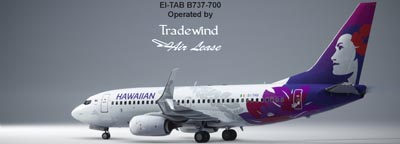
EI-TAB Tradewind Air Lease Hawaiian B737 SSW
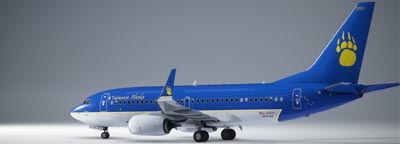
N73701 Tradewind Alaska B737 BW
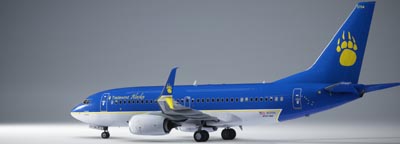
N73704 Tradewind Alaska B737 SSW
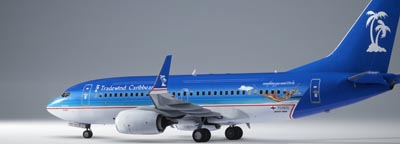
PJ-GCG Tradewind Caribbean B737 BW
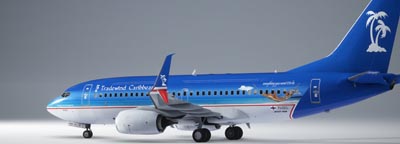
PJ-GCL Tradewind Caribbean B737 SSW
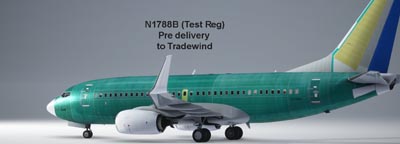
N7188B (Test Reg, Pre delivery to Tradewind) Factory B737 BW
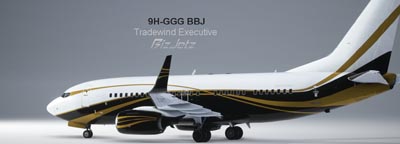
9H-GGG Tradewind Executive B737 BW BBJ
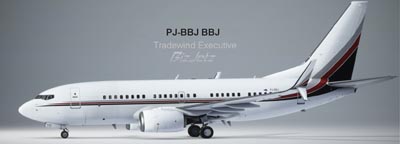
PJ-BBJ Tradewind Executive B737 SSW BBJ
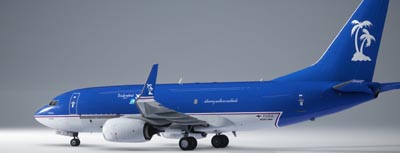
PJ-GCZ Tradewind Logistics B737 BDSF WL
Additional B737 ground vehicles 'Tradewind Aviation Services'
|
Boeing
737-700/BDSF/BBJ NG3 ~ PMDG
Boeing's
Next Generation 737-800 and 737-900 are the largest members
of the strong selling 737 family. Unlike the other Next
Generation 737s, the -800 and -900 introduce new fuselage
lengths, extending 737 single class seating range out
to 189, compared with 100 in the original 737-100.
Like the -600 and -700, the -800 and -900 feature the
Next Generation improvements including more efficient
CFM56-7B turbofans, the new wing with greater chord, span
and wing area, larger tail surfaces and the 777 style
EFIS flightdeck with six flat panel LCDs which can present
information as on the 777 or as on the 737-300/400/500
series, the latter allowing a common pilot type rating
for the two 737 families. A HUD is optional. BBJ style
winglets are offered as an optional feature for the -800
|
MSFS ONLY
|
Other Required Files:
The payware B737-700 by PMDG
|
Repaint by JF
|
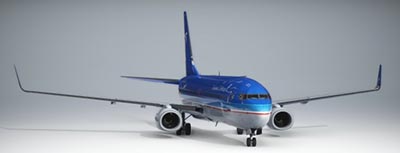
PJ-GCH Tradewind Caribbean 'Isla de la Juventud' B738 Blended Winglets
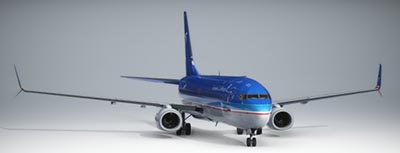
PJ-GCM Tradewind Caribbean 'Gonave Island' B738 Split Scimitar Winglets
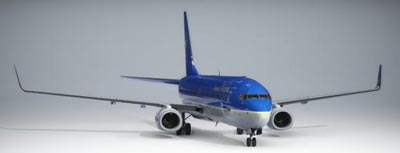
N73801 Tradewind Alaska 'Juneau' B738 Blended Winglets
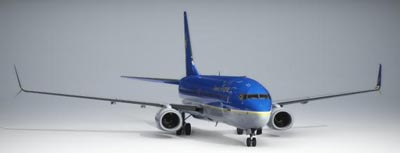
N73804 Tradewind Alaska 'Yakutat' B738 Split Scimitar Winglets
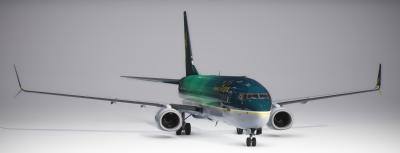
N73805 Tradewind Alaska 'Aurora Borealis' B738 Split Scimitar Winglets (Aurora Borealis Special Livery)
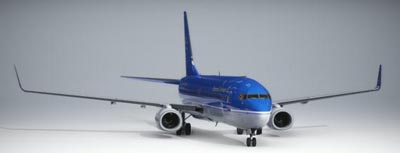
PH-TEB Tradewind European 'Madrid' B738 Blended Winglets
Front fuselage replacement file due to wrong registration
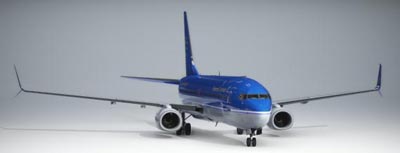
PH-TEC Tradewind European 'Athens' B738 Split Scimitar Winglets
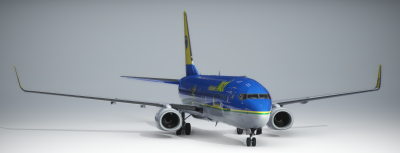
PP-GCP Tradewind Brazil 'Porto Alegre' B738 Blended Winglets
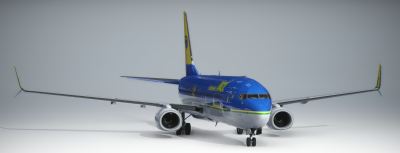
PP-GCQ Tradewind Brazil 'Salvador' B738 Split Scimitar Winglets
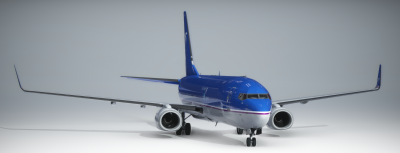
PJ-GDA Tradewind Cargo 'Dominica' B738BCF Blended Winglets
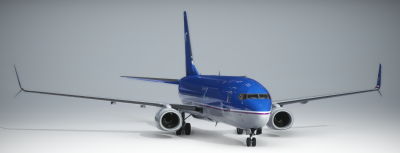
PJ-GDB Tradewind Cargo 'Martinique' B738BCF Split Scimitar Winglets
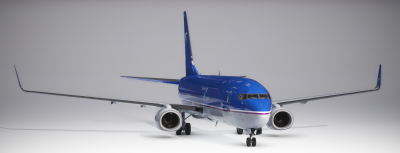
PJ-GDC Tradewind Cargo 'Montserrat' B738BDSF Blended Winglets
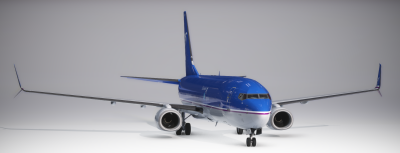
PJ-GDD Tradewind Cargo 'Antigua' B738BDSF Split Scimitar Winglets
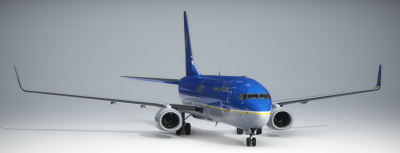
N73831 Tradewind Alaska Cargo 'Rainy Pass' B738BCF Blended Winglets
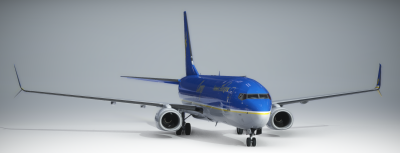
N73832 Tradewind Alaska Cargo 'Iditarod' B738BCF Split Scimitar Winglets
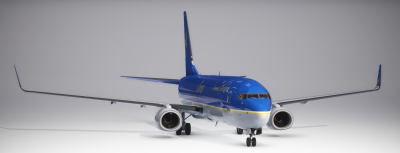
N73833 Tradewind Alaska Cargo 'Unalakleet' B738BDSF Blended Winglets
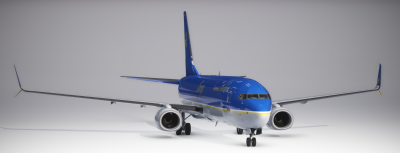
N73834 Tradewind Alaska Cargo 'Cripple' B738BDSF Split Scimitar Winglets
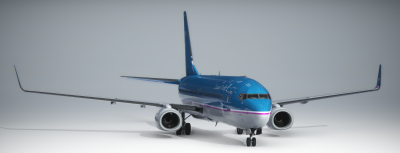
F-OHBA Tradewind Pacific 'Manuae' B738 Blended Winglets
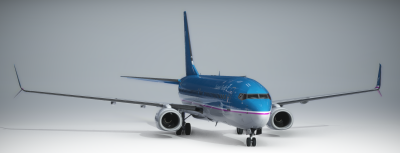
F-OHBB Tradewind Pacific 'Maupihaa' B738 Split Scimitar Winglets
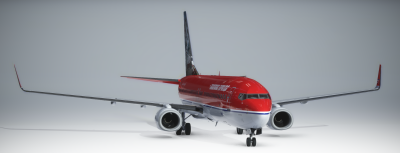
CU-T7384 Tradewind Express 'Merida Express' B738 Blended Winglets
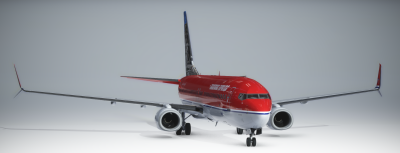
CU-T7385 Tradewind Express 'Houston Express' B738 Split Scimitar Winglets
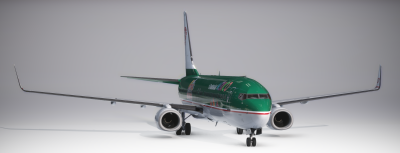
XA-GCH Tradewind Mexico 'Teotihuacán' B738 Blended Winglets
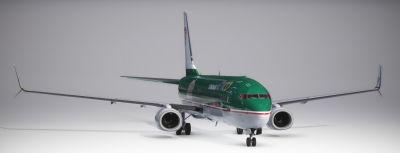
XA-GCI Tradewind Mexico 'Quetzalcóatl' B738 Split Scimitar Winglets
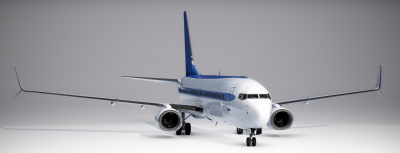
8P-BBB Tradewind Executive B738 BBJ2 Split Scimitar Winglets
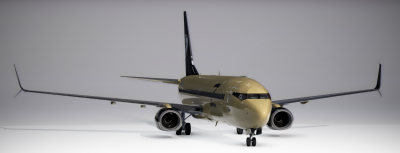
P4-TEB Tradewind Executive B738 BBJ2 Split Scimitar Winglets (Zorro Scheme)
More to follow...?
|
Boeing
737-800/BDSF/BBJ NG3 ~ PMDG
Boeing's
Next Generation 737-800 and 737-900 are the largest members
of the strong selling 737 family. Unlike the other Next
Generation 737s, the -800 and -900 introduce new fuselage
lengths, extending 737 single class seating range out
to 189, compared with 100 in the original 737-100.
Like the -600 and -700, the -800 and -900 feature the
Next Generation improvements including more efficient
CFM56-7B turbofans, the new wing with greater chord, span
and wing area, larger tail surfaces and the 777 style
EFIS flightdeck with six flat panel LCDs which can present
information as on the 777 or as on the 737-300/400/500
series, the latter allowing a common pilot type rating
for the two 737 families. A HUD is optional. BBJ style
winglets are offered as an optional feature for the -800
|
MSFS ONLY |
Other Required Files:
The payware B737-800 by PMDG
|
Repaint by Christian Breuer
Tailpictures of Tradewind Express Aircraft courtesy by Stefaan Cappelle
|
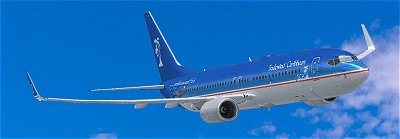
PJ-GCH 'Isla de la Juventud' Tradewind Caribbean 738WL
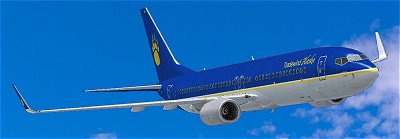
N789TA 'Beavertail Island' Tradewind Alaska 738WL
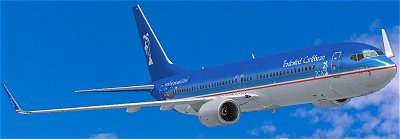
PJ-GCP 'Îlet de Vieux Fort' Tradewind Caribbean 739WL
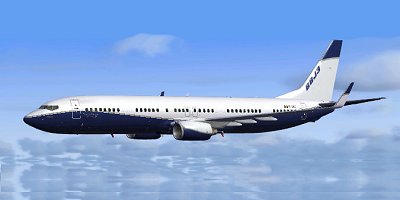
8P-BBJ 'Santhana' Tradewind BizJetz BBJ3
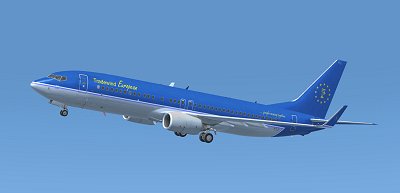
PH-TEB 'Madrid' Tradewind European 738WL
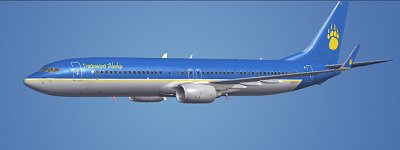
N901TA 'Avatanak Island' Tradewind Alaska 739WL
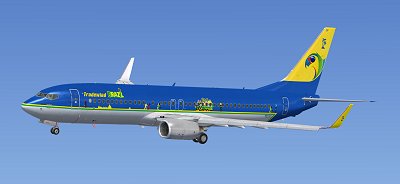
PP-GCP 'Porto Alegre' Tradewind Brazil 738WL
|
Boeing
737-800/900/BBJ ~ PMDG
Boeing's
Next Generation 737-800 and 737-900 are the largest members
of the strong selling 737 family. Unlike the other Next
Generation 737s, the -800 and -900 introduce new fuselage
lengths, extending 737 single class seating range out
to 189, compared with 100 in the original 737-100.
Like the -600 and -700, the -800 and -900 feature the
Next Generation improvements including more efficient
CFM56-7B turbofans, the new wing with greater chord, span
and wing area, larger tail surfaces and the 777 style
EFIS flightdeck with six flat panel LCDs which can present
information as on the 777 or as on the 737-300/400/500
series, the latter allowing a common pilot type rating
for the two 737 families. A HUD is optional. BBJ style
winglets are offered as an optional feature for the -800
|
FSX ONLY
|
Other Required Files:
The payware PMDG 737NGX package
No longer available!
|
Repaint by JF
Includes VC
and 2D Panel
|
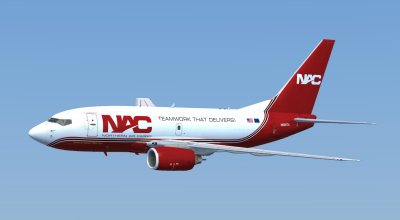
N600TA NAC Operated by TAC 736F
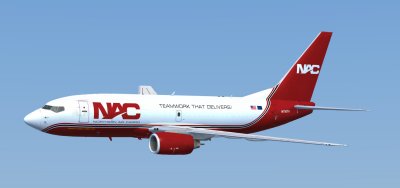
N700TA NAC Operated by TAC 737F
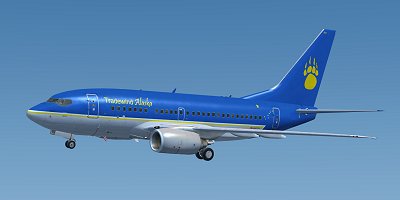
N601TA 'Soldotna' Tradewind Alaska 736
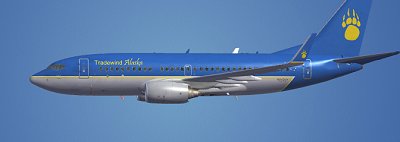
N701TA 'Eagle Lake' Tradewind Alaska 737
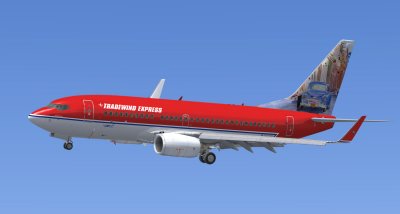
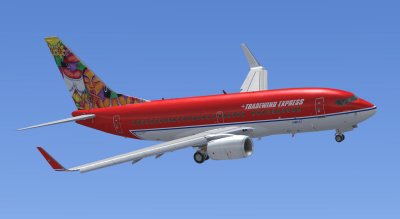
CU-T7371 'Havana Express' Tradewind Express 737
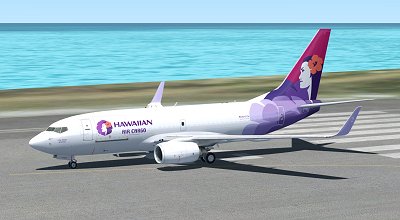
Hawaiian Air Cargo B737-700 BDSF N737TH 'Leta haawi'
Operated by Tradewind Logistics
|
Boeing
737-600 / 700 ~ PMDG
Boeing's
Next Generation 737-800 and 737-900 are the largest members
of the strong selling 737 family. Unlike the other Next
Generation 737s, the -800 and -900 introduce new fuselage
lengths, extending 737 single class seating range out
to 189, compared with 100 in the original 737-100.
Like the -600 and -700, the -800 and -900 feature the
Next Generation improvements including more efficient
CFM56-7B turbofans, the new wing with greater chord, span
and wing area, larger tail surfaces and the 777 style
EFIS flightdeck with six flat panel LCDs which can present
information as on the 777 or as on the 737-300/400/500
series, the latter allowing a common pilot type rating
for the two 737 families. A HUD is optional. BBJ style
winglets are offered as an optional feature for the -800
|
FSX - P3D ONLY
|
Other Required Files:
The payware PMDG 737NG 600/700 Expansion package
No longer available!
|
Repaint by JF
|
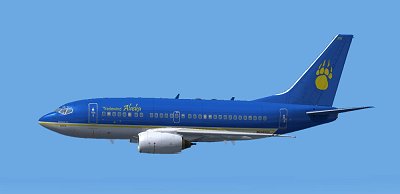
N376TA 'Skookum Jim' Tradewind Alaska 736
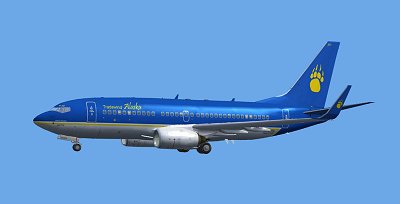
N377TA 'Martin Buser' Tradewind Alaska 737
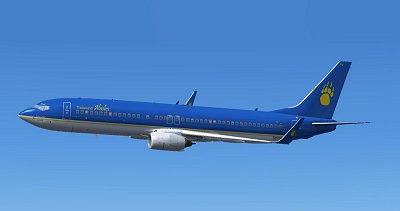
N378TA 'Bruce Linton' Tradewind Alaska 738
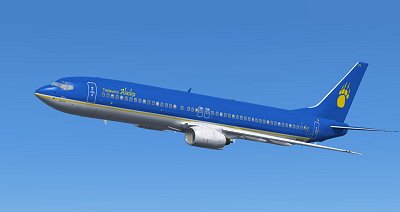
N379TA 'Balto' Tradewind Alaska 739
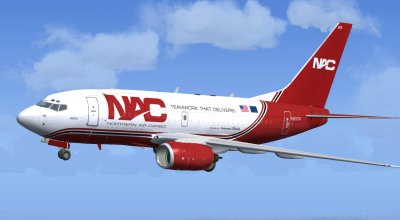
N609TA Op by Tradewind Alaska 737-600
Improved textures added August 2016
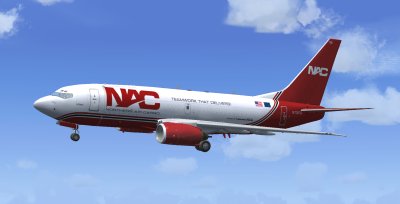
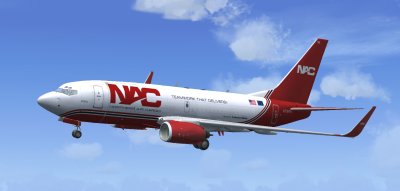
N709TA Op by Tradewind Alaska 737-700
N809TA Op by Tradewind Alaska 737-800
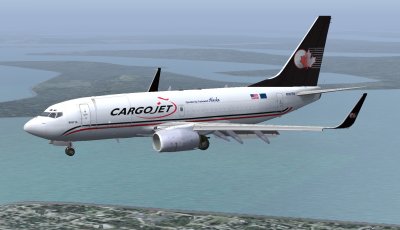
N707TA Op by Tradewind Alaska 737-700
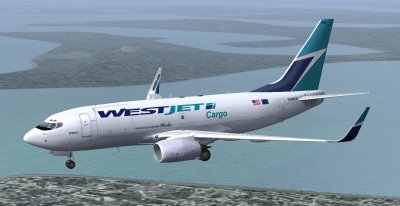
N708TA Op by Tradewind Alaska 737-700
|
Boeing
737-600/700WL/800WL/900/ ~ PMDG
Boeing's
Next Generation 737-800 and 737-900 are the largest members
of the strong selling 737 family. Unlike the other Next
Generation 737s, the -800 and -900 introduce new fuselage
lengths, extending 737 single class seating range out
to 189, compared with 100 in the original 737-100.
Like the -600 and -700, the -800 and -900 feature the
Next Generation improvements including more efficient
CFM56-7B turbofans, the new wing with greater chord, span
and wing area, larger tail surfaces and the 777 style
EFIS flightdeck with six flat panel LCDs which can present
information as on the 777 or as on the 737-300/400/500
series, the latter allowing a common pilot type rating
for the two 737 families. A HUD is optional. BBJ style
winglets are offered as an optional feature for the -800
|
FS9 ONLY
|
Other Required Files:
The payware PMDG 737_FS9 package
No longer available!
|
Repaint by JF
|
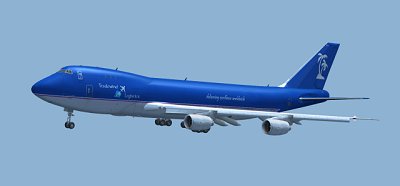
PJ-BXX 'Enduring Trader' TL
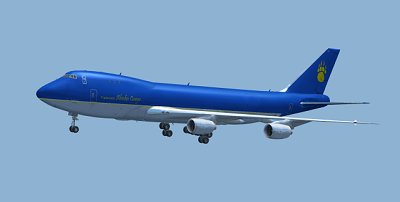
N742TA 'Emelian Basof' TA Cargo
FS9 & FSX
|
Boeing
747- 200F RR ~ CLS
The hugely significant 747 revolutionised airline transport. Far bigger than anything before it, the 747 slashed operating costs per seat and thus cut the cost of long haul international airline travel.
Boeing conceived the 747 in the mid 1960s following its failure to secure a US Air Force contract for an ultra large strategic transport (which resulted in the Lockheed C-5 Galaxy), when it identified a market for a high capacity 'jumbo jet'. Boeing was able to draw upon design experience with the USAF transport and launched the new airliner on July 25 1966. First flight occurred on February 9 1969, certification was awarded on December 30 that year.
The basic 747-100 entered service with Pan American in January 1970. Progressive development of the 747 led to the 747-200B with higher weights, more powerful engines and longer range. The -200B first flew in October 1970 entering service with KLM, while nine higher weight 747-100Bs were built.
Developments include the 747-200F freighter, the SR (short range) optimised for high cycle short sector operations and the C (Combi).
The 747 holds a place in the public eye unlike any other aircraft. The so called `Queen of the Skies' opened up international travel to millions. It is also notable for being the first widebody airliner, the largest and heaviest airliner, and the first to use fuel efficient, high bypass turbofans.
|
|
Other Essential Files:
The payware CLS B747-200/300 incl F versions package
|
Repaint by JF
|
|
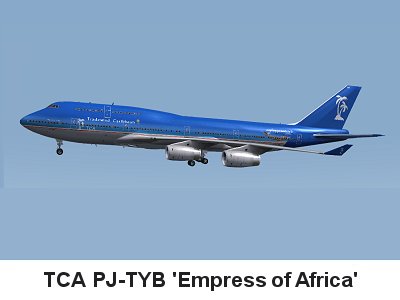
Optional
VC textures -
Replacing
the manual covers and drink cans here
|
|
Boeing
747- 400 RR ~ PMDG
TCA PJ-TYB 'Empress of Africa'
|
The
747-400 is the latest, longest ranging and best selling
model of the 747 family.
Boeing launched
the 747-400 in October 1985 and the first development aircraft
first flew on April 29 1988. US certification (with PW-4000s)
was awarded in January 1989.
The 747-400 externally
resembles the -300, but it is a significantly improved aircraft.
Changes include a new, two crew digital flightdeck with
six large CRT displays, an increased span wing with winglets
(the -400 was the first airliner to introduce winglets),
new engines, recontoured wing/fuselage fairing, a new interior,
lower basic but increased max takeoff weights, and greater
range.
Apart from the
basic passenger 747-400 model, a number of variants have
been offered including the winglet-less 747-400 Domestic
optimised for Japanese short haul domestic sectors, the
747-400M Combi passenger/freight model, and the 747-400F
Freighter (which combines the 747-200F's fuselage with the
-400's wing).
The latest model
is the 747-400ER, which was launched on November 28, 2000
when Qantas placed an order for 6. The -400ER has the same
size as the -400, but has more range or payload capability.
The MTOW was increased by 15,870kg (35,000lb) to 412,770kg
(910,000lb), giving a further range of 805km (435nm) or
a 6800kg (15,000lb) greater payload. The -400ER also features
a wholly new cabin interior with larger luggage bins, and
several flight deck improvements.
The -400ER incorporates
the strengthened wing, body, and landing gear of the -400F,
plus an auxiliary fuel tank in the forward cargo hold, and
an optional second one. Operators who don't need these can
remove them both, gaining additional cargo volume.
The first 747-400ER
was rolled out in June 2002, and flew for the first time
on July 31, 2002, and this was the 1308th 747 to fly.
A cargo version,
the 747-400ERF, followed the standard -400ER, and was launched
April 30, 2001 on an order by leasing company ILFC for 5.
The first -400ERF is the 1315th 747 built. The -ERF has
the same MTOW as the -ER, and this will give an extra range
of 970km (525nm), or an extra payload of 9980kg (22,000lb)
at MTOW compared with the standard -400F.
Shortly before
delivery of the first -400ER, Boeing had received orders
for 15 ER/ERFs from 5 customers.
|
|
|
Other Essential Files:
The payware PMDG
B747- 400 package
No longer available!
|
Repaint by JF
|
|
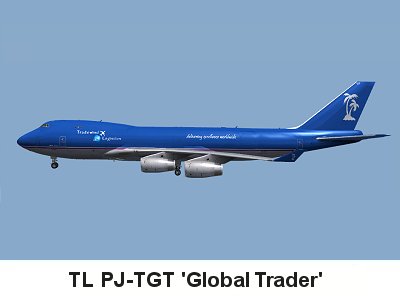
Optional
VC textures -
Replacing
the manual covers and drink cans here
|
|
Boeing
747- 400F RR ~ PMDG
TL PJ-TGT 'Global Trader'
|
The
747-400 is the latest, longest ranging and best selling
model of the 747 family.
Boeing launched
the 747-400 in October 1985 and the first development aircraft
first flew on April 29 1988. US certification (with PW-4000s)
was awarded in January 1989.
The 747-400 externally
resembles the -300, but it is a significantly improved aircraft.
Changes include a new, two crew digital flightdeck with
six large CRT displays, an increased span wing with winglets
(the -400 was the first airliner to introduce winglets),
new engines, recontoured wing/fuselage fairing, a new interior,
lower basic but increased max takeoff weights, and greater
range.
Apart from the
basic passenger 747-400 model, a number of variants have
been offered including the winglet-less 747-400 Domestic
optimised for Japanese short haul domestic sectors, the
747-400M Combi passenger/freight model, and the 747-400F
Freighter (which combines the 747-200F's fuselage with the
-400's wing).
The latest model
is the 747-400ER, which was launched on November 28, 2000
when Qantas placed an order for 6. The -400ER has the same
size as the -400, but has more range or payload capability.
The MTOW was increased by 15,870kg (35,000lb) to 412,770kg
(910,000lb), giving a further range of 805km (435nm) or
a 6800kg (15,000lb) greater payload. The -400ER also features
a wholly new cabin interior with larger luggage bins, and
several flight deck improvements.
The -400ER incorporates
the strengthened wing, body, and landing gear of the -400F,
plus an auxiliary fuel tank in the forward cargo hold, and
an optional second one. Operators who don't need these can
remove them both, gaining additional cargo volume.
The first 747-400ER
was rolled out in June 2002, and flew for the first time
on July 31, 2002, and this was the 1308th 747 to fly.
A cargo version,
the 747-400ERF, followed the standard -400ER, and was launched
April 30, 2001 on an order by leasing company ILFC for 5.
The first -400ERF is the 1315th 747 built. The -ERF has
the same MTOW as the -ER, and this will give an extra range
of 970km (525nm), or an extra payload of 9980kg (22,000lb)
at MTOW compared with the standard -400F.
Shortly before
delivery of the first -400ER, Boeing had received orders
for 15 ER/ERFs from 5 customers.
|
|
|
Other Essential Files:
The payware PMDG
B747- 400 package
No longer available!
|
Repaint by JF
|
Tradewind Caribbean B747-400ER GE PJ-TQB 'Queen Beatrix'
Tradewind Alaska B747-400ER GE N744TA 'Alaska Queen'
Tradewind Logistics B747-400ERF GE PJ-TQM 'Queen Máxima'
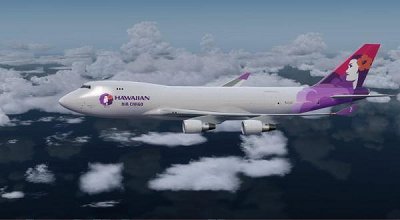
Hawaiian Air Cargo B747-400ERF PW PJ-HAC 'Makuahine o nui'
Operated by Tradewind Logistics
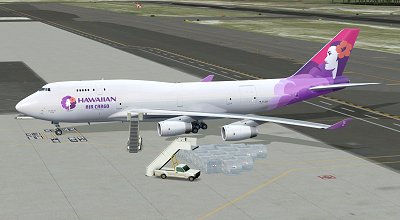
Hawaiian Air Cargo B747-400BCF PW PJ-HAB 'aeto holo ana'
Operated by Tradewind Logistics
|
Boeing
747- 400 QOTS III v3 ~ PMDG
The
747-400 is the latest, longest ranging and best selling
model of the 747 family.
Boeing launched
the 747-400 in October 1985 and the first development aircraft
first flew on April 29 1988. US certification (with PW-4000s)
was awarded in January 1989.
The 747-400 externally
resembles the -300, but it is a significantly improved aircraft.
Changes include a new, two crew digital flightdeck with
six large CRT displays, an increased span wing with winglets
(the -400 was the first airliner to introduce winglets),
new engines, recontoured wing/fuselage fairing, a new interior,
lower basic but increased max takeoff weights, and greater
range.
Apart from the
basic passenger 747-400 model, a number of variants have
been offered including the winglet-less 747-400 Domestic
optimised for Japanese short haul domestic sectors, the
747-400M Combi passenger/freight model, and the 747-400F
Freighter (which combines the 747-200F's fuselage with the
-400's wing).
The latest model
is the 747-400ER, which was launched on November 28, 2000
when Qantas placed an order for 6. The -400ER has the same
size as the -400, but has more range or payload capability.
The MTOW was increased by 15,870kg (35,000lb) to 412,770kg
(910,000lb), giving a further range of 805km (435nm) or
a 6800kg (15,000lb) greater payload. The -400ER also features
a wholly new cabin interior with larger luggage bins, and
several flight deck improvements.
The -400ER incorporates
the strengthened wing, body, and landing gear of the -400F,
plus an auxiliary fuel tank in the forward cargo hold, and
an optional second one. Operators who don't need these can
remove them both, gaining additional cargo volume.
The first 747-400ER
was rolled out in June 2002, and flew for the first time
on July 31, 2002, and this was the 1308th 747 to fly.
A cargo version,
the 747-400ERF, followed the standard -400ER, and was launched
April 30, 2001 on an order by leasing company ILFC for 5.
The first -400ERF is the 1315th 747 built. The -ERF has
the same MTOW as the -ER, and this will give an extra range
of 970km (525nm), or an extra payload of 9980kg (22,000lb)
at MTOW compared with the standard -400F.
Shortly before
delivery of the first -400ER, Boeing had received orders
for 15 ER/ERFs from 5 customers.
|
|
Other Essential Files:
The payware PMDG
B747- 400 package
|
Repaint by JF
|
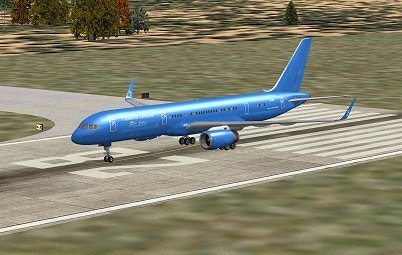
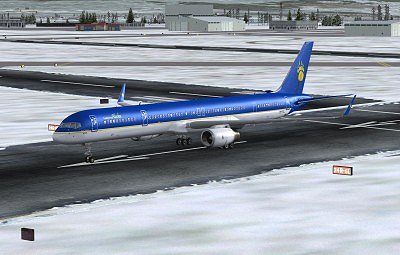
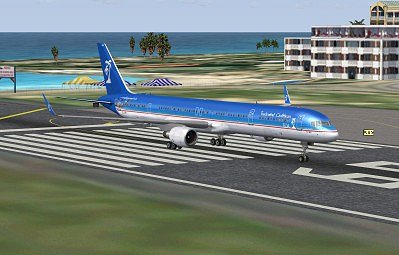
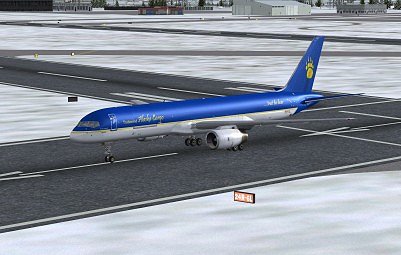
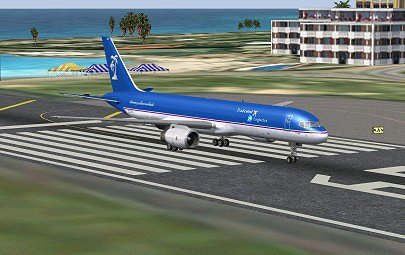
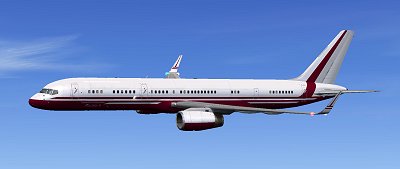
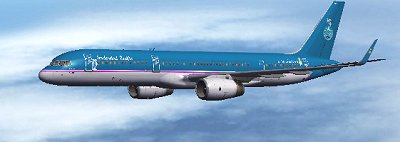
FS9
& FSX Winglet & Standard/ RR & PW versions
TCA B752 PJ-TMM 'Oualiche' - FS9 - FSX
TCA B753 PJ-TMW 'Wai' tukubuli'- FS9 - FSX
TA B752 N752TA 'Carl Ben Eielson' - FS9 - FSX
TA B753 N753TA 'Anna Tobeluk' - FS9 - FSX
TL B752SF PJ-TMF - FS9 - FSX
TAC B752SF N757TA 'Molly Hootch' - FS9 - FSX
TBJ B752 C6-BBJ - FS9 - FSX
Replacement wings for C6-BBJ HERE
TBJ B752 VQ-BBJ - FS9 - FSX
TP B752 F-OHEB 'Moorea' - FS9 - FSX
Thumbnails
|
Boeing
757-200 RR/PW ~ QualityWings
Boeing
launched development of the 757 in March 1979 following
orders from British Airways and Eastern. Developed in
tandem with the larger widebody 767 the two types share
a number of systems and technologies, including a common
early generation EFIS flightdeck.
First flight was on February 19 1982 and the 757 entered
service in January the following year. Subsequent versions
to appear are the 757-200PF Package Freighter, a pure
freighter, and the 757-200M Combi (only one has been built).
The standard passenger aircraft is designated the 757-200,
there being no 100. The stretched 757-300 is described
separately.
Initial sales of the 757 were fairly slow, however orders
picked up significantly in the mid to late 1980s as traffic
on routes previously served by smaller 727s and 737s grew
to require the 757's extra capacity. Today 757 sales comfortably
exceed those of the 767
|
|
Essential Files: QualityWings
|
Repaint by JF
Includes VC
and 2D Panel
|
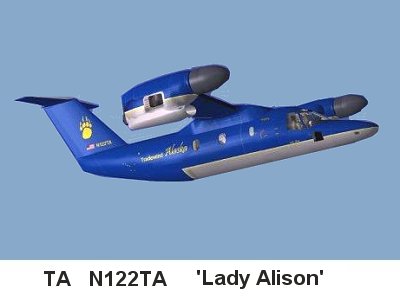
FSX
|
Boeing/Bell- Augusta BA609 ~ Wilco
TA N122TA 'Lady Alison'
The Bell BA 609 is set to become the first civil application of the revolutionary tiltrotor technology, taking advantage of its experience with the military V22 Osprey.
Bell pioneered the tiltrotor concept with the experimental XV3 which first flew as early as 1957 and then with NASA developed the XV15 experimental demonstrator which first flew in 1977. In conjunction with Boeing it is building the military V-22 Osprey - the first production Ospreys are due to be delivered to the US Marines in 1999.
In late 1996 Bell and Boeing announced that they intended to use their expertise and experience with the V22 to develop a nine seat civil tiltrotor. The Bell Boeing 609 was formally unveiled on November 18 1996. However in early 1998 Boeing announced its withdrawal from the program as a risk sharing partner to remain as a major subcontractor. Then in September that year Bell announced that Agusta would become a risk sharing development partner in the redesignated BA 609. Agusta will participate in BA 609 development, manufacture components and assemble BA 609s for European and other markets.
First flight for the BA 609 is planned for mid 1999 with certification and first deliveries scheduled for April 2002. (The US FAA is drawing up a new certification category for tiltrotors and a new pilot type rating.)
The benefits of a tiltrotor are that it has the vertical takeoff, landing and hovering abilities of a helicopter combined with fixed wing turboprop speed and performance. As such Bell anticipates that the 609 will compete against helicopters such as the Sikorsky S76 and turboprops such as Beech's King Air. As well as point to point corporate transport Bell envisages that the 609 will be used for offshore oil rig support, search and rescue and medevac missions, where its unique capabilities would be particularly useful.
The 609 will incorporate advanced technologies such as a glass cockpit, flybywire flight controls and a composite construction fuselage. Power will be from two PT6C67A turboprops.
The 609 could form the basis for a family of civil tiltrotors.
|
|
Other Essential Files:
The payware Wilco Tiltrotor package
|
Repaint by Francisco Aguiar
|
|
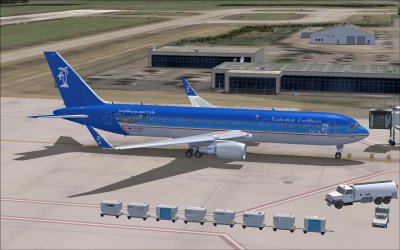
TCA PJ-LDP 'Antillean Promise' FS9 FSX
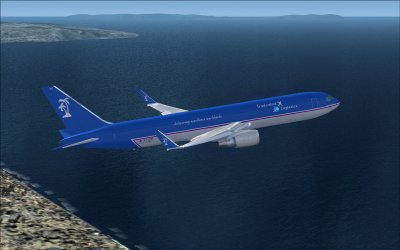
TL PJ-LDF 'Atlantic Trader' FS9 FSX
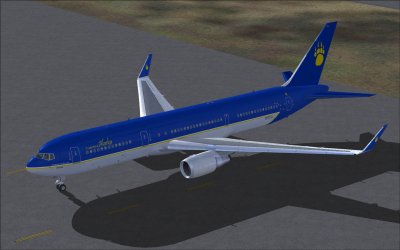
TA N763TA 'Elizabeth Peratrovich' FS9 FSX
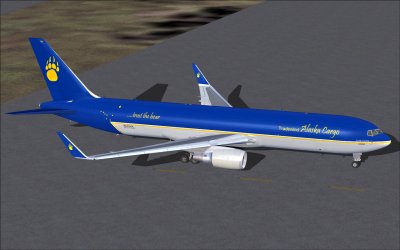
TAC N766TA 'Ernest Gruening' FS9 FSX
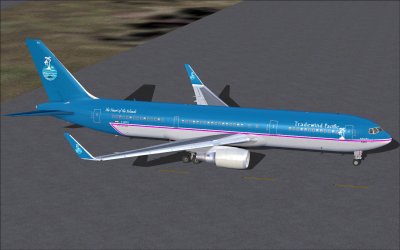
TP F-OHFC 'Pukapuka' FS9 FSX
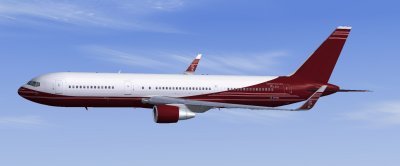
TBJ 8P-BIZ B767-300 BBJ FS9 FSX
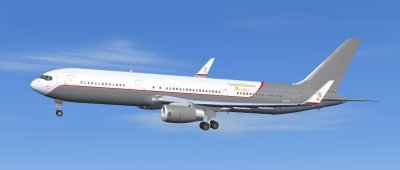
TBJ M-BZNS B767-300 BBJ FS9 FSX
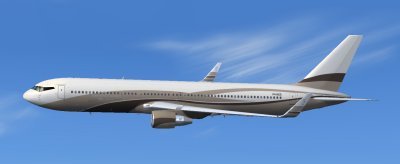
TBJ P4-MES B767-300 BBJ FS9 FSX
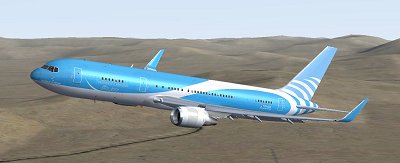
TBJ PJ-CLH 'Cuidad de La Habana’ B767-300 BBJ
FS9 FSX
|
Boeing
767-300 ER/ERF/BBJ ~ Level-D
Winglet and non Winglet versions - FS9 and FSX
|
Boeing
announced that it was developing a stretched development
of the 767-200 in February 1982.
The resulting 767-300 features a 6.42m (21ft 1in) stretch
consisting of fuselage plugs forward (3.07m/10ft 1in) and
behind (3.35m/11ft) the wing centre section. The flightdeck
and systems were carried directly over from the 767-200,
the only other changes were minor, and related to the increased
weights of the new version. Initially the max takeoff weight
was the same as the later 767-200ER.
The 767-300 flew for the first time on January 30 1986,
and was awarded certification and entered service in September
that year. The higher weight Extended Range ER version flew
on December 19 1986, while RollsRoyce RB-211-524G engines
became available from 1989. The range of the 767-300ER has
proven to be very popular with a number of airlines using
them for long range low density flights.
In 1993 Boeing launched the 767-300F General Market Freighter.
Changes include strengthened undercarriage and wing structure,
a cargo handling system, no cabin windows and a main deck
freight door. Capacity is 24 containers.
|
|
|
Other Essential Files:
The payware
LDS 767-300ER package
|
Repaints by JF
|
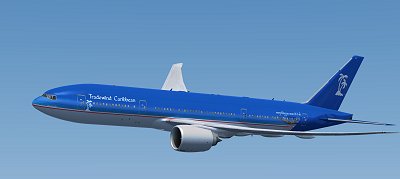
PJ-TGC 'Caribbean Essence'
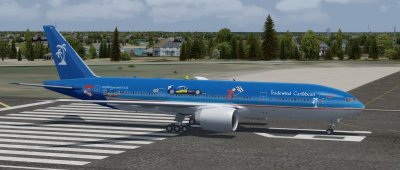
PJ-TGE 'Caribbean Endeavour' Formula 1Jet
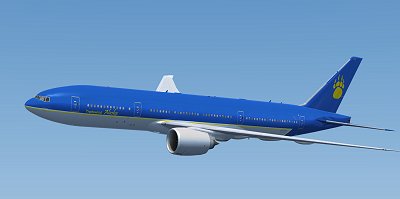
N777TA 'Virgil F Partch'
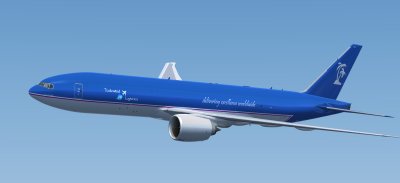
PJ-LRG 'Mundo Transportadó'
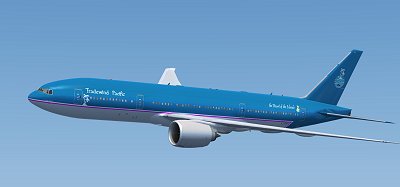
F-OHGG 'Pacific Essence'
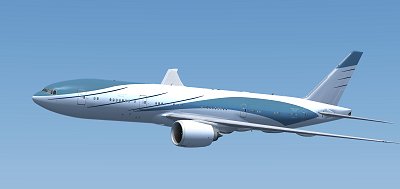
PJ-TBJ Tradewind BizJetz
DOWNLOAD
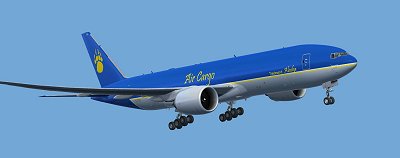
N778TA 'Alaskan Essence'
|
Boeing
777-200LR/F ~ PMDG
Boeing's
advanced widebody 777 twin incorporates more advanced
technologies than any other previous Boeing airliner,
and has been progressively developed into increasingly
longer range developments.
The 777 was originally conceived as a stretched 767, but
Boeing instead adopted an all new design. Notable 777
design features include a unique fuselage cross section,
Boeing's first application of fly-by-wire, an advanced
technology glass flightdeck with five liquid crystal displays,
comparatively large scale use of composites (10% by weight),
and advanced and extremely powerful engines. The 777 was
also offered with optional folding wings where the outer
6m/21ft of each would fold upwards for operations at space
restricted airports.
The basic 777-200 as launched in October 1990 was offered
in two versions, the basic 777-200 (initially A-Market)
and the increased weight longer range 777-200IGW (Increased
Gross Weight, initially B-Market). The IGW has since been
redesignated 777-200ER.
The 777-200 first flew on June 12 1994, with FAA and JAA
certification awarded on April 19 1995. The FAA awarded
full 180 minutes ETOPS clearance for PW4074 -200s on May
30 that year. First customer delivery was to United Airlines
in May 1995. The first 777-200IGW/ER was delivered to
British Airways in February 1997.
The 777-100X was a proposed shortened ultra long range
(16,000km/8635nm) model, dropped in favour of the 777-200LR
(originally 777-200X) design study. Boeing claims the
777-200LR will be the longest ranging airliner, capable
of flying 16,417km (8865nm) - 18 hours flying time. It
will achieve this with awesomely powerful 489kN (110,000lb)
thrust GE90-110B1 turbofans, a significantly increased
max takeoff weight and optional auxiliary fuel tanks in
the rear cargo hold. Other changes include 2m (6.5ft)
raked wingtips, new main landing gear, structural strengthening
and optional overhead crew and flight attendant rest stations
above the cabin. The 777-200LR was launched in 2000, but
is now delayed until 2006.
|
FSX ONLY
|
Other Suggested Files:
Updated tail textures:
TCA - TA - TP - TL - TAC - TBJ
|
Repaint by JF
|
PJ-TGH 'Caribbean Spirit'
N773TA 'Knik-Fairview'
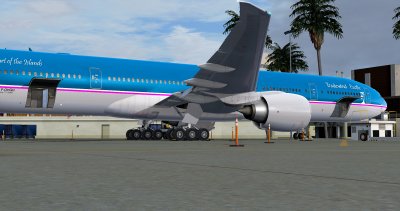
F-OHGH 'Pacific Spirit'
TCA - TA DOWNLOAD
TP DOWNLOAD
|
Boeing
777-300ER ~ PMDG
Boeing's 777-300 is powered by the world's most powerful turbofan engines.
The stretched 777-300 is designed as a replacement for early generation 747s (747-100s and 200s). Compared to the older 747s the stretched 777 has comparable passenger capacity and range, but burns one third less fuel and features 40% lower maintenance costs.
Compared with the baseline 777-200 the 300 features a 10.13m (33ft 3in) stretch, comprising plugs fore and aft of the wings. The longer fuselage allows seating for up to 550 passengers in a single class high density configuration. To cope with the stretch and the up to 13 tonne (28,600lb) increased max takeoff weight the 300 features a strengthened undercarriage, airframe and inboard wing. Other changes compared with the 777-200 include a tailskid and ground manoeuvring cameras mounted on the horizontal tail and underneath the forward fuselage. Otherwise changes have been kept to a minimum to maximise commonality.
Boeing publicly announced it was developing the 777-300 at the Paris Airshow in mid June 1995 where it revealed it had secured 31 firm orders from All Nippon, Cathay Pacific, Korean Airlines and Thai Airways. Later that month Boeing's board authorised production of the new aircraft.
The 777-300 rolled out on September 8 1997, followed by first flight on October 16 that year. The type made history on May 4 1998 when it was awarded type certification simultaneously from the US FAA and European JAA and was granted 180min ETOPS approval. Service entry with Cathay Pacific was later in that month.
Like the 777-200, a 777-300ER long range version has been developed. Changes made to the 777-300ER are more powerful General Electric GE90-115B engines (currently the world's most powerful jet engine), raked wingtips, strengthened body, wings, empennage, nose gear, engine struts and nacelles, new main landing gear, and provision for extra fuel tanks. The range, carrying 365 passengers, is increased up to 13,427km (7,250nm).
Roll-out of the first 777-300ER was made on November 14 2002, followed by the first flight on February 24 2003. First delivery, to Air France, is scheduled for March 2004.
|
FSX ONLY
|
Other Suggested Files:
|
Repaints by JF
|

N773TA Tradewind Alaska 'Quinhagak'

N776TA Tradewind Alaska 'Knik-Fairview'

PJ-TGH Tradewind Caribbean 'Caribbean Spirit' F1 Logo

PJ-TGH Tradewind Caribbean 'Caribbean Spirit' Standard

PJ-TGI Tradewind Caribbean 'Caribbean Sunrise' F1-Theme

PJ-TGI Tradewind Caribbean 'Caribbean Sunrise' Standard

PJ-TGJ Tradewind Caribbean 'Caribbean Dream' F1-Logo

PJ-TGJ Tradewind Caribbean 'Caribbean Dream' Standard

PJ-TGK Tradewind Caribbean 'Caribbean Flair' F1-Theme

PJ-TGK Tradewind Caribbean 'Caribbean Flair' Standard

F-OHGH Tradewind Pacific 'Pacific Spirit'

F-OHGI Tradewind Pacific 'Pacific Dream'

XA-TGA Tradewind Mexico 'Veracruz'

XA-TGB Tradewind Mexico 'Puebla'
More to follow
|
Boeing
777-300ER ~ PMDG
Boeing's 777-300 is powered by the world's most powerful turbofan engines.
The stretched 777-300 is designed as a replacement for early generation 747s (747-100s and 200s). Compared to the older 747s the stretched 777 has comparable passenger capacity and range, but burns one third less fuel and features 40% lower maintenance costs.
Compared with the baseline 777-200 the 300 features a 10.13m (33ft 3in) stretch, comprising plugs fore and aft of the wings. The longer fuselage allows seating for up to 550 passengers in a single class high density configuration. To cope with the stretch and the up to 13 tonne (28,600lb) increased max takeoff weight the 300 features a strengthened undercarriage, airframe and inboard wing. Other changes compared with the 777-200 include a tailskid and ground manoeuvring cameras mounted on the horizontal tail and underneath the forward fuselage. Otherwise changes have been kept to a minimum to maximise commonality.
Boeing publicly announced it was developing the 777-300 at the Paris Airshow in mid June 1995 where it revealed it had secured 31 firm orders from All Nippon, Cathay Pacific, Korean Airlines and Thai Airways. Later that month Boeing's board authorised production of the new aircraft.
The 777-300 rolled out on September 8 1997, followed by first flight on October 16 that year. The type made history on May 4 1998 when it was awarded type certification simultaneously from the US FAA and European JAA and was granted 180min ETOPS approval. Service entry with Cathay Pacific was later in that month.
Like the 777-200, a 777-300ER long range version has been developed. Changes made to the 777-300ER are more powerful General Electric GE90-115B engines (currently the world's most powerful jet engine), raked wingtips, strengthened body, wings, empennage, nose gear, engine struts and nacelles, new main landing gear, and provision for extra fuel tanks. The range, carrying 365 passengers, is increased up to 13,427km (7,250nm).
Roll-out of the first 777-300ER was made on November 14 2002, followed by the first flight on February 24 2003. First delivery, to Air France, is scheduled for March 2004
MSFS ONLY
|
Other Required Files:
The payware B777-300ER by PMDG
|
Repaints by Christian Breuer
|
| |
|
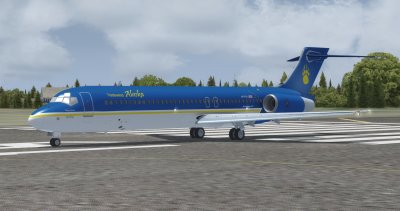
Tradewind Alaska N717TA ' Napakiak '
FSX/P3D
|
Boeing717 ~ TFDi
The Boeing 717 is a twin-engine, single-aisle jet airliner, developed for the 100-seat market. The airliner was designed and originally marketed by McDonnell Douglas as the MD-95, a derivative of the DC-9 family. Capable of seating up to 134 passengers, the 717 has a design range of 2,060 nautical miles. It is powered by two Rolls-Royce BR715 turbofan engines mounted at the rear of the fuselage.
|
|
Other Essential Files:
The payware TFDi B717 package
|
Repaint by JF
|
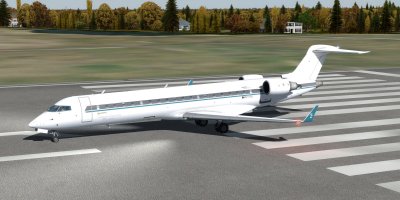
8P-CRJ TBJ Challenger 870CS
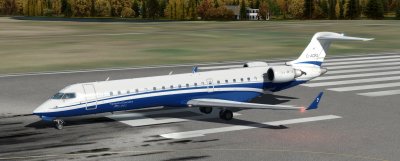
D-ACRJ TBJ Challenger 870CS
FSX_P3D
ONLY
|
Bombardier CRJ700ER ~ Aerosoft
The CRJ900 is a stretched 76–90 seat version of the CRJ700. The aircraft features two GE CF34-8C5 engines, 59.4 kN (13,400 lbf) thrust with APR, and added leading edge slats. Max GTOW is 84,500 pounds. The airplane is loosely based on the CRJ200 series with a few major improvements. The environmental packs have a target temperature instead of a hot-cold knob. The cabin has a recirculation fan which aids in cooling and heating. The engines are controlled by FADEC digital engine control instead of control cables and a fuel control unit. The cabin floor has been lowered 2 inches which gains outward visibility from the windows in the cabin as the windows become closer to eye level height. The APU is a Honeywell RE220 unit which supplies much more air to the AC packs and has higher limits for starting and altitude usage. The wingspan is longer, the tail is redesigned with more span and anhedral. In typical service the CRJ900 can cruise 8–10,000 ft higher with a slightly higher fuel burn and an average true airspeed of 450–500 knots, a significant improvement over its predecessor. The FAA Type Certificate designation of the CRJ900 is the CL-600-2D24.
The first CRJ900 (C-FRJX) was modified from the prototype CRJ700 by adding longer fuselage plugs fore and aft; it was later converted into the prototype CRJ1000 by installing yet longer fuselage plugs
|
|
Other Suggested Files:
|
Repaint by JF
|
Boeing 787-8 BBJ GE Tradeind BizJetz 8P-BHH

Boeing 787-9 BBJ GE Tradeind BizJetz PJ-GHH
Boeing 787-9 GE Tradeind Caribbean PJ-DRN 'Pico Duarte'
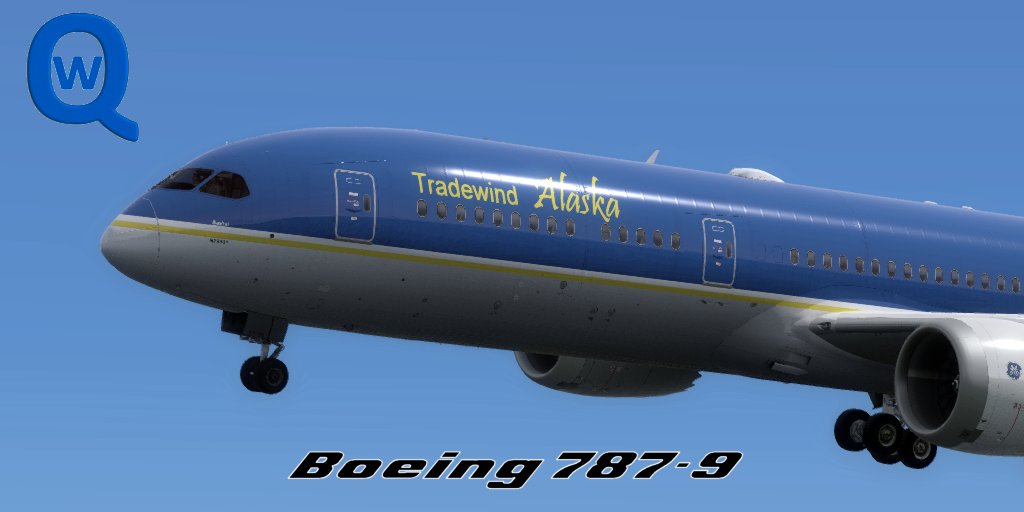
Boeing 787-9 GE Tradeind Alaska N78901 'Bethel'
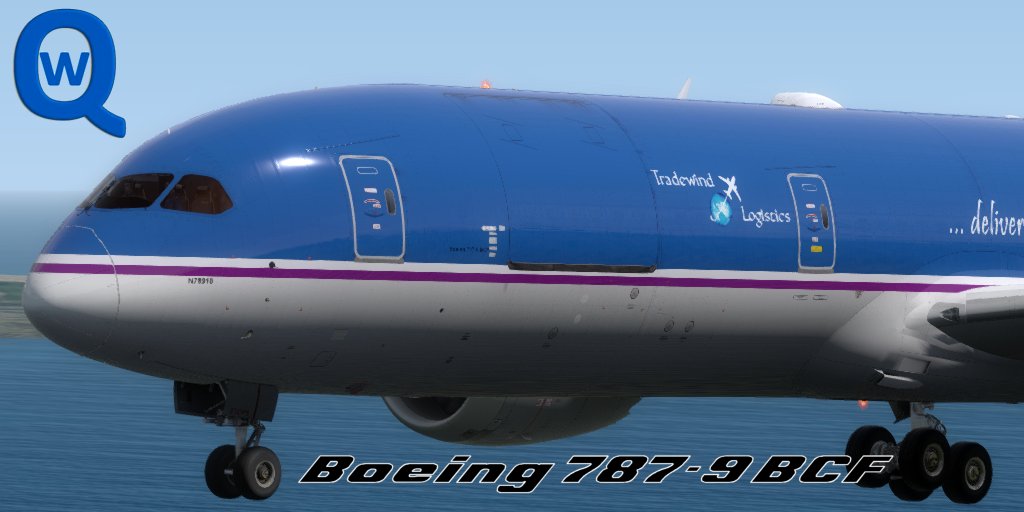
Boeing 787-9 BCF GE Tradeind Logistics N78910
|
Boeing
787- 8/9 QualityWings
The Boeing 787 Dreamliner is an American long-haul, mid-size wide-body, twin-engine jet airliner manufactured by Boeing Commercial Airplanes. Its variants seat 242 to 335 passengers in typical three-class seating configurations. It is the first airliner with an airframe constructed primarily of composite materials. The 787 was designed to be 20% more fuel-efficient than the Boeing 767, which it was intended to replace. The 787 Dreamliner's distinguishing features include mostly electrical flight systems, raked wingtips, and noise-reducing chevrons on its engine nacelles.
The aircraft's initial designation was the 7E7, prior to its renaming in January 2005. The first 787 was unveiled in a roll-out ceremony on July 8, 2007 at Boeing's Everett factory. Development and production of the 787 has involved a large-scale collaboration with numerous suppliers worldwide. Final assembly takes place at the Boeing Everett Factory in Everett, Washington, and at the Boeing South Carolina factory in North Charleston, South Carolina. Originally planned to enter service in May 2008, the project experienced multiple delays. The airliner's maiden flight took place on December 15, 2009, and flight testing was completed in mid-2011. Boeing has reportedly spent $32 billion on the 787 program.
Final US Federal Aviation Administration (FAA) and European Aviation Safety Agency (EASA) type certification was received in August 2011, and the first 787-8 was delivered in September 2011. It entered commercial service on October 26, 2011 with launch customer All Nippon Airways. The stretched 787-9 variant, which is 20 feet (6.1 m) longer and can fly 450 nautical miles (830 km) farther than the -8, first flew in September 2013. Deliveries of the 787-9 began in July 2014; it entered commercial service on August 7, 2014 with All Nippon Airways, with 787-9 launch customer Air New Zealand following two days later. As of March 2019, the 787 had orders for 1,441 aircraft from 72 identified customers
|
|
Other Essential Files:
The payware QualityWings B787 package
|
Repaint by JF
|

PJ-CRT 'Punta Cana' TCA
N391TA 'Tengausqaq' Tradewind Alaska
FSX_P3D
ONLY
|
Bombardier CRJ900ER ~ Aerosoft
The CRJ900 is a stretched 76–90 seat version of the CRJ700. The aircraft features two GE CF34-8C5 engines, 59.4 kN (13,400 lbf) thrust with APR, and added leading edge slats. Max GTOW is 84,500 pounds. The airplane is loosely based on the CRJ200 series with a few major improvements. The environmental packs have a target temperature instead of a hot-cold knob. The cabin has a recirculation fan which aids in cooling and heating. The engines are controlled by FADEC digital engine control instead of control cables and a fuel control unit. The cabin floor has been lowered 2 inches which gains outward visibility from the windows in the cabin as the windows become closer to eye level height. The APU is a Honeywell RE220 unit which supplies much more air to the AC packs and has higher limits for starting and altitude usage. The wingspan is longer, the tail is redesigned with more span and anhedral. In typical service the CRJ900 can cruise 8–10,000 ft higher with a slightly higher fuel burn and an average true airspeed of 450–500 knots, a significant improvement over its predecessor. The FAA Type Certificate designation of the CRJ900 is the CL-600-2D24.
The first CRJ900 (C-FRJX) was modified from the prototype CRJ700 by adding longer fuselage plugs fore and aft; it was later converted into the prototype CRJ1000 by installing yet longer fuselage plugs
|
|
Other Suggested Files:
|
Repaint by JF
|
PJ-HDH 'Isle à Quatre' TDM
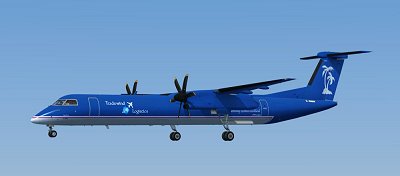
PJ-HDA 'Paki Pára' Tradewind Logistics
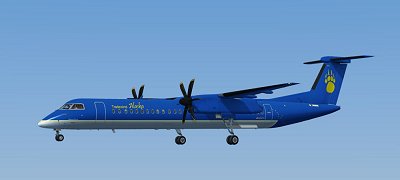
N840TA 'Sadlerochit River' Tradewind Alaska
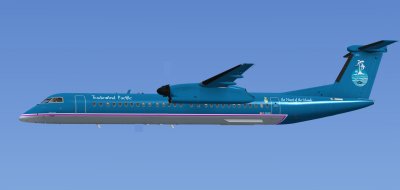
F-OHDH 'Nuku-Hiva' Tradewind Pacific
FSX
ONLY
|
Bombardier
Dash8 Q400 ~ Majestic
Bombardier's
70 seat de Havilland Dash 8 Series Q400 is the latest
and longest member of the successful Dash 8 twin turboprop
family, but with new engines, avionics and systems, a
modified wing and stretched fuselage is essentially an
all new aeroplane
|
|
Other Suggested Files:
|
Repaint by JF
|
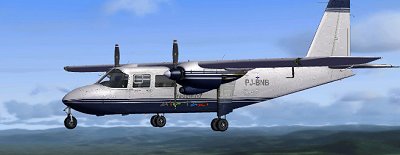
PJ-BNB Islander Tradewind Air Taxis
|
BN-2 Islander ~ Flight 1
The BN-2 Islander was Britten-Norman's second original design, work on which began during 1963.
Developed as a Dragon Rapide replacement, the emphasis was on producing a rugged and durable aircraft that had good field performance, low operating costs and was easy to maintain. One unusual feature is that there is no centre aisle between seats in the main cabin, instead there are three doors along each side of the fuselage for passenger boarding. The prototype BN-2 Islander was powered by two 155kW (210hp) IO-360s and first flight was on June 13 1965.
The first production machines were powered by 195kW (260hp) IO-540s and were simply designated BN-2, the first flew in 1967. A small number were built before production switched to the BN-2A which introduced fairings to the main undercarriage legs, wing leading edge and flap droop, and an increased max takeoff weight. From 1970 the base A model was the BN-2A-6 and the BN-2A-7 had extended wingtips, while the BN-2A-2 and BN-2A-3 were powered by the 225kW (300hp) IO-540, the latter with the extended wingtips.
Appearing in 1972 were the 195kW (260hp) powered BN-2A-26 and extended wingtips BN-2A-27, and the 225kW (300hp) BN-2A-20 and extended wingtips BN-2A-21, all four models having higher weights. Further improvements came with the BN-2B range with higher weights, improved interior and instrument panel and shorter diameter props. The 26, 27, 20 and 21 variants were available as before. The 27 and 21 were later dropped while the BN-2B-20 and BN-2B-26 remain in production. The turboprop (Allison 250) powered BN-2T has been built since 1981.
In September1979 Britten-Norman became Pilatus Britten-Norman, in July 1998 it was renamed back to Britten-Norman, and from April 2000 it became B-N Group.
|
|
Other Essential Files:
The payware F1/Virtavia BN-2 Islander package
|
Repaint by JF
|
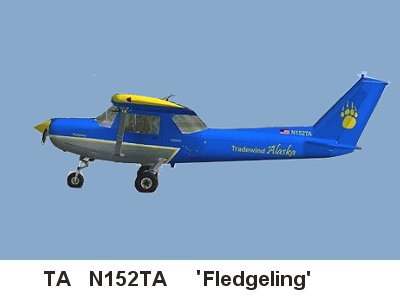
|
Cessna
C152 ~ Just Flight/FSInsider
TA N152TA 'Fledgeling'
The introduction of the Cessna 150 marked Cessna's return to the two seat trainer market after a six year absence and resulted in the most prolific and successful two seat trainer line in history.
Development of the original 150 began in the mid 1950s, resulting in a first flight in September 1957. This modern, all new aircraft followed the Cessna conventions then gaining favour of a strut braced high wing, all metal construction and tricycle undercarriage. Production began in September 1958.
What followed was a continuous process of product improvement, although throughout the 150 model life the Continental O-200A powerplant remained unchanged. One of the most significant model changes was the 150D of 1964 which introduced the wraparound rear window. Most versions were built in Standard, Commuter and Trainer forms with differing equipment levels, while licence production was undertaken in France by Reims and in Argentina by DINFIA. Aerobat versions were stressed for limited aerobatic work.
The 152 was a response to availability problems with 80/87 octane fuel, and used the 150's fuselage coupled with a Lycoming O-235 running on 100 Octane. The 152 replaced the 150 from 1977 and remained in production until late 1985. It too was progressively updated, offered in A152 Aerobat form, and also built in France
|
|
Other Essential Files:
The payware Cessna C152 package- Free if you sign up
|
Repaint by Francisco Aguiar
|
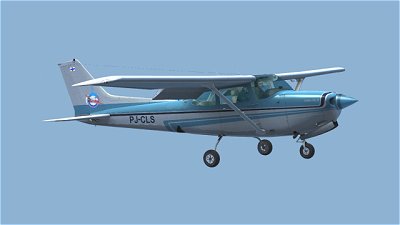
PJ-CLS Tradewind Flying Club
FSX/P3D
|
Cessna C172RG Cutlass II ~ Alabeo
The introduction of the Cessna 150 marked Cessna's return to the two seat trainer market after a six year absence and resulted in the most prolific and successful two seat trainer line in history.
Development of the original 150 began in the mid 1950s, resulting in a first flight in September 1957. This modern, all new aircraft followed the Cessna conventions then gaining favour of a strut braced high wing, all metal construction and tricycle undercarriage. Production began in September 1958.
What followed was a continuous process of product improvement, although throughout the 150 model life the Continental O-200A powerplant remained unchanged. One of the most significant model changes was the 150D of 1964 which introduced the wraparound rear window. Most versions were built in Standard, Commuter and Trainer forms with differing equipment levels, while licence production was undertaken in France by Reims and in Argentina by DINFIA. Aerobat versions were stressed for limited aerobatic work.
The 152 was a response to availability problems with 80/87 octane fuel, and used the 150's fuselage coupled with a Lycoming O-235 running on 100 Octane. The 152 replaced the 150 from 1977 and remained in production until late 1985. It too was progressively updated, offered in A152 Aerobat form, and also built in France
|
|
Other Essential Files:
The payware Alabeo C172RG Cutlass II
|
Repaint by JF
|
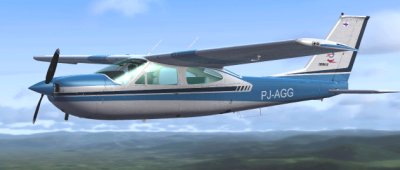
PJ-AGG Tradewind Flying Club
FSX/P3D
|
Cessna C177RG Cardinal II ~ Alabeo
The Cessna 177 (Cardinal for the Deluxe option) was developed in the mid 1960s as an all new replacement for the ubiquitous 172 family.
Announced in late 1967, this new aircraft featured a wide and fairly spacious cabin, a rear set flush riveted high wing which offered good visibility in turns, a single piece all moving tailplane, a high level of standard equipment and the 110kW (150hp) O-320-E recently installed on the 172 driving a fixed pitch prop. Offered in two versions, the standard 177 and upspec Cardinal (wheelspats, overall paint, etc.), it entered the marketplace priced around 10% more than the then current 172 model.
While not a failure, the 177 failed to attract anywhere near the sales volume of the 172 (in its first full year - 1968 - 601 were built, about half the number of 172s built that year). A perceived shortcoming of the initial model was a lack of power, this was addressed with the 135kW (180hp) O-360-A powered 177A introduced in late 1968. The increase in engine power and hence performance lifted the 177 into a more upmarket four seater market niche between the 172 and 182.
The 1970 model 177B introduced a revised aerofoil, conical camber wingtips, cowl flaps and a constant speed propeller. An up market version of the 177B known as the Cardinal Classic appeared in 1978 with full IFR instrumentation and luxury interior fittings.
The 177RG was announced in December 1970, and, as its designation suggests, featured hydraulically actuated retractable undercarriage, plus a 150kW (200hp) fuel injected IO-360-A engine and a constant speed prop.
Both the 177B and 177RG remained in production until 1978.
|
|
Other Essential Files:
The payware Alabeo C177RG Cardinal II
|
Repaint by JF
|
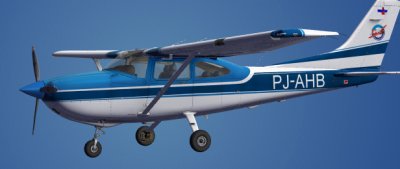
PJ-AHB Tradewind Flying Club
FSX/P3D
|
Cessna C182T Skylane~ A2A
The popular, relatively high performance Cessna 182 began life as a tricycle development of the 180.
The first Model 182 appeared in 1956 while the Skylane name was first introduced with the 182A development to denote an optional higher level of equipment. Major changes were introduced with the 182C, including a third window on each side of the cabin and a swept vertical tail. Other improvements introduced over the 182's lifespan included shorter undercarriage, reprofiled cowling, wrap around rear cabin window, progressively higher takeoff weights and improved wing root, fintip, and rudder fairings.
The retractable undercarriage Skylane RG arrived in 1977, giving a significant speed increase. A further performance boost came with the introduction of the turbocharged 175kW (235hp) Lycoming O-540-L engine on the T182RG, which became available from 1979. The AiResearch turbocharger meant that maximum power could be delivered right up to the 182's service ceiling of 20,000ft. A turbocharged fixed gear model was also offered for a time, but only small numbers were built.
The 182 was also produced by Reims in France as the F182, and by DINFIA in Argentina as the A-182. Cessna 182 production initially ceased in 1985.
In 1994 Cessna announced plans to return the 182 to production, following the success of product liability law reforms in the USA. The new 182S prototype first flew on July 15 1996, the first was delivered in April 1997. Improvements include a IO-540-AB1A5 engine, new interior and avionics panel.
|
|
Other Essential Files:
The payware A2A C182T
|
Repaint by JF
|
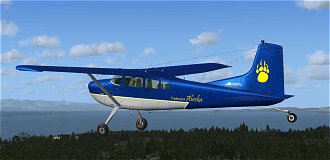
N185TA 'Gail'
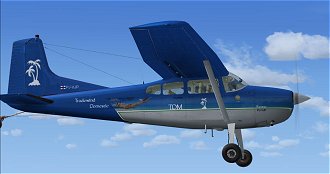
PJ-VJP 'Roseau'
For FSX ONLY
- texture update available
|
Cessna
C185F Skywagon ~ Carenado
The 180 started life as a more powerful development of the 170, and evolved into a family of useful utility aircraft that was in production for over three decades.
The first 180s were essentially Model 170s with a more powerful 170kW (225hp) O-470-A engine. The first of the type flew in 1952 and deliveries began in February the following year. The 180's career as a high performance single was short lived due to the arrival of the tricycle 180 based 182 in 1956, but by then the type had established itself a useful niche as a utility aircraft.
Progressive updating of the line led to a range of updated models including the 170kW (230hp) 180A, and 1964's 180G with a third cabin window which from 1966 was offered as a six seater, by then having the same fuselage as the more powerful 185 Skywagon. The Skywagon name was applied to the 180 in 1969. The 180 remained in production until 1981.
The first 185 Skywagon flew in July 1960. It differed from the 180 in having a more powerful engine (195kW/260hp) and larger cabin, allowing six seats. Updated models include the 225kW (300hp) A185E from 1967 and the AgCarryall capable of chemical spraying.
|
|
Other Essential Files:
The payware Carenado Cessna
C185F Skywagon
|
Repaints by Francisco Aguiar
Includes optional tweaks
|
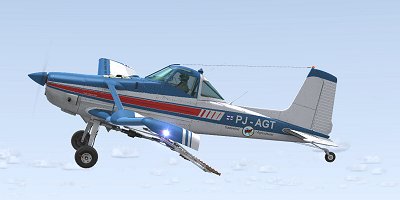
Tradewind Agricultural PJ-AGT
For FSX ONLY
|
Cessna C188 Ag Truck ~ Alabeo
The The successful 188 Agwagon agricultural aircraft were Cessna's only purpose designed agplanes.
Cessna's Model 188 resulted from extensive research and consultation with agricultural aircraft operators conducted in the early 1960s. The design Cessna settled upon was of the conventional agricultural aircraft arrangement with a braced low wing (unique among Cessna singles) with seating for the pilot only. Like other ag aircraft the chemical hopper is of fibreglass and the rear fuselage is of semi monocoque construction and sealed to reduce the potential for damage from chemical contamination.
The prototype Cessna 188 Agwagon flew for the first time on February 19 1965, and type approval was awarded the following February. The 188 was initially offered in two forms, the 170kW (230hp) Continental O-470-R powered 188 (which was named the AgPickup from 1972) and the 250kW (300hp) Continental IO-520-D powered 188A Agwagon.
The 1972 model year also saw the introduction of the most successful 188 model, the AgTruck. The AgTruck has the same powerplant as the Agwagon, but a larger hopper and a higher max takeoff weight. The ultimate 188 model is the AgHusky, which was introduced in 1979. It features a turbocharged TSIO-520-T and a further increased max takeoff weight.
Production of the AgPickup was suspended in 1976, the Agwagon in 1981 and the AgTruck and AgHusky in 1985, when all Cessna light aircraft production ceased.
|
|
Other Essential Files:
|
Repaints by JF
|
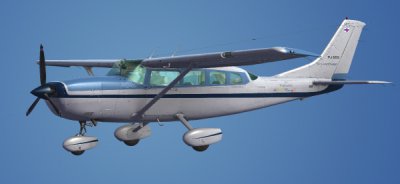
Tradewind Air Taxis PJ-XXG
For FSX & P3D
|
Cessna
C207 Skywagon ~ Alabeo
The popular 205/206/207 line began life as a four seat utility aircraft, stretched from the 182 Skylane.
In its initial form the 205 (originally 210-5) was essentially a fixed undercarriage derivative of the 210 Centurion, optimised for utility roles, giving more baggage space. Introduced to the Cessna lineup in 1962, the 205 was powered by the same IO-470 engine as the 210B and featured an additional small cargo door on the left side of the fuselage. It later gained it's 6th seat.
The 205 lasted in production until 1964 when it was replaced by the more powerful 206, which came in 2 options, the P206 Super Skylane and the U206 Super Skywagon, which respectively meant Passenger and Utility, the U206 featuring larger double cargo doors on the right fuselage side. Continuous improvement followed, including introduction of turbocharged and fuel injected models. The 'Super' prefix for the Super Skywagon was dropped in 1969 and the Stationair name was adopted in 1971. Production originally ceased in 1985.
The 207 Skywagon meanwhile featured a 1.07m (3ft 6in) fuselage stretch (allowing seating for seven) and became available from 1969. Known as the Stationair 7 from 1978, it was replaced by the 207A Stationair 8 from 1979 which had seating for an eighth occupant. Production ended in 1984. A few were built in France by Reims as the F207. Several 206 and 207 aircraft have been converted to turbine power by Soloy as the Turbine 206 and 207.
The 206 is the third Cessna single to be returned to production at the company's new Independence plant in Kansas. Two versions are offered, the normally aspirated 206H and turbo T206H. The T206H first flew on August 6 1996, powered by a TIO-580, while the normally aspirated 206H, powered by an IO-580, followed on November 6. A decision to switch to the TIO-540 and IO-540 because of reliability concerns pushed back production by about 10 months. The 206H was certificated on September 9 1998, the T206H on October 1.
|
|
Other Essential Files:
The payware Alabeo
|
Repaints by JF
|
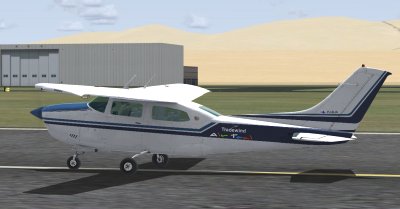
Tradewind Air Taxis PJ-BJA
For FSX ONLY
|
Cessna
CT210M ~ Carenado
During its production life the Cessna 210 was at the top of the Cessna single piston engine model lineup, positioned between the 182 and the 310 twin.
First flight of the 210 occurred in January 1957. This new aircraft featured for the first time on a Cessna aircraft retractable undercarriage and swept back vertical tail surfaces. The 210 entered production in late 1959, and from that time the line was constantly updated.
Notable early upgrades include the 210B which introduced the wraparound rear windows, the 210D with a more powerful (210kW/285hp) engine and introduced the Centurion name, and the turbocharged T210F. The 210G introduced a new strutless cantilever wing, increased fuel capacity, restyled rear windows and enlarged tail surfaces. Continual development of the 210 and T210 range continued through until production ceased in 1985.
A significant development of the T210 was the high performance, pressurised P210 which first appeared in 1978. The pressurisation system meant that the cabin's internal altitude was equivalent to 8000ft when flying at 17,350ft.
In 1998 Cessna was considering returning the 210 to production.
|
|
Other Essential Files:
The payware Carenado
|
Repaints by JF
|
|
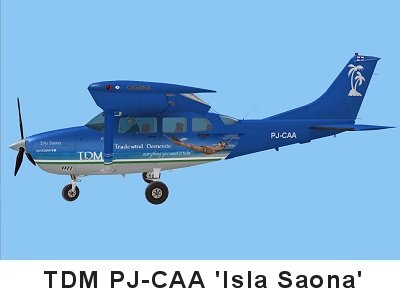
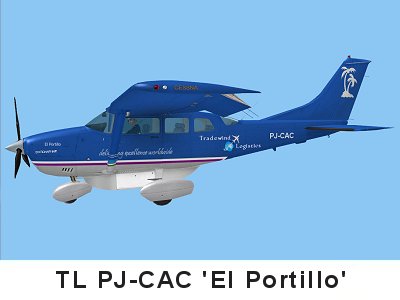
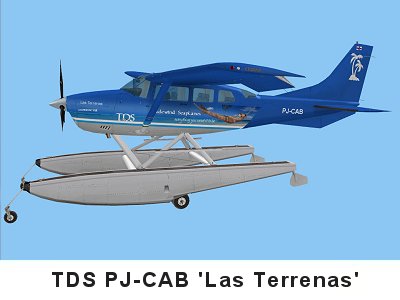
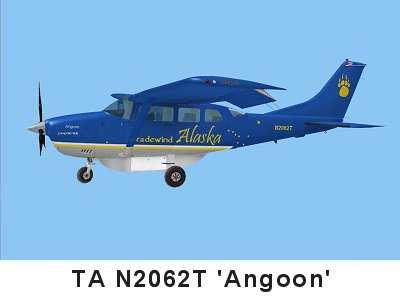
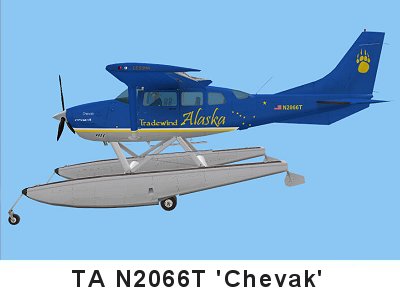
PJ-STN Tradewind Flying Club
|
Cessna
U206G Stationair 6 II ~ Carenado
|
The
popular 205/206/207 line began life as a four seat utility
aircraft, stretched from the 182 Skylane.
In its initial
form the 205 (originally 210-5) was essentially a fixed
undercarriage derivative of the 210 Centurion, optimised
for utility roles, giving more baggage space. Introduced
to the Cessna lineup in 1962, the 205 was powered by the
same IO-470 engine as the 210B and featured an additional
small cargo door on the left side of the fuselage. It later
gained it's 6th seat.
The 205 lasted
in production until 1964 when it was replaced by the more
powerful 206, which came in 2 options, the P206 Super Skylane
and the U206 Super Skywagon, which respectively meant Passenger
and Utility, the U206 featuring larger double cargo doors
on the right fuselage side. Continuous improvement followed,
including introduction of turbocharged and fuel injected
models. The 'Super' prefix for the Super Skywagon was dropped
in 1969 and the Stationair name was adopted in 1971. Production
originally ceased in 1985.
The 207 Skywagon
meanwhile featured a 1.07m (3ft 6in) fuselage stretch (allowing
seating for seven) and became available from 1969. Known
as the Stationair 7 from 1978, it was replaced by the 207A
Stationair 8 from 1979 which had seating for an eighth occupant.
Production ended in 1984. A few were built in France by
Reims as the F207. Several 206 and 207 aircraft have been
converted to turbine power by Soloy as the Turbine 206 and
207.
The 206 is the
third Cessna single to be returned to production at the
company's new Independence plant in Kansas. Two versions
are offered, the normally aspirated 206H and turbo T206H.
The T206H first flew on August 6 1996, powered by a TIO-580,
while the normally aspirated 206H, powered by an IO-580,
followed on November 6. A decision to switch to the TIO-540
and IO-540 because of reliability concerns pushed back production
by about 10 months. The 206H was certificated on September
9 1998, the T206H on October 1.
TDM PJ-CAA 'Isla Saona'
TL PJ-CAC 'El Portillo'
TDS PJ-CAB 'Las Terrenas'
TA N2062T 'Angoon'
TA N2066T 'Chevak'
TFC PJ-STN
|
|
|
Other Essential Files:
The payware Carenado
U206G
Stationair 6 II package
|
Repaints by JF
|
PJ-STO Tradewind Air Taxis
|
Cessna
CT206H Stationair 6 II ~ Carenado
The
popular 205/206/207 line began life as a four seat utility
aircraft, stretched from the 182 Skylane.
In its initial
form the 205 (originally 210-5) was essentially a fixed
undercarriage derivative of the 210 Centurion, optimised
for utility roles, giving more baggage space. Introduced
to the Cessna lineup in 1962, the 205 was powered by the
same IO-470 engine as the 210B and featured an additional
small cargo door on the left side of the fuselage. It later
gained it's 6th seat.
The 205 lasted
in production until 1964 when it was replaced by the more
powerful 206, which came in 2 options, the P206 Super Skylane
and the U206 Super Skywagon, which respectively meant Passenger
and Utility, the U206 featuring larger double cargo doors
on the right fuselage side. Continuous improvement followed,
including introduction of turbocharged and fuel injected
models. The 'Super' prefix for the Super Skywagon was dropped
in 1969 and the Stationair name was adopted in 1971. Production
originally ceased in 1985.
The 207 Skywagon
meanwhile featured a 1.07m (3ft 6in) fuselage stretch (allowing
seating for seven) and became available from 1969. Known
as the Stationair 7 from 1978, it was replaced by the 207A
Stationair 8 from 1979 which had seating for an eighth occupant.
Production ended in 1984. A few were built in France by
Reims as the F207. Several 206 and 207 aircraft have been
converted to turbine power by Soloy as the Turbine 206 and
207.
The 206 is the
third Cessna single to be returned to production at the
company's new Independence plant in Kansas. Two versions
are offered, the normally aspirated 206H and turbo T206H.
The T206H first flew on August 6 1996, powered by a TIO-580,
while the normally aspirated 206H, powered by an IO-580,
followed on November 6. A decision to switch to the TIO-540
and IO-540 because of reliability concerns pushed back production
by about 10 months. The 206H was certificated on September
9 1998, the T206H on October 1.
|
|
Other Essential Files:
The payware Carenado CT206H
Stationair HD package
|
Repaints by JF
|
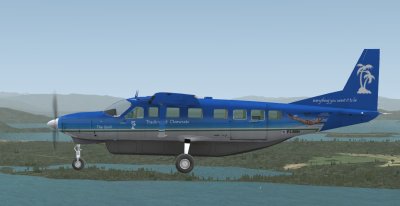
PJ-BOH 'The Quill'
FS9 - FSX
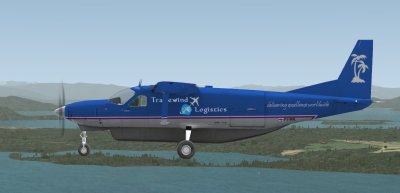
PJ-BOL
FS9 - FSX
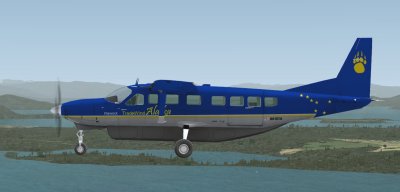
N618TA 'Klawock'
FS9 - FSX
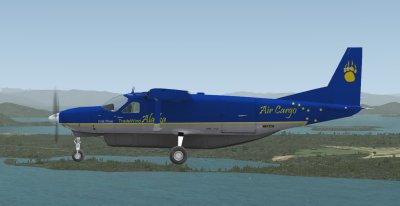
N611TA 'Knik River'
FS9 - FSX
|
Cessna C208 Grand Caravan ~ feelThere
For FS9 & FSX
With sales exceeding the 1000 mark the useful Caravan is a popular utility workhorse worldwide.
Design work for the Caravan dates back to the early eighties. First flight of a prototype occurred on December 9 1982 and certification was granted in October 1984. When production began the following year it became the first all new single engine turboprop powered aircraft to achieve production status.
The Caravan I has had a close association with US package freight specialist Federal Express (FedEx), on whose request Cessna especially developed two pure freight versions. The first of these was the 208A Cargomaster (40 delivered), the second was the stretched 208B Super Cargomaster (260 delivered). The first Super Cargomaster flew in 1986 and features a 1.22m (4ft) stretch and greater payload capacity, including an under fuselage cargo pannier. FedEx's aircraft lack cabin windows.
The 208B Grand Caravan first flew in 1990 and like the Super Cargomaster is a stretched version of the basic Caravan powered by a 505kW (675shp) PT6A-114. It can seat up to 14 passengers.
Announced at the 1997 NBAA convention, the 208-675 has replaced the basic 208. It combines the standard length airframe of the 208 with the more powerful PT6A-114 of the 208B.
Underbelly cargo pods, floats and skis are offered as options on the Caravan I family, and the type is easily converted from freight to passenger configurations.
A military/special missions version of the 208A, dubbed the U-27A, is also on offer. The Brazilian Air Force designation is C-98.
Soloy is offering a dual-engine conversion of the 208B, named Pathfinder 21. This version is powered by a 991kW (1329shp) Pratt & Whitney Canada/Soloy Dual Pac powerplant, consisting of two PT6D-114A engines driving a single propeller. Other distinguishing features of the Pathfinder 21 include a 72in cabin stretch behind the wing and a large integral cargo pod.
|
|
Other Essential Files:
The payware feelThere package
|
Repaint by JF
|
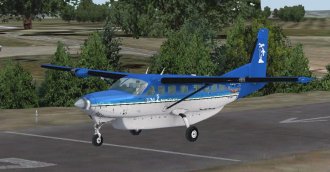
TDM PJ-CAR 'Gulf of Guacanayabo / Golfo de Guacanayabo'
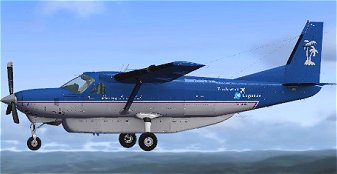
Tradewind Logistics PJ-CAQ
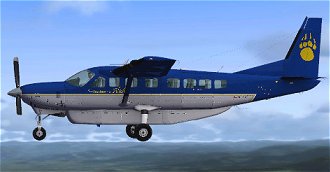
Tradewind Alaska N617TA 'Huslia'
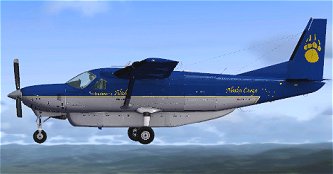
Tradewind Alaska Cargo N612TA 'Emmonak'
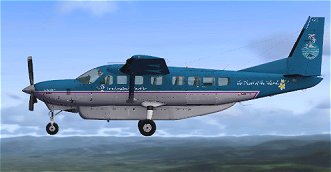
Tradewind Pacific F-OHGC 'Fakarava Lagoon'
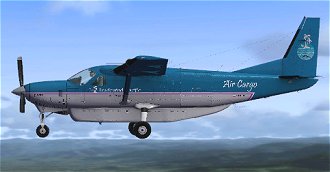
Tradewind Pacific Cargo F-OHGF
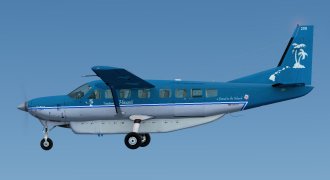
Tradewind Hawaii N208TH 'Haiku-Pauwela'
Converted textures for FS9
|
Cessna C208 Grand Caravan ~ Carenado
for FSX and FS9
With sales exceeding the 1000 mark the useful Caravan is a popular utility workhorse worldwide.
Design work for the Caravan dates back to the early eighties. First flight of a prototype occurred on December 9 1982 and certification was granted in October 1984. When production began the following year it became the first all new single engine turboprop powered aircraft to achieve production status.
The Caravan I has had a close association with US package freight specialist Federal Express (FedEx), on whose request Cessna especially developed two pure freight versions. The first of these was the 208A Cargomaster (40 delivered), the second was the stretched 208B Super Cargomaster (260 delivered). The first Super Cargomaster flew in 1986 and features a 1.22m (4ft) stretch and greater payload capacity, including an under fuselage cargo pannier. FedEx's aircraft lack cabin windows.
The 208B Grand Caravan first flew in 1990 and like the Super Cargomaster is a stretched version of the basic Caravan powered by a 505kW (675shp) PT6A-114. It can seat up to 14 passengers.
Announced at the 1997 NBAA convention, the 208-675 has replaced the basic 208. It combines the standard length airframe of the 208 with the more powerful PT6A-114 of the 208B.
Underbelly cargo pods, floats and skis are offered as options on the Caravan I family, and the type is easily converted from freight to passenger configurations.
A military/special missions version of the 208A, dubbed the U-27A, is also on offer. The Brazilian Air Force designation is C-98.
Soloy is offering a dual-engine conversion of the 208B, named Pathfinder 21. This version is powered by a 991kW (1329shp) Pratt & Whitney Canada/Soloy Dual Pac powerplant, consisting of two PT6D-114A engines driving a single propeller. Other distinguishing features of the Pathfinder 21 include a 72in cabin stretch behind the wing and a large integral cargo pod.
|
|
Other Essential Files:
The payware Carenado package
Tradewind Pacific (TPAC) Editvoicepack file
|
Repaints by JF
|
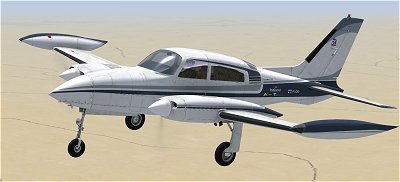
Tradewind Air Taxis PJ-CIO
For FSX ONLY
|
Cessna
C310R ~ MilViz
The sleek Cessna 310 was the first twin engine design from Cessna to enter production after WW2.
The 310 first flew on January 3 1953. The modern rakish lines of the new twin were backed up by innovative features such as engine exhaust thrust augmentor tubes and the storage of all fuel in tip tanks. Deliveries commenced in late 1954.
The first significant upgrade to the 310 line came with the 310C of 1959, which introduced more powerful 195kW (260hp) IO-470-D engines. The 310D of 1960 featured swept back vertical tail surfaces. An extra cabin window was added with the 310F. A development of the 310F was the turbocharged 320 Skyknight, with TSIO-470-B engines and a fourth cabin side-window. The Skyknight was in production between 1961 and 1969 (the 320D, E and F were named Executive Skyknight), when it was replaced by the similar Turbo 310.
The 310G introduced the 'stabila-tip' tip tanks, while the 310K replaced the rear two windows on each side with a single unit. Subsequent significant developments include the 310Q and turbocharged T310Q with redesigned rear cabin with a skylight window, and the final 310R and T310R, identifiable for their lengthened noses. Production ended in 1980.
USAF military versions were the L-27A (310A) and L-27B (310M) Blue Canoe, later redesignated U-3A and U-3B.
|
|
Other Essential Files:
The payware MilViz
|
Repaints by JF
|
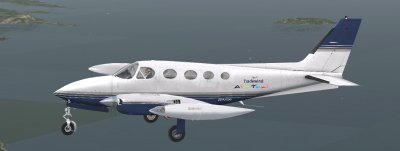
Tradewind Air Taxis PJ-CDO
For FSX ONLY
|
Cessna
C340 ~ Carenado
When released, the Cessna 340 joined the Beechcraft Duke as the only other six seat pressurised piston twin from a major manufacturer, positioned in Cessna's product line between the 310 and the eight seat 414 and 421.
Development of the 340 began in 1969, but the loss of the prototype early in 1970 set back the development program so that production deliveries did not begin until early 1971. The resulting aircraft borrowed heavily from other Cessna twins of the time including the wings from the 414 and the 310's undercarriage and a similar tail unit. Design features of the new aircraft included a pressurisation system with a differential of 0.29bars (4.2psi) that kept the cabin's internal altitude at 8000ft while the aircraft was at 20,000ft, an all new fail safe fuselage and an integral airstair door.
Initial production 340s were powered by two 210kW (285hp) turbocharged Continental TSIO-520-K engines, but these were replaced on the improved 340A, which was first introduced in 1976. Power for the 340A was supplied by two 230kW (310hp) TSIO-520-NBs, while other improvements included reduced diameter props and a slight increase in weights. The 340A was offered in optional 340A II and 340A III forms with various levels of IFR avionics fitted.
The Cessna 335 is an unpressurised, lighter weight and thus lower cost development of the 340. Available from 1979, aside from being unpressurised it differed in having 225kW (300hp) TSIO-520-EB engines. Although claimed by Cessna as the lowest priced cabin class business twin on the market, just 64 335s were built before production was terminated in 1980.
Production of the 340 continued until 1984.
|
|
Other Essential Files:
The payware Carenado
|
Repaints by JF
|
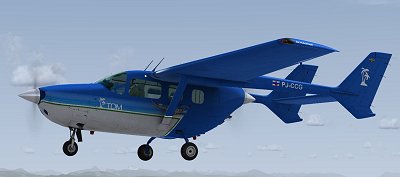
TDM PJ-CCG
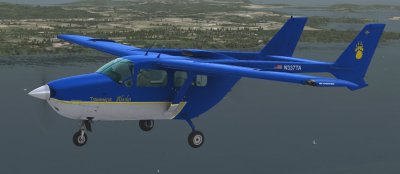
Tradewind Alaska N337TA 'Shishmaref'
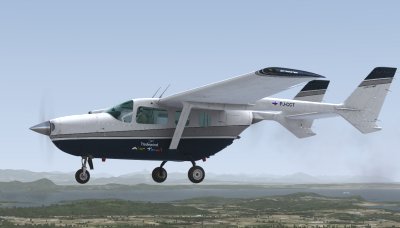
Tradewind Air Taxis PJ-CCT
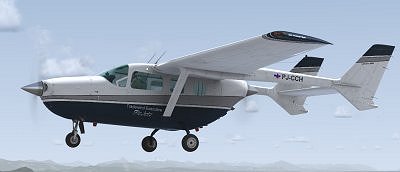
Tradewind BizJetz PJ-CCH
For FSX ONLY
|
Cessna
C337H ~ Carenado
Through their pushpull engine configuration the twin boom Cessna 336 and 337 were designed to overcome conventional twins' problems of poor engine out asymmetric flight handling characteristics.
Cessna called the layout concept Centre Line Thrust, as the nose mounted tractor and rear fuselage mounted pusher engine eliminated asymmetric handling problems normally experienced when one of a twin's engines fails. The concept was recognised by the US FAA which created a new centre thrust rating for pilots to be rated on the type.
The Model 336 Skymaster first flew on February 18 1961, but significant improvements to the design were made before production aircraft were delivered. Changes included more powerful engines, a larger fuselage with seating for six, and revised wing, tail and rear engine cowling. The 336 was delivered from mid 1963 and production lasted until late 1964 when it was replaced by the 337 Super Skymaster ('Super' was later dropped) which was released in February 1965.
The improved 337 introduced retractable undercarriage, more powerful 160kW (210hp) engines, a dorsal air intake for the rear engine, variable cowl flaps, repositioned forward engine and cowl for improved visibility, and higher weights.
Subsequent development resulted in the turbocharged T337 (first released in the 1967 model year, dropped in 1972 and relaunched in 1978), while the ultimate 337 was the T337G Pressurized Skymaster, introduced from August 1972.
Development of the 337 continued in France by Reims after Cessna production ended in 1980, resulting in the FTB337 Milirole, a military STOL version with underwing hardpoints. Cessna also built more than 500 337s as O-2s for the US Air Force, used largely in the Forward Air Control role.
|
|
Other Essential Files:
The payware Carenado
|
Repaints by JF
|
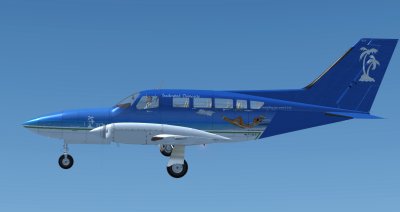
TDM PJ-BLR 'Pelican Creek'
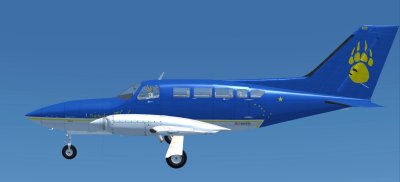
Tradewind Alaska N402TA 'Kongakut River'
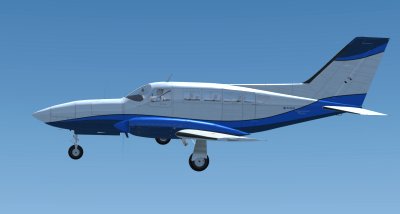
Tradewind BizJetz PJ-BLN
For FSX ONLY
|
Cessna
C402C ~ Flysimware
The 411 was Cessna's entry into the eight seat cabin class twin market that had previously been dominated by the Beech Queen Air.
Much more modern than the Queen Air, the 411 was lighter, smaller and faster. The prototype first flew in July 1962 and differed from the following production aircraft in having two blade props and direct drive engines (as opposed to the geared GTSIO-520-C engines of production aircraft). Production deliveries commenced in October 1964. Optional features for corporate configured aircraft included folding tables, a toilet and refreshment centre. The 411 was followed up by the 411A from 1967 with lighter and more efficient props and optional extra fuel capacity.
The 411 was soon after replaced by the 401 and 402, which had first been introduced in late 1966. These developments of the 411 were lighter, less powerful and had direct drive engines, and thus were less costly to operate. While the 401 and 402 were essentially the same aircraft, the 401 was optimised for corporate transport and was fitted with fewer seats than the 402, which was configured for commuter and freighter work. A number of versions of both models were developed with minor refinements, including the 402A, which had a lengthened nose, square windows and an optional 10th seat.
The 402 replaced the 401 from mid 1972, and, as the 402B, was offered in Businessliner corporate configuration, and Utililiner convertible passenger or freighter aircraft. The 402C appeared in late 1978 and featured the longer span wings from the 414A and 421C and more powerful engines. It remained in production until 1985.
|
|
Other Essential Files:
The payware Flysimware Cessna 402C Businessliner
|
Repaints by JF
|
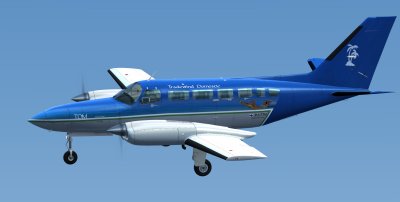
PJ-TTN 'Shark River' Tradewind Domestic
Tradewind Alaska N404TA 'Shark River'
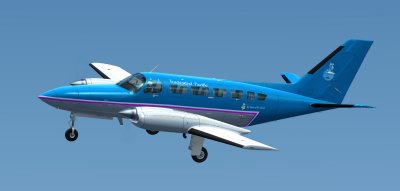
Tradewind Pacific F-OHAC 'Paea'
Tradewind BizJetz PJ-TTP
For FSX & P3D ONLY
|
Cessna
C404 Titan~ Alabeo
In July 1975 Cessna announced it was developing a new piston twin suitable for airline, freight and corporate work, capable of taking off with a 1560kg (3500lb) payload from a 770m (2530ft) strip, similar in concept to the successful 402, but larger overall.
The resulting aircraft was the Model 404 Titan, Cessna's largest piston engined twin developed thus far. It shares the same basic fuselage as the turbine powered 441 Conquest which was developed concurrently, but differs in having geared 280kW (375hp) piston engines and it is unpressurised. Other features include a bonded wet wing (then appearing on a number of 400 series Cessna twins) and the trailing link main undercarriage design shared with the Conquest.
The prototype Titan first flew on February 26 1975, production deliveries got underway in October the following year. Throughout the Titan's model life it was offered in three major versions, each differing in internal equipment fit.
The base aircraft was the Titan Ambassador, configured for passenger operations, while the Titan Courier was convertible from passenger to freight configurations, and the Titan Freighter was a pure cargo aircraft. The Titan Freighter was specially equipped for freight operations with a strengthened floor, cargo doors and walls and a ceiling made from impact resistant material. All were offered with II and III avionics equipment levels (as with other Cessna twins).
The Titan underwent minor modifications from 1980 when the wing span was increased and the wingtips redesigned, but production was to last for only another two years until 1982, by which time 378 had been built.
|
|
Other Essential Files:
The payware Alabeo C404 Titan
|
Repaints by JF
|
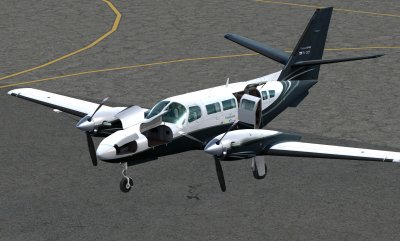
PJ-DOF Tradewind Air Taxis
For FSX & P3D ONLY
|
Cessna
F406 Caravan II - Carenado
The F406 Caravan II is a twin turboprop engined, fourteen-seat low-wing monoplane of conventional aluminium and steel construction. A development of the Cessna 404 with two Pratt & Whitney PT-6 turboprop engines, it is similar to the pressurized Cessna 441. The aircraft first flew on 22 September 1983,[1] and was produced by Reims Aviation (later known as GECI Aviation) until their 2013 demise[2] In 2014, the Chinese based Aviation Industry Corporation of China subsidiary Continental Motors, Inc. partnered with French based marketer ASI Innovation to purchase rights to the F406, and restart production of piston and turboprop variants with diesel fuel capability.[3][4]
The F406 is aimed at passenger and small cargo transport, and civilian and military surveillance. For extra cargo capacity a cargo pod can be fitted to the belly of the aircraft. The Surmar is a new maritime surveillance version of the aircraft with extra equipment such as a 360 degree radar.
Though the two engines make it more expensive to operate than similar aircraft such as the single-engined Cessna 208 Caravan I, having two engines makes it comply with European regulations regarding commercial operations, which only allow multi-engine aircraft for commercial instrument flight.
|
|
Other Essential Files:
The payware Carenado Cessna
F406
|
Repaints by JF
|

PJ-JCA Tradewind Domestic 'Cat Island'

N414TA Tradewind Alaska 'Eagle Island'
For MSFS ONLY
|
Cessna
C414AW 'Chancellor' - Flysimware
The Cessna 414 is an American light, pressurized, twin-engine transport aircraft built by Cessna. It first flew in 1968 and an improved variant was introduced from 1978 as the 414A Chancellor.
The pressurized 414 was developed to appeal to owners of unpressurized, twin-engined aircraft, and was based on the fuselage of the Cessna 421 and used the wing design of the Cessna 401. The 414 is a low-wing cantilever monoplane with a conventional tail unit and a retractable tricycle landing gear. It is powered by two wing-mounted 310 hp (231 kW) Continental TSIO-520-J horizontally opposed, six-cylinder engines. The prototype, registered N7170C, first flew on 1 November 1968, and production aircraft were available in a number of optional seating arrangements and avionics packages. The name Chancellor was used for models marketed from 1976. An improved variant the Cessna 414A Chancellor was introduced in 1978 with the major change being a redesigned and increased-span wing with integral fuel tanks and an extended nose to give more baggage space.
Many supplemental type certificates exist for the aircraft that allow upgrades to improve performance. Common are engine and aerodynamic modifications, including winglets.[1]
In 1974, American Jet Industries built a turboprop-powered conversion of the Cessna 414, named the Turbo Star Pressurized 414, using Allison 250-B17B engines.[2] Scenic Airlines of Las Vegas purchased the rights to the design in 1977.[3]
Thielert has offered engine conversions using their Centurion Engines.[4] This involves the installation of FADEC-controlled aviation diesel piston engines that run on commonly available jet fuel. Thielert claims increased power and improved fuel economy over other available conventional piston engines. |
|
Other Essential Files:
The payware Flysimware C414AW 'Chacellor'
|
Repaints by Christian Breuer
|
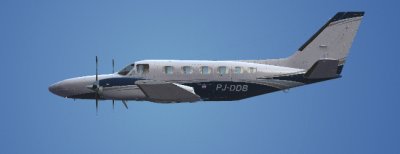
PJ-DDB Tradewind BizJetz
For FSX & P3D ONLY
|
Cessna
441 Conquest II - Alabeo
The Cessna 441 Conquest II is the first turboprop powered aircraft designed by Cessna and was meant to fill the gap between their jets and piston-engined aircraft.
|
|
Other Essential Files:
The payware Alabeo Cessna
441
|
Repaints by JF
|
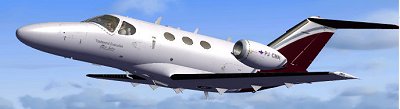
PJ-CMA Tradewind BizJets
|
Cessna Citation Mustang ~ F1
It's an entirely new kind of business jet. One that's designed - and priced - to bring the dream of jet ownership comfortably within reach of a whole new class of aircraft operators. Ample cabin-class seating, true jet speed and a good half-continent of range come together with a price tag that's almost a million dollars lower than that of any comparable aircraft. And above all, it's a Cessna. So as your needs grow and missions expand, your next Citation will be waiting for you, quite literally, in the wings. This natural, seamless process can take you from where you are today all the way to the fastest business aircraft in history.
General characteristics
Performance
- Takeoff distance: 3,110 ft (948 m)
- Landing distance: 2,380 ft (729 m)
|
|
Other Essential Files:
The payware F1_Cessna_Mustang1 package-
|
Repaint by JF
|
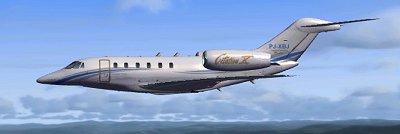
PJ-XBJ 'Christopher Winter' Tradewind BizJets
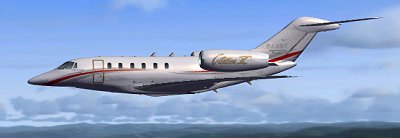
PJ-XBT 'Francis Drake' Tradewind BizJets
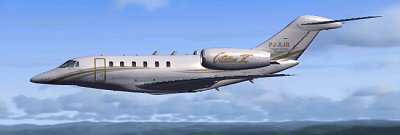
PJ-XJB 'Edward England' Tradewind BizJets
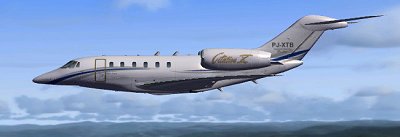
PJ-XTB 'Henry Avery' Tradewind BizJets
Download for FS9
Download for FSX
|
Cessna Citation X v2.0 ~ Eaglesoft
The Citation X is Cessna's largest, fastest and longest range aircraft yet, and Cessna claims it to be the fastest civil transport in service other than the supersonic Concorde.
The Citation X (as in the Roman numeral, not the letter, and Cessna's Model 750) is also the largest member of business aviation's biggest corporate jet family, the Citation series.
The design objectives behind the Citation X included transcontinental USA and trans Atlantic range in a mid size package that cruises faster than any other business jet available. This high speed cruise capability, which Cessna says is 105 to 210km/h (55 to 113kt) faster than other mid size corporate jet, means the X can save up to one hour's flight time on transcontinental US flights, flying from Los Angeles to New York with normal wind conditions in 4 hours 10 minutes. Because of its ability to cruise at high speed at high altitudes, Cessna also says the Citation X will consume less fuel than current jets on such a transcontinental flight.
The X's FADEC equipped Allison AE 3007A turbofans are very powerful for an aircraft of the X's size, while the highly swept (37°) wings are also long in span.
Other design features of the Citation X include the fuselage cross section of the Citation III, VI and VII but with more efficient use of internal space that allows greater head and shoulder room, an area ruled, waisted rear fuselage, trailing link main undercarriage units and a modern Honeywell Primus 2000 EFIS avionics suite with five colour CRT displays.
Cessna announced that it was developing the Citation X in October 1990 at that year's NBAA conference. The prototype was publicly rolled out in September 1993 and flew for the first time on December 21 that year. Certification was granted on June 3 1996, with the first customer delivery (to golfer Arnold Palmer) that month.
A Citation X was the 2500th Citation to be delivered, handed over on September 10 1997. The USA's National Aeronautics Association awarded its prestigious Collier Trophy to the Citation X design team in February 1997.
|
|
Other Essential Files:
The payware Citation X v2.0 package-
|
Repaint by JF
|
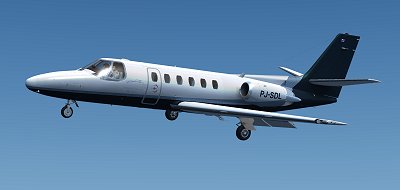
Tradewind BizJetz PJ-SDL
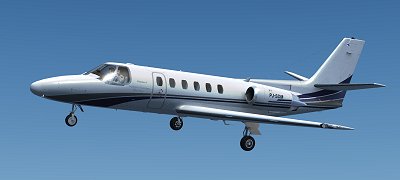
Tradewind BizJetz PJ-SDM
For FSX P3D ONLY
DOWNLOAD
|
Cessna
S550 Citation II ~ Carenado
The early success of the original Citation led Cessna to develop a larger capacity Citation model in the mid 1970s.
Cessna announced the stretched Citation in September 1976. The fuselage was extended by 1.14m (3ft 9in) to increase maximum seating capacity to 10, while more powerful Pratt & Whitney Canada JT15D4 engines and greater fuel tankage meant higher cruise speeds and longer range. Increased baggage capacity and increased span wings were also added.
The new Model 550 Citation II first flew on January 31 1977 and FAA certification for two pilot operation was awarded in March 1978. The II/SP is the single pilot version.
Major improvements were made to the design with the arrival of the Model S550 Citation S/II. Announced in October 1983, this improved version first flew on February 14 1984. Certification, including an exemption for single pilot operation, was granted that July. Improvements were mainly aerodynamic, including a new wing designed using supercritical technology developed for the Citation III (described separately), plus JT15D4B turbofans. The S/II initially replaced the II in production from 1984, but the II returned to the lineup from late 1985, and both variants remained in production until the introduction of the Bravo.
The Bravo features new P&WC PW530A turbofans, modern Honeywell Primus EFIS avionics suite, a revised interior based on that introduced in the Citation Ultra and other improvements such as trailing link main undercarriage. The Bravo first flew on April 25 1995 and was granted certification in August 1996. First delivery was in February 1997.
|
|
Other Essential Files:
The payware Carenado
|
Repaints by JF
|

Tradewind BizJetz PJ-EBE

Tradewind BizJetz PJ-EBE (Large Reg)
For FSX P3D ONLY
|
Cessna 525A Citation CJ2 ~ Carenado
The highly successful CitationJet was developed as a replacement for the Citation and Citation I. Improved and stretched developments, the CJ1 and CJ2 respectively, are under development.
Cessna launched the new Model 525 CitationJet at the annual US National Business Aircraft Association convention in 1989. First flight occurred on April 29 1991, FAA certification was awarded on October 16 1992 and the first delivery was on March 30 1993.
The CitationJet is effectively an all new aircraft. The same basic Citation forward fuselage is mounted to a new T-tail configured tailplane and a new supercritical laminar flow wing, and it features Williams Rolls FJ44 turbofans (with paddle thrust reversers) and trailing link main undercarriage. The CitationJet's fuselage is 27cm (11in) shorter than the Citation/Citation I's, while cabin height is increased courtesy of a lowered centre aisle. It features EFIS avionics and is certificated for single pilot operation.
At the 1998 NBAA convention Cessna revealed it was developing the improved CJ1 and stretched CJ2. The CJ1 will replace the CitationJet and will introduce a Collins Pro Line 21 EFIS avionics suite and a moderate increase in maximum takeoff weight. The CJ1 will be delivered from the first quarter of 2000.
The CJ2 meanwhile is a stretched, faster and more powerful development. Due to fly in the second quarter of 1999 and be certificated 12 months later, the CJ2 will feature a 89cm (35in) cabin and 43cm (17in) tailcone stretch allowing standard seating for six in the main cabin. Like the CJ1 it will feature Collins Pro Line 21 EFIS avionics, plus uprated FJ44-2C engines, increased span wings, larger area tail, six cabin windows per side and greater range. It will be certificated for single pilot operation.
|
|
Other Essential Files:
The payware Carenado
|
Repaints by JF
|
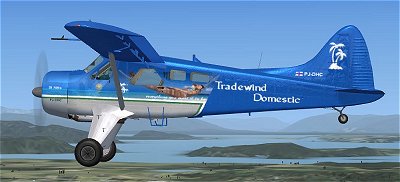
PJ-DHC
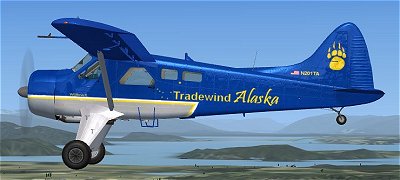
N201TA
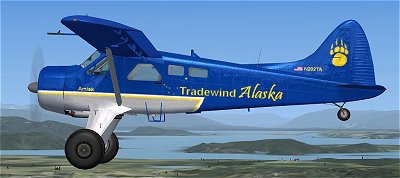
N202TA
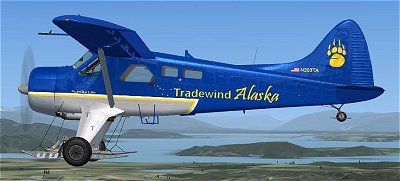
N203TA
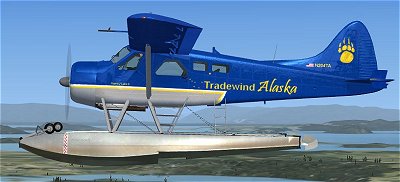
N204TA
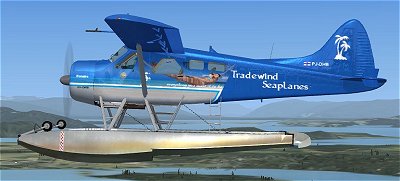
PJ-DHB
FSX
|
for FSX
De Havilland Canada's first purpose designed bush aircraft, the Beaver was that company's most successful program sales wise (both military or civil), with almost 1700 built in a production run lasting two decades.
Beaver development work began in 1946 and the Ontario Department of Lands and Forests had considerable input into the final design and configuration of this rugged and versatile utility. A prototype flew on August 16 1947, with seating for five or six, although the production Beaver grew slightly to seat an extra two passengers by the time civil certification was awarded in March 1948.
The only major development of the Beaver (aside from a one off powered by a 410kW/550hp Alvis Leonides 502/4 radial engine) was the Turbo Beaver. First flown in December 1963 it featured a Pratt & Whitney PT6A6 turboprop, which offered lower empty and higher takeoff weights, and even better STOL performance. The Turbo Beaver's cabin was also longer, allowing maximum accommodation for 11, including the pilot. Externally, the Turbo Beaver had a much longer and reprofiled nose, and squared off vertical tail. DHC also offered conversion kits enabling piston powered Beavers to be upgraded to Turbo standard. Other conversions have been performed.
|
|
Other Essential Files:
The payware Aerosoft package
|
Repaint by Francisco Aguiar
|
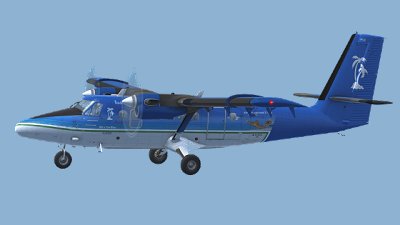
DHC-6 300 Wheels
PJ-FCD 'Will o' the Wisp' Tradewind Domestic Pax
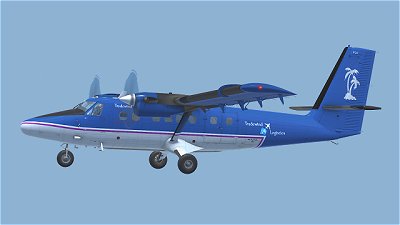
PJ-FCS Tradewind Logistics Cargo
FSX
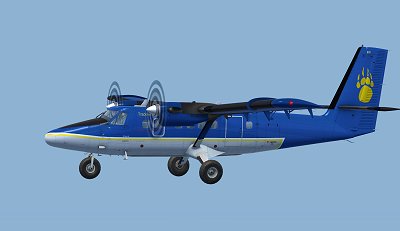
DHC-6 300 Tundra
N631TA 'Atpasuk' Tradewind Alaska Pax
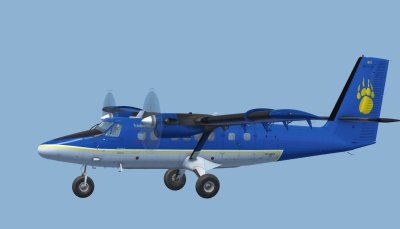
N632TA 'Atmautluak' Tradewind Alaska Cargo
FSX
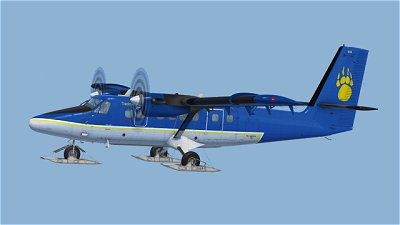
DHC-6 300 Ski Wheel
FSX
N633TA 'Hoonah' Tradewind Alaska Pax
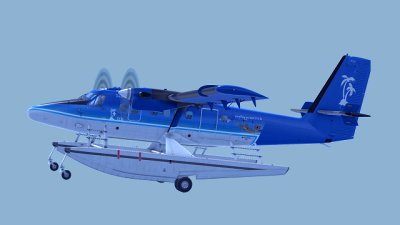
DHC-6 300 Amphibian
PJ-FCU 'Limpkin' Tradewind Seaplanes Pax
FSX
|
DH Twin Otter Extended
~ Aerosoft
for FSX
De Havilland Canada's first purpose designed bush aircraft, the Beaver was that company's most successful program sales wise (both military or civil), with almost 1700 built in a production run lasting two decades.
Beaver development work began in 1946 and the Ontario Department of Lands and Forests had considerable input into the final design and configuration of this rugged and versatile utility. A prototype flew on August 16 1947, with seating for five or six, although the production Beaver grew slightly to seat an extra two passengers by the time civil certification was awarded in March 1948.
The only major development of the Beaver (aside from a one off powered by a 410kW/550hp Alvis Leonides 502/4 radial engine) was the Turbo Beaver. First flown in December 1963 it featured a Pratt & Whitney PT6A6 turboprop, which offered lower empty and higher takeoff weights, and even better STOL performance. The Turbo Beaver's cabin was also longer, allowing maximum accommodation for 11, including the pilot. Externally, the Turbo Beaver had a much longer and reprofiled nose, and squared off vertical tail. DHC also offered conversion kits enabling piston powered Beavers to be upgraded to Turbo standard. Other conversions have been performed.
|
|
Other Essential Files:
The payware Aerosoft package
|
Repaint by JF
|
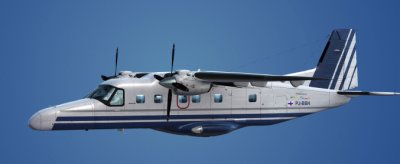
PJ-BBH Tradewind Air Taxis
|
Dornier Do228-100
~ Carenado
for FSX-P3D
In terms of civil sales the 228 series was Dornier's most successful postwar design. The Dornier 228 incorporates the fuselage cross section of the earlier Do 28 and 128 combined with an all new high technology supercritical wing and TPE331 turboprops.
Two fuselage length versions, the 100 and 200, were developed concurrently, the 100 offering better range, the 200 more payload. The 100 was the first to fly taking to the skies for the first time on March 28 1981, the first 200 followed on May 9 that year. The first 228 entered service in August 1982.
Composites were used in a number of secondary structure areas on the 228 including upper wing skins, nose and tail. At one stage Dornier also planned to offer the Pratt & Whitney Canada PT6A as an optional powerplant, but this never eventuated. 228 developments include the 228-101 with reinforced structure and landing gear for higher weights, the corresponding 228-201 version of the 200, the 228-202 version built under licence production in India with HAL to meet that country's Light Transport Aircraft requirement, and the 228-212.
The 212 is the last Dornier (now Fairchild Aerospace) production aircraft, its improvements include higher operating weights, structural strengthening and a lower empty weight, improvements to enhance STOL performance and modern avionics. The last of 238 Dornier built 228s was completed in 1999. HAL licence production continues.
|
|
Other Essential Files:
The payware Carenado package
|
|
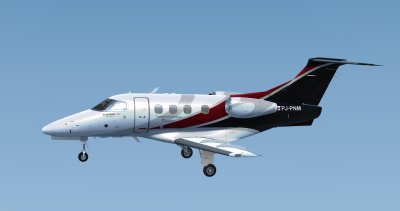
PJ-PNM Tradewind BizJets
|
Embraer Phenom 100 ~ Carenado
It has a capacity for four passengers in its normal configuration, but it can carry up to six passengers with a single crew, with optional side facing seat and belted toilet. It has a maximum flying range of 1,178 nmi (2,182 km) with four occupants and NBAA IFR Reserves. As of 1 January 2009, its price was US$ 3.6 million,[4] with the first aircraft delivered in December 2008.
General characteristics
Performance
|
|
Other Essential Files:
|
Repaint by JF
|
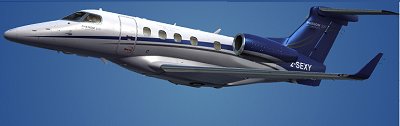
2-SEXY Phenom 300
FSX- P3D
ONLY
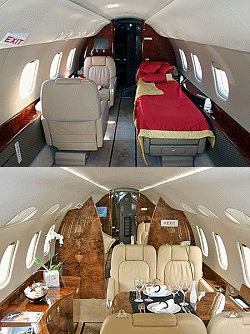
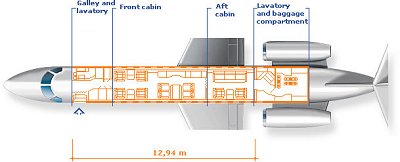
|
Embraer
Phenom 300 ~ Carenado
The
Embraer
Phenom 100 has a capacity for 4 passengers in its normal configuration, but it can carry up to 6-7 passengers with a single crew, optional side facing seat and belted toilet. It has a maximum flying range of 1,178 nautical miles with 4 occupants and NBAA IFR Reserves.
The
Embraer
Phenom 300 is a light jet aircraft can carry 8 or 9 occupants with a flying range of 1,971 nautical miles.
|
|
Other Essential Files:
Payware Carenado Emb505 Phenom 300
|
Repaint by JF
|
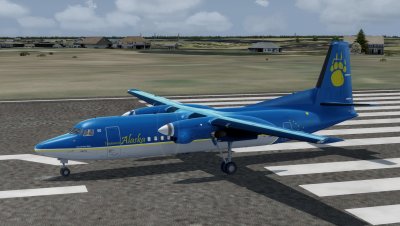
N501TA 'Goodnews Bay' Tradewind Alaska
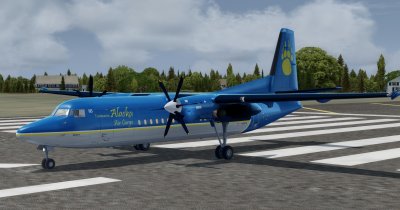
N505TA Tradewind Alaska Air Cargo
FSX/P3D
|
Fokker F50 ~ Carenado
The Fokker 50 is a regional turbo-prop aircraft of which a total of 208 were built until 1997 by the Fokker Aircraft Company. It has been the natural successor of the ubiquitous F-27 Friendship. Most Fokker 50s are currently still in service with close to 30 operators worldwide.
Prevailing market conditions have made Fokker 50 aircraft available at affordable prices or montly lease rentals. Many of these aircraft have previously been operated by European flag carriers and represent exceptional quality and value. The Fokker 50 is a very reliable and mature aircraft with low operating expenses and this, combined with its high payload capability, makes for outstanding economics.
Fokker50 Freighter
The Fokker 50 is available as an effective platform for P2F conversion. Many Fokker50Freighters in operation have already clearly proven to be a reliable and efficient cargo turboprop alternative. The large lefthand forward cargo door (2.34 m x 1.77 m, the same size as the F-27 door, but with a larger clear opening) and cabin flexibility enable cargo of many sizes and weights to be transported. For more information please visit:www.AircraftConversions.com.
|
|
Other Essential Files:
|
Repaint by JF
|
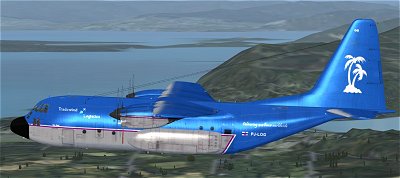
PJ-LOG 'Guaynabo'
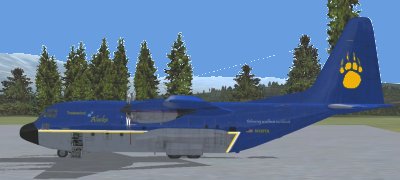
N130TA 'Ingalik'
FSX
|
Lockheed L100
~ Captainsim
for FSX
Lockheed's L-100 freighters are the civil equivalents of the venerable military C-130 Hercules, and have proven to be of great utility, particularly in undeveloped countries.
Lockheed initiated design of the Hercules in response to a 1951 US Air Force requirement for a turboprop powered freighter. This resulted in the C-130 Hercules, which first flew in prototype form on August 23 1954. Design features included the high mounted wing, four Allison 501/T56 turboprops and the rear loading freight ramp. The USAF ordered the C-130 into series production in September 1952, and since that time more than 2500 have been built.
The C-130's appeal to freight operators led Lockheed to develop a civil version. The first commercial versions were based on the C-130E model, and a demilitarised demonstrator first flew in April 1964. This initial civil development, the L-100 (L-382), was awarded civil certification in February 1965. This model was soon followed up by the series L-100 (L-382B), which introduced an improved freight handling system.
Sales of these initial versions were slow, leading Lockheed to develop the 2.54m (8ft 4in) stretched L-100-20 (L-382E), which offered better freight capacity and operating economics. The L-100-20 was certificated in October 1968, but was soon followed by the even longer L-100-30 (L-382G). The -30 was 2.03m (6ft 8in) longer than the -20, first flew in August 1970, and was delivered from December that year. Most civil Hercules sales have been of the L-100-30 variant. Although basically a civil aircraft, several L-100s are in service with military operators, e.g. in Algeria, Gabon and Kuwait. The last L-100 was built in 1992, while the last military Allison 501/T56 powered C-130 was delivered in 1996.
The L-100J would be a commercial derivative of the new generation C-130J Hercules II. Improvements would include new 3425kW (4591shp) Rolls-Royce (Allison) AE-2100D3 advanced turboprop engines driving six blade props, two crew EFIS flightdeck and significantly lower maintenance and operating costs. The C-130J first flew on April 5 1996, while US FAA civil certification was awarded in September 1998. The L-100J would be based on the stretched fuselage C-130J-30, but in 2000 the program was frozen as Lockheed martin focussed on the military variants.
|
|
Other Essential Files:
The payware CS C-130 package
|
Repaint by Francisco Aguiar
|
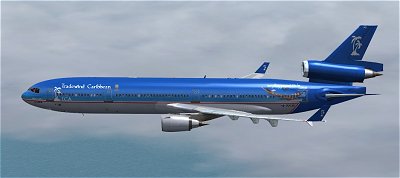
PJ-LAB 'Rainer Labie' - FS9 - FSX
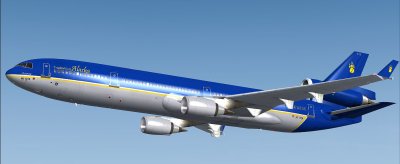
N112TA 'Juneau' - FS9 - FSX
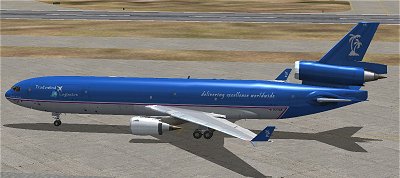
PJ-TAB 'World Trader' - FS9 - FSX
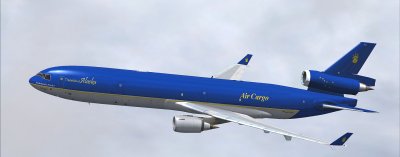
N111TA 'Fairbanks Trader' - FS9 - FSX
|
McDonnell Douglas MD-11 ~ PMDG
The MD-11 is a modernised, slightly stretched and re-engined development of the DC-10 trijet.
Launched on December 30 1986 (following a launch order from British Caledonian for three placed earlier that month), the MD-11 was the result of a two year study to find a replacement for the DC-10. First flight occurred on January 10 1990, certification was granted in November that year, and the first one was delivered on December 7 1990 to Finnair.
Compared to the DC-10, the MD-11 features a 5.71m (18ft 9in) fuselage stretch, winglets, modified tail with less sweepback, an advanced two crew six screen EFIS flightdeck, restyled main cabin interior and new engine options. Variants offered were the longer range MD-11ER available from early 1996, MD-11F freighter, MD-11C Combi and MD-11CF convertible passenger/freighter models.
McDonnell Douglas at various times proposed MD-11 developments aimed at increasing seating through stretches and underfloor panorama deck seating. In 1996 MDC looked closely at the MD-XX, MD-11 variants with a new wing. Two versions were proposed, one with the standard MD-11 fuselage and a 15,565km (8400nm) range, the other a stretched 375 seater. These were not launched.
In November 1997 following the Boeing/McDonnell Douglas merger Boeing announced that the MD-11 would be retained in production, primarily as a freighter. However in June 1998 Boeing reversed that decision, saying that due to a lack of market demand production would be wound up. The last MD-11 built, a MD-11F for Lufthansa cargo, was delivered February 22 2001.
|
|
Other Essential Files:
The payware PMDG
MD-11 packages
|
Repaint by JF
Includes Excel Logbooks by Christian Breuer
|
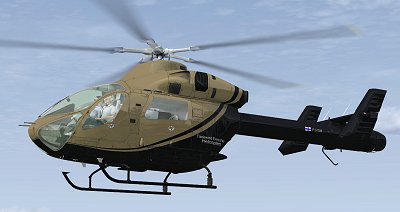
PJ-IOB - Tradewind Executive Helicopters
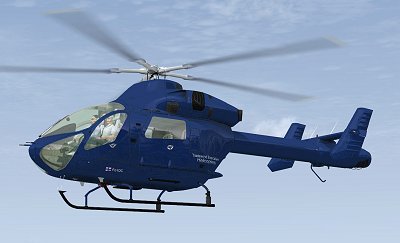
PJ-IOC - Tradewind Executive Helicopters
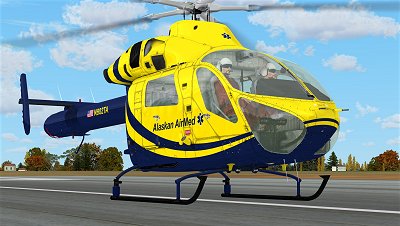
N902TA - Alaskan AirMed op by Tradewind Helicopters
|
Boeing MD Explorer ~ Nemeth
for FSX
Developed by McDonnell Douglas, the Boeing MD Explorer light twin helicopter is the first all new design to incorporate the unique NOTAR (NO TAil Rotor) system.
McDonnell Douglas Helicopters launched the Explorer as the MDX in January 1989. First flight took place on December 18 1992. Full certification for the initial PW206B powered MD 900 version was granted in December 1994.
One of the most advanced helicopters in its market segment, the MD Explorer features Boeing's unique NOTAR anti torque system (described in detail under the MD 520N entry), with benefits including increased safety, far lower noise levels and performance and controllability enhancements.
The design also features an advanced bearingless five blade main rotor with composite blades, plus a carbonfibre fuselage and tail. Initial aircraft are powered by two Pratt & Whitney Canada PW206Bs (the Explorer was the first application for the PW200 series).
The improved Explorer 902 replaced the MD 900 in September 1997. Features of the MD 902 include PW206E engines with higher one engine inoperative ratings, revised engine air inlets, improved NOTAR inlet design and a more powerful stabiliser control system. Benefits include improved range and endurance and an increased max takeoff weight.
On August 31 1998 the 902 configured Explorer became the first helicopter to be validated by Europe's JAA JAR Part 27 Category A guidelines, which requires helicopters be capable of safely continuing flight during takeoff or landing on a single engine.
Like the MD 520N and MD 600N singles the MD Explorer line is for sale. In 1998 US regulatory authorities prohibited a planned sale of all three lines to Bell. Belgian company HeliFly has expressed an interest. |
|
Other Essential Files:
The payware Nemeth Designs package
|
Repaint by JF
|
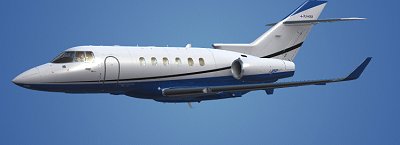
Tradewind BizJetz PJ-HXA
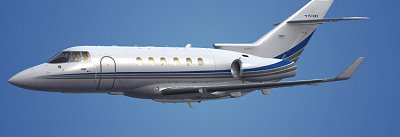
Tradewind BizJetz PJ-HXX
For FSX ONLY
|
Hawker 800XP ~ Carenado
In April 1981, the British Aerospace Board sanctioned the programme to improve the BAe 125-700 series. By May 1983 the new aircraft was ready for its first test flight.The 800 series has a number of modifications and changes over the 700, the most noticeable being the redesigned cockpit windscreen. Accompanying this are a modified rear fuselage fairing, as well as a glass cockpit and uprated (from 3,700 to 4,300 lb) Garrett TFE731-5R-1H engines.
British Aerospace also improved the wing by incorporating new outer wing sections. This helped to reduce drag and improve aerodynamic efficiency.The 800 series would become a sales success. From the first BAe 125 flight in August 1961 it took nineteen years until the 500th airframe was sold. In a little over five years British Aerospace were registering the 200th sale of the 800 series.In 1994 Beech Aircraft (which was also controlled by Raytheon) merged with Raytheon Corporate Jets to form Raytheon Aircraft.
In March 2007, Raytheon Aircraft Company was sold to Hawker Beechcraft Corp., a company formed and controlled by GS Capital Partners and Onex Partners of Canada.The current version is identified as the Hawker 850XP and was certified for operation in March 2006. The 850XP is identical to the 800XP except that it includes winglets, which have extended its operating range by 100 nautical miles (190 km).
This version also incorporates upgraded avionics and a redesigned interior. The Hawker 850XP essentially fills the gap left behind by the Hawker 1000 when production of that aircraft ceased.Two new variants were announced in October 2006 for future deliveries:[1]
- The Hawker 750, in which the ventral fuel tank is replaced by an externally accessed baggage pannier, which reduces range slightly.
- The Hawker 900XP, using new Honeywell TFE731-50BR engines for increased range
After the bankruptcy of Hawker Beechcraft the production of Business Jets ceased
|
|
Other Essential Files:
The payware Carenado aircraft
|
Repaints by JF
|
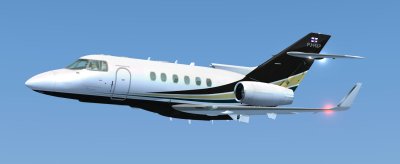
Tradewind BizJetz PJ-HXP
For FSX ONLY
|
Hawker 800XP ~ Just Flight
In April 1981, the British Aerospace Board sanctioned the programme to improve the BAe 125-700 series. By May 1983 the new aircraft was ready for its first test flight.The 800 series has a number of modifications and changes over the 700, the most noticeable being the redesigned cockpit windscreen. Accompanying this are a modified rear fuselage fairing, as well as a glass cockpit and uprated (from 3,700 to 4,300 lb) Garrett TFE731-5R-1H engines.
British Aerospace also improved the wing by incorporating new outer wing sections. This helped to reduce drag and improve aerodynamic efficiency.The 800 series would become a sales success. From the first BAe 125 flight in August 1961 it took nineteen years until the 500th airframe was sold. In a little over five years British Aerospace were registering the 200th sale of the 800 series.In 1994 Beech Aircraft (which was also controlled by Raytheon) merged with Raytheon Corporate Jets to form Raytheon Aircraft.
In March 2007, Raytheon Aircraft Company was sold to Hawker Beechcraft Corp., a company formed and controlled by GS Capital Partners and Onex Partners of Canada.The current version is identified as the Hawker 850XP and was certified for operation in March 2006. The 850XP is identical to the 800XP except that it includes winglets, which have extended its operating range by 100 nautical miles (190 km).
This version also incorporates upgraded avionics and a redesigned interior. The Hawker 850XP essentially fills the gap left behind by the Hawker 1000 when production of that aircraft ceased.Two new variants were announced in October 2006 for future deliveries:[1]
- The Hawker 750, in which the ventral fuel tank is replaced by an externally accessed baggage pannier, which reduces range slightly.
- The Hawker 900XP, using new Honeywell TFE731-50BR engines for increased range
After the bankruptcy of Hawker Beechcraft the production of Business Jets ceased
|
|
Other Essential Files:
The payware Just Flight aircraft
|
Repaints by JF
|
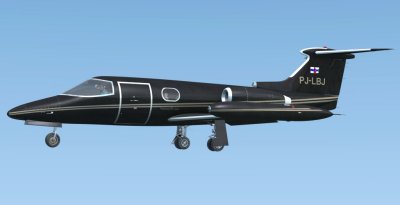
Tradewind BizJetz PJ-LBJ
FSX - P3D
|
Lear Jet 24B ~ Lionheart Creations
One of the world's largest, fastest, best selling and well known series of business jets, the Learjet family began with the original six to eight seat Lear Jet 23 which first flew on October 7 1963.
The 23 originated in Switzerland, where William P. Lear had formed the Swiss-American Aviation Corporation (SAAC) in 1960 to manufacture a twin-jet high-speed executive aircraft, the SAAC-23. This aircraft was designed and conceived by Dr.eng. Hans-Luzius Studer, who previously had developed the FFA P-16 fighter. The aerodynamics and many other characteristics of the 23 were taken over from the P-16. Although it was originally planned to manufacture at least the first 25 Lear Jets in Switzerland, production was transferred to the United States, where Lear had founded Lear Jet Corporation.
The diminutive Model 23 pioneered an entirely new market segment for the light business jets, and proved very successful. The first production 23 was delivered in October 1964, but was replaced by the improved Model 24 in 1966 after 105 had been built. The 24, which introduced uprated engines and a number of detail changes, first flew in February 1966 and was delivered from the middle of that year. Developments of the 24 included the 24D, E and F, introducing improvements such as increased weights, thrusts, and range.
The Learjet 25 introduced a 1.27m (4ft 2in) fuselage stretch allowing seating for up to eight passengers and was first flown on August 12 1966, and, like the 24, a number of subsequent developments were built, including the B, C, and D.
In 1966 the name of the manufacturer changed to Lear Jet Industries, and in January 1970 Gates Rubber Company, who had bought a controlling interest, changed the name again, to Gates Learjet Corporation.
The unsuccessful Gates Learjet 28 and 29 Longhorns are based on the 25 but introduced a new increased span wing fitted with winglets, which improved fuel efficiency and overall performance, particularly payload range and fuel economy. The Longhorn 28 seats up to eight passengers, the similar dimensions Longhorn 29 sacrifices two seats for extra range. Production of the family ceased in 1982.
Learjets are known for their tight accomodation. Max internal cabin width is just 1.50m (4ft 11in), max height 1.32m (4ft 4in).
|
|
Other Essential Files:
The payware Lionheart Creations aircraft
|
Repaints by JF
|
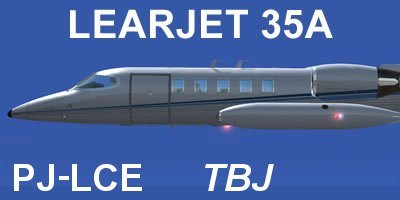
Tradewind BizJetz PJ-LCE
FSX - P3D
|
Lear Jet 35A ~ Flysimware
The Learjet 35 and 36 are stretched, turbofan powered developments of the initial Learjet models, the 23, 24 and 25.
The availability of the Garrett AiResearch TFE731 turbofan in the late 1960s led to a development of the Learjet 25 that was initially known as the 25B-GF (Garrett Fan). A testbed Learjet 25 with a TFE731 on its left side flew in May 1971, while the definitive Learjet 35 prototype first flew on August 22 1973.
Aside from turbofans, the 35 and longer range 36 differ from the earlier Learjet 25 in having a 0.33m (1ft 1in) fuselage stretch and five windows (instead of four) on the right side of the fuselage. The Learjet 35 has seating for up to eight, but has less fuel than the longer range 36, which can only seat up to six, as both types share the same maximum takeoff weight. The 35 and 36 were certificated in July 1974.
Improvements to the two models led to the 35A and 36A from 1976, with higher standard max takeoff weights. Both models remained in production until 1994.
Development of the 35 and 36 range was taken one step further with the Learjet 31, which combines the 35/36's fuselage and powerplants with the more modern wing of the 55 (now also on the 60) and delta fins under the tail. A 31 development aircraft first flew in May 1987 and certification was awarded in August 1988.
The improved 31A and 31A/ER are later production models, the 31A/ER being an extended range variant with a higher maximum takeoff weight and more fuel. A new interior with increased headroom was introduced in 1995. The 200th 31A was delivered in October 2000.
Learjet became a Bombardier subsidiary in 1990. |
|
Other Essential Files:
The payware Lionheart Creations aircraft
|
Repaints by JF
|
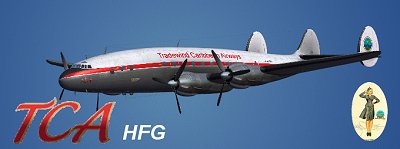
TCA~HFG PJ-ODI 'Curaçao'
FSX - P3D
|
Lockheed L-049 Constellation
Captain of the Ship
~ A2A Simulations
The Lockheed L-049 Constellation was the first model of the Lockheed Constellation aircraft line. It entered service as the C-69 military transport aircraft during World War II for the United States Army Air Forces and was the first civilian version after the war. When production ended in 1946 it was replaced by the improved L-649 and L-749 Constellation. |
|
Other Essential Files:
The payware A2A Simulations aircraft
|
Repaints by JF
|
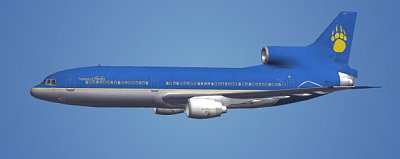
N683TA 'Kongakut River' Tradewind Alaska
Pax
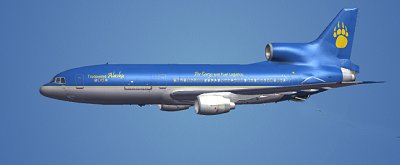
N688TA 'Hoonah' TAC and Fuel Services
(a converted RAF Tanker) for transporting fuel
FSX - P3D
|
Lockheed Tristar 500 Pro ~ Just Flight
The Lockheed TriStar was the second widebody airliner to be launched, and although it was dogged with early financial and development problems, particularly with the engine, it went on to gain an excellent reputation in service for its reliability, economy of operation and low noise emissions.
The L-1011 TriStar was the last Lockheed airliner to be developed and was launched in March 1968 in response to an American Airlines requirement (that also resulted in the DC-10) for a large capacity medium range airliner. Lockheed initially studied a twin engined layout, but it was decided that three engines would be necessary to ensure it could takeoff at max weights from existing runways.
Work on the L-1011 prototype began early in 1969, resulting in a November 16 1970 first flight. The engine choice of Rolls-Royce's advanced three shaft design RB211 however dogged the TriStar's early career. Rolls-Royce went bankrupt in February 1970 largely due to higher than estimated RB211 development costs, severely harming both Lockheed and the TriStar sales program. The problems were able to be resolved after the British government nationalised Rolls-Royce, guaranteeing the supply of production engines. Despite the initial problems the RB211 proved to be extremely reliable and efficient in service and grew into a family of variants.
The first L-1011 model that entered service with Eastern and TWA in April 1972 was the initial domestic L-1011-1 (which was built in greater numbers than any other TriStar variant). Subsequent models to be developed were the -100 with more fuel and higher weights, the -200 with higher thrust engines, and the long range shorter fuselage -500, described separately.
Production ceased in 1983, when 250 had been built. The prototype was sold to be broken up for spares in 1986.
Many aircraft were converted to improved models: the -50 with a higher MTOW and strengthened fuselage, wings, and undercarriage, the -150 with a higher MTOW, the -250 with RB211-524B4 engines (as on the 500) for US carrier Delta, a small number to freighters with a large cargo door as -1(F) and -200(F), and quite a few to -100 and -200.
An ex Air Canada TriStar 100 was converted in 1992 by Marshall of Cambridge (Engineering) Ltd for Orbital Sciences Corporation as the "Stargazer" flying satellite launcher. After launching the Pegasus Air-Launched Space Booster from the TriStar, the Pegasus itself launched a satellite into low Earth orbit.
Another TriStar 100, ex Worldways Canada, was converted in 1995/1996 by Lockheed Aeromod Center to a flying hospital for Operation Blessing International Relief & Development Corporation, a non-profit humanitarian organisation. Apart from the hospital equipment, the aircraft is fitted with systems to be independent from local ground-based equipment.
Approximately 156 TriStars remained in service in 1998, of which 122 were standard fuselage models. In 2000 this number had gone down to about 137, of which 109 standard fuselage models, and at the end of 2002 this had further dropped to 51 active TriStars, of which 23 standard fuselage ones.
|
|
|
Repaints by Jack Ford
|
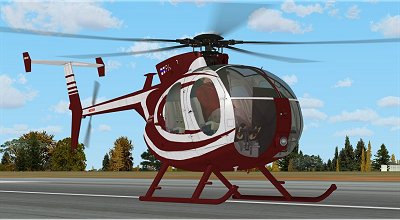
PJ-EOO - Tradewind Executive Helicopters
|
MD-500/530 ~ Nemeth
for FSX
One of the world's most successful and useful light turbine helicopters, the Hughes/McDonnell Douglas/MD Helicopters 500 series began life in response to a US Army requirement for a light observation helicopter.
Hughes won the US Army observation helicopter contest against competition from Bell and Hiller with its Allison 250 powered YOH-6A Cayuse, which first flew in February 1963. By then Hughes was already working on a civil variant, to be marketed as the Hughes 500. However, the engineering and certification designation for all military and civil variants of this helicopter type is Hughes Model 369. It was offered in basic five and seven seat configurations, and a 500U utility version. The 500 and 500U were powered by an Allison 250-C18A engine.
In 1970 the 500C followed with a more powerful 250-C20 turboshaft. From 1976 deliveries were of the 500D, an improved version with again a more powerful engine, the 250-C20B, a T-tail, and new five blade main and optional four blade tail rotors. The 500D was followed by the 500E from 1982 with recontoured nose and various interior improvements including greater head and leg room. The 530F (first delivery January 1984) is a more powerful version optimised for hot and high work.
McDonnell Douglas acquired Hughes Helicopters in January 1984, and in August 1985 the Hughes name disappeared. From then on the 500E and 530F were built as the MD-500E and MD-530F Lifter. After the 1997 merger with Boeing, the line was up for sale. Bell's plans to acquire the Boeing civil helicopter lines were thwarted by the US Federal Trade Commission (FTC) in 1998. Then in January 1999 Boeing announced the sale of the light helicopter lines to MD Helicopters, a newly formed division of Netherlands based RDM Holdings. The sale was finalised in february 1999. In April 2000 MD Helicopters contracted Kaman to build the fuselages for the single engine MDs.
Military variants are marketed under the MD-500 Defender name.
License production was undertaken in Argentina by RACA, in Italy by BredaNardi (later merged with Agusta), in Japan by Kawasaki, and in South Korea by Korean Air. |
|
Other Essential Files:
The payware Nemeth Designs package
|
Repaint by JF
|
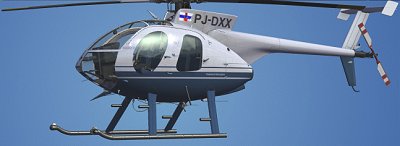
PJ-DXX - Tradewind Executive Helicopters
|
MD530F ~ MilViz
for FSX
One of the world's most successful and useful light turbine helicopters, the Hughes/McDonnell Douglas/MD Helicopters 500 series began life in response to a US Army requirement for a light observation helicopter.
Hughes won the US Army observation helicopter contest against competition from Bell and Hiller with its Allison 250 powered YOH-6A Cayuse, which first flew in February 1963. By then Hughes was already working on a civil variant, to be marketed as the Hughes 500. However, the engineering and certification designation for all military and civil variants of this helicopter type is Hughes Model 369. It was offered in basic five and seven seat configurations, and a 500U utility version. The 500 and 500U were powered by an Allison 250-C18A engine.
In 1970 the 500C followed with a more powerful 250-C20 turboshaft. From 1976 deliveries were of the 500D, an improved version with again a more powerful engine, the 250-C20B, a T-tail, and new five blade main and optional four blade tail rotors. The 500D was followed by the 500E from 1982 with recontoured nose and various interior improvements including greater head and leg room. The 530F (first delivery January 1984) is a more powerful version optimised for hot and high work.
McDonnell Douglas acquired Hughes Helicopters in January 1984, and in August 1985 the Hughes name disappeared. From then on the 500E and 530F were built as the MD-500E and MD-530F Lifter. After the 1997 merger with Boeing, the line was up for sale. Bell's plans to acquire the Boeing civil helicopter lines were thwarted by the US Federal Trade Commission (FTC) in 1998. Then in January 1999 Boeing announced the sale of the light helicopter lines to MD Helicopters, a newly formed division of Netherlands based RDM Holdings. The sale was finalised in february 1999. In April 2000 MD Helicopters contracted Kaman to build the fuselages for the single engine MDs.
Military variants are marketed under the MD-500 Defender name.
License production was undertaken in Argentina by RACA, in Italy by BredaNardi (later merged with Agusta), in Japan by Kawasaki, and in South Korea by Korean Air. |
|
Other Essential Files:
The payware MilViz package
|
Repaint by JF
|
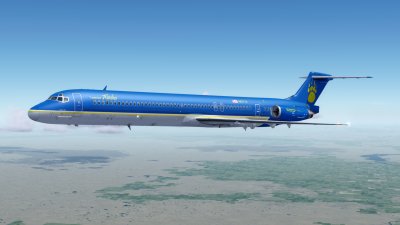
N821TA 'Hooper Bay' Tradewind Alaska
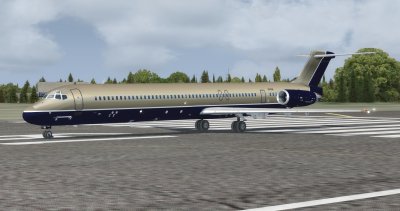
VP-CNI Tradewind BizJetz Grey Flightdeck
|
MD82 ~ FlyTheMadDogX
for FSX/P3D
The McDonnell Douglas MD-80 is a series of twin-engine, short- to medium-range, single-aisle commercial jet airliners. It was lengthened and updated from the DC-9. This series can seat from 130 to 172 passengers depending on variant and seating configuration.
The MD-80 series was introduced into commercial service on October 10, 1980 by Swissair. The series includes the MD-81, MD-82, MD-83, MD-87, and MD-88. These all have the same fuselage length except the shortened MD-87. The series was followed into service in modified form by the MD-90 in 1995 and the Boeing 717 (originally MD-95) in 1999. |
|
Other Essential Files:
The payware FlyTheMaddogX package
|
Repaint by JF
|
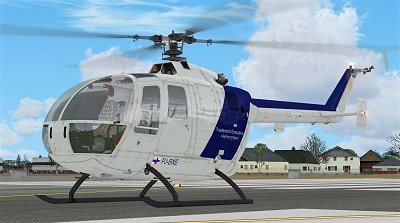
PJ-BXE - Tradewind Executive Helicopters
|
Messerschmitt-Bolkow-Blohm BO-105 ~ Nemeth
for FSX
In widespread military and civilian service, the BO 105 is MBB's (now part of Eurocopter) most successful helicopter design.
Construction of the first of three prototypes began in 1964, the first of which made the type's first flight on February 16 1967. This aircraft was powered by 236kW (317shp) Allison 250C18 turboshafts and featured a conventional main rotor hub, but the subsequent prototypes incorporated a new rigid hub with feathering hinges, plus composite blades and MANTurbo 6022 engines. The BO 105 reverted back to Allison 250 power with the second of two preproduction aircraft, flying in this form in January 1971.
Initial production was of the BO 105C which was available from 1970. The Allison 250C20 powerplant became standard from 1973. The BO 105 CB was introduced in 1975, and became the standard production model. It introduced uprated engines and a strengthened transmission. The BO 105 is now built in BO 105 CBS form with a slight 25cm (10in) fuselage stretch and extra window, allowing an extra passenger to be carried.
The BO 105 D has IFR instrumentation and was developed for the British offshore oil rig support market. The BO 105 L has more powerful engines and higher takeoff weight. The BO 105 LSA-3 is a hot and high version with Allison 250C28C engines and built exclusively in Canada by Eurocopter Canada. The BO 105 LSA-3 Super Lifter has been developed for aerial crane work and has a 2850kg (6283lb) max takeoff weight.
The EC Super Five is a high performance development of the BO 105 CBS with new main rotor blades. It was certificated in late 1993. |
|
Other Essential Files:
The payware Nemeth Designs package
|
Repaint by JF
|
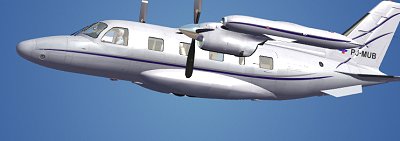
Tradewind BizJetz PJ-MUB
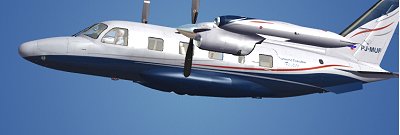
Tradewind BizJetz PJ-MUF
For FSX/P3D
|
Mitsubishi MU 2B 60 ~ Flysimware
The MU-2 was one of postwar Japan's most successful commercial aircraft types.
Development of the MU-2, Mitsubishi's first indigenous postwar design, began in the late 1950s. Designed as a light twin turboprop transport suitable for a variety of civil and military roles, the MU-2 first flew on September 14 1963. This first MU-2 and the handful of MU-2As built were powered by Turboméca Astazou turboprops, all other models from the MU-2B onwards had Garrett TPE331s.
The MU-2 lineup can be divided up into two basic types, the standard fuselage and stretched fuselage models. The MU-2B, E, F, K, M, P and Solitaire feature the short fuselage, the others, including the Marquise, the stretched fuselage. The first stretched fuselage MU-2G flew on January 10 1969.
The MU-2 was progressively improved and upgraded throughout its production life. Notable changes include improved and more powerful TPE331 engines, and four blade propellers from the N and P models.
Mitsubishi established a production facility for MU-2s in San Angelo, Texas in the USA in 1967 to build MU-2s for the North American and world markets. The San Angelo Mitsubishi International facility became the sole source of MU-2 production until 1986 when the line finally closed.
Mitsubishi certificated all the civil TPE331 powered MU-2s as variants of the MU-2B and they were thus given the MU-2B type number followed by a number. However, these MU-2s were also given a separate marketing designation with a sequential suffix letter. The MU-2B-10 is e.g. the MU-2D, and the MU-2B-36A is the MU-2N.
Four MU-2Cs and 16 MU-2Ks were delivered to the Japanese Army as LR-1s for the liaison and photo reconnaissance role, while 29 MU-2Es were delivered two the Japanese Air Force as search-and-rescue MU-2Ss, equipped with an extended "thimble" nose radome, increased fuel capacity, bulged observation windows, and a sliding entry door for dropping rafts.
In 2000 over 500 MU-2s were in use as corporate transports (mainly in the USA), while many have been converted as freighters.
|
|
Other Essential Files:
The payware Flysimware aircraft
|
Repaints by JF
|
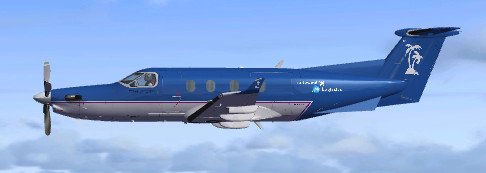
TL PJ-FTK
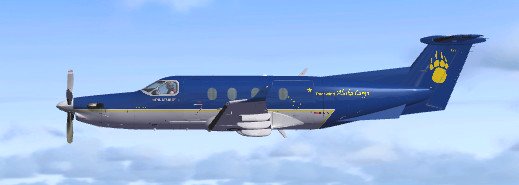
TA Cargo N129TA 'Chickaloon'
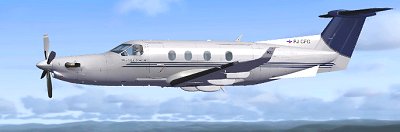
TBJ PJ-CEO
TBJ PJ-XEC
|
Pilatus PC12 ~ Flight1
For FSX
The PC-12 is a King Air class and size turboprop aimed at corporate transport and regional airliner operators. It is the latest in a line of single engined PT6 powered Pilatus products.
Pilatus announced it was developing the PC-12 at the National Business Aircraft Association's annual convention in October 1989. First flight of the first of two prototypes occurred on May 31 1991. Certification was originally planned for mid 1993 but a redesign of the wings with the addition of winglets to ensure performance guarantees were met pushed this back, with Swiss certification awarded on March 30 1994 and US FAA FAR Part 23 approval following on July 15 1994.
Compared to the King Air 200 twin, its major competitor, the PC-12's most significant design feature is its use of a single PT6A-67B turboshaft. Internally the PC-12's cabin is also longer (by 6cm/2.4in) and wider (by 15cm/6in) than the King Air 200's, and the same height. The cockpit features EFIS displays and the PC-12 is certificated for single pilot operation while each PC-12 built features a standard cargo door in the rear fuselage. Weather radar is an option but has been fitted to all production aircraft thus far. From 1997 the increased 4.5 tonne MTOW has been standard. New, smaller winglets were introduced in 1998.
The PC-12 is offered in standard nine seat airliner form, in a four passenger seat/freight combi version and as a six place corporate transport. A pure freighter model is under consideration. The PC-12 Eagle is a military special missions platform.
Most PC-12s built thus far have been corporate transports but recent important regulatory changes in Australia, Brazil, Canada and the USA have cleared single engine turboprops for IFR RPT operations in those nations. This has opened up new potential markets for the PC12 as a regional airliner, replacing older King Airs and elderly piston twins such as the Navajo Chieftain and Cessna 400 series.
|
|
Other Essential Files:
The payware Flight1 package
|
Repaints by JF
|
Tradewind Flying Club PJ-COM
For FSX/P3D
|
Piper PA-24-250 Comanche ~ A2A
Piper's PA-24 Comanche was a high performance retractable undercarriage single designed to challenge the established high performance Beech Bonanza.
Piper's first low wing single engine design, the Comanche featured a retractable tricycle undercarriage, swept back tail, flying tail or "stabilator" horizontal tail surfaces, laminar flow wing and all metal construction, a stark contrast to Piper's earlier high wing fabric covered designs. The Comanche first flew on May 24 1956 and was delivered to customers from late 1957 in PA-24-180 form.
Since then through to the cessation of production in June 1972 (due to flooding of Piper's Lock Haven plant), a number of progressively higher performance variants were released. These included 1958's 185kW (250hp) PA-24-250 and the 300kW (400hp) PA-24-400.
Just 148 400s were built, despite Piper claiming it to be the fastest production four seat single available at the time. Its massive eight cylinder IO-720 engine consumed fuel at a prodigious rate, meaning that it was expensive to operate, and there were problems with cooling the rear cylinders. Today however it has something of a mini cult status.
Following the PA-24-400 was the PA-24-260 from 1964, with a 195kW (260hp) O-540 or IO-540, and finally the Rajay turbocharger fitted PA-24-260 Turbo C, available from 1970.
|
|
Other Essential Files:
The payware A2A
|
Repaints by JF
|
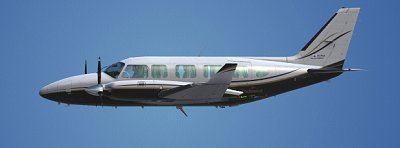
Tradewind Air Taxis PJ-PCA
For FSX/P3D
|
Piper PA-31 Navajo Chieftain ~ Alabeo
The PA-31P-350 Mojave was the last pressurised version of the PA-31 series to be built, while the PA-31-350 Chieftain was a stretched Navajo, built on the smaller Navajo's success in the commuter and charter roles, while the T-120 and T-1040 were airliner developments.
The stretched Navajo Chieftain first appeared in 1973, after Piper began design work in 1971 (delays were caused by the destruction of the second prototype and early production aircraft due to flooding at Piper's Lock Haven plant in June 1972). Originally dubbed the Navajo II, the Navajo Chieftain was intended to compete against the Cessna 402 and to a lesser extent the turboprop powered Beech 99. Changes over the basic Navajo were many, including a 61cm (2ft) fuselage stretch, six side cabin windows, larger doors (an extra crew door was optional), and more powerful and counter rotating 260kW (350hp) TIO-540 engines. From the 1980 model year the PA-31-350 became known simply as the Chieftain, and the type remained in production until October 1984.
Small numbers were also built of the airline optimised T-1020 (based on the Chieftain but "hardened" for airline operations) and the Pratt & Whitney Canada PT6A powered T-1040 (PA-31T3).
The Mojave was a development of the PA-31P, and its airframe was essentially similar to the turboprop powered PA-31T Cheyenne I's. Changes included less powerful 260kW (350hp) counter rotating IO-540-V2As, a lower cabin pressure differential and longer span wings. Mojaves were built between 1983 and 1986.
|
|
Other Essential Files:
The payware Alabeo
|
Repaints by JF
|

Tradewind BizJetz PJ-CEM
For FSX/P3D
|
Piper PA31T Cheyenne II ~ Carenado
|
The Piper Cheyenne family of turboprop corporate aircraft is based on the popular Navajo and Chieftain piston twins. Although the first Cheyenne was not delivered until mid 1974, work on a turboprop version of the Pressurized Navajo dates back almost a decade earlier to the mid 1960s. The prototype of the Cheyenne flew for the first time on August 29 1969, but Piper had to redesign the flight controls to handle the increased loads on the airframe due to the higher speeds. Production deliveries were further delayed due to flooding at Piper's Lock Haven plant in June 1972. Certification had been granted on May 3 1972, while the first production aircraft (powered by 462kW/620shp PT6A-28s) first flew on October 22 1973. Piper introduced the lower powered (373kW/500shp PT6A-11s) and less expensive Cheyenne I in 1978, and renamed the original Cheyenne the Cheyenne II. Refinements to the Cheyenne I made in 1983, including more power at altitude, revised cowlings and interior, resulted in the Cheyenne IA. Meanwhile the stretched Cheyenne IIXL had been introduced in 1979. Compared with the standard length Cheyennes, the IIXL was 61cm (2ft) longer, featured an extra cabin window on the left side, 180kg (400lb) increased max takeoff weight and 560kW (750shp) PT6A-135s. An improved IIXLa was planned, but did not enter production. The further stretched and T-tail PA-42 Cheyenne III was also introduced in 1978, and is described separately.
|
|
Other Essential Files:
The payware Carenado
|
Repaints by JF
|
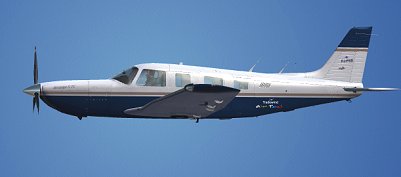
Tradewind Air Taxis PJ-PSB
For FSX/P3D
|
Piper PA-32 SARATOGA II TC ~ Alabeo
The PA-32 series began life as the Cherokee Six, a significantly modified six seat development of the PA-28 Cherokee series.
While similar in configuration to the Cherokee, the Cherokee Six differed in a number of major areas. Two of the big differences were implied in its name, a six cylinder O-540 or IO-540 powerplant, and the six seat configuration. While the wing was based on the Cherokee's, the fuselage was substantially larger, with strengthened undercarriage and a larger tail.
The Cherokee Six first flew on December 6 1963, while deliveries of production PA-32-260s began from mid 1965. Development led to a range of improved models, starting with the 225kW (300hp) fuel injected IO-540 powered Cherokee Six 300 (PA-32-300). Production of the 260 and 300 ended in the late 1970s, but in the meantime they had been joined by the PA-32R Cherokee Lance. The Cherokee Lance, or just Lance from mid 1977 with the introduction of the improved Lance II, was a retractable undercarriage development. The Lance II and turbocharged PA-32R-300T Turbo Lance also introduced a T-tail as the PA-32RT and remained in production to late 1979.
The Lance II and Cherokee Six were replaced by the Saratoga. Available in fixed or retractable undercarriage form, with standard or turbocharged powerplants, the major change was the new increased span tapered wing.
Production of the Saratoga ceased in 1985, but New Piper reintroduced the Saratoga II HP in 1993 with aerodynamic improvements and a revised instrument panel and interior. The turbocharged Saratoga II TC was introduced in 1997. 1999 models introduce new Garmin and S-TEC avionics. A five seat interior with a entertainment/workstation console (similar to that in the Seneca V) is optional.
The PA-32 was also built under licence in Brazil as the Embraer EMB-720 Minuano, and the PA-32R as the EMB-721 Sertanejo, while Chincul in Argentina built the PA-32 as PA-A-32, the PA-32R as PA-A-32R, and the PA-32RT as the PA-A-32RT.
Production of the Saratoga ceased in 1985, but Piper reintroduced the Saratoga II HP in 1993 with aerodynamic improvements and a revised instrument panel and interior. The turbocharged Saratoga II TC was introduced in 1997. The 1999 models introduced new Garmin and S-TEC avionics. A five seat interior with an entertainment/workstation console (similar to that in the Seneca V) is optional.
|
|
Other Essential Files:
The payware Alabeo
|
Repaints by JF
|
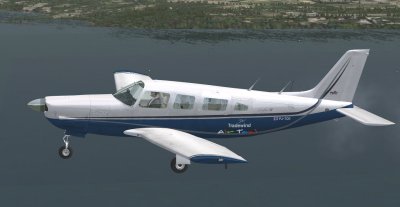
Tradewind Air Taxis PJ-TOG
For FSX ONLY
|
Piper PA-32R SARATOGA ~ Carenado
The PA-32 series began life as the Cherokee Six, a significantly modified six seat development of the PA-28 Cherokee series.
While similar in configuration to the Cherokee, the Cherokee Six differed in a number of major areas. Two of the big differences were implied in its name, a six cylinder O-540 or IO-540 powerplant, and the six seat configuration. While the wing was based on the Cherokee's, the fuselage was substantially larger, with strengthened undercarriage and a larger tail.
The Cherokee Six first flew on December 6 1963, while deliveries of production PA-32-260s began from mid 1965. Development led to a range of improved models, starting with the 225kW (300hp) fuel injected IO-540 powered Cherokee Six 300 (PA-32-300). Production of the 260 and 300 ended in the late 1970s, but in the meantime they had been joined by the PA-32R Cherokee Lance. The Cherokee Lance, or just Lance from mid 1977 with the introduction of the improved Lance II, was a retractable undercarriage development. The Lance II and turbocharged PA-32R-300T Turbo Lance also introduced a T-tail as the PA-32RT and remained in production to late 1979.
The Lance II and Cherokee Six were replaced by the Saratoga. Available in fixed or retractable undercarriage form, with standard or turbocharged powerplants, the major change was the new increased span tapered wing.
Production of the Saratoga ceased in 1985, but New Piper reintroduced the Saratoga II HP in 1993 with aerodynamic improvements and a revised instrument panel and interior. The turbocharged Saratoga II TC was introduced in 1997. 1999 models introduce new Garmin and S-TEC avionics. A five seat interior with a entertainment/workstation console (similar to that in the Seneca V) is optional.
The PA-32 was also built under licence in Brazil as the Embraer EMB-720 Minuano, and the PA-32R as the EMB-721 Sertanejo, while Chincul in Argentina built the PA-32 as PA-A-32, the PA-32R as PA-A-32R, and the PA-32RT as the PA-A-32RT.
Production of the Saratoga ceased in 1985, but Piper reintroduced the Saratoga II HP in 1993 with aerodynamic improvements and a revised instrument panel and interior. The turbocharged Saratoga II TC was introduced in 1997. The 1999 models introduced new Garmin and S-TEC avionics. A five seat interior with an entertainment/workstation console (similar to that in the Seneca V) is optional.
|
|
Other Essential Files:
The payware Carenado
|
Repaints by JF
|
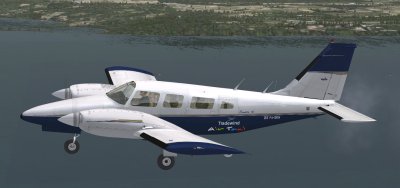
Tradewind Air Taxis PJ-SEN
For FSX ONLY
|
Piper PA-34 Seneca II ~ Carenado
The most successful six place light twin since its introduction, the Seneca is a twin engine development of the Cherokee Six.
Seneca development began when Piper flew a converted trimotor Cherokee Six, designated PA-32-3M, fitted with two additional 85kW (115hp) Lycomings O-235 on either wing. The subsequent twin engine prototype PA-34-180 Twin 6 first flew with two 135kW (180hp) Lycomings, while the definitive standard third Seneca prototype, the PA-34-200 Twin 6, first flew in October 1969 with fuel injected 150kW (200hp) IO-360s. Production deliveries of the initial PA-34-200 Seneca began in late 1971.
Handling and performance criticisms were addressed from the 1974 model year with the PA-34-200T Seneca II which introduced changes to the flight controls and, more importantly, two turbocharged Continental TSIO-360-Es. Piper originally planned that the follow-on PA-34-220T Seneca III would feature a T-tail, but these plans were dropped and the main changes introduced were counter rotating 165kW (220hp) TSIO-360s and a revised interior and instrument panel. Introduced in 1981, the Seneca III was replaced by New Piper's improved PA-34-220T Seneca IV in 1994 with aerodynamic refinements, axisymetric engine inlets and a revised interior.
The current PA-34-220T Seneca V was introduced in January 1997. It features intercooled turbocharged L/TSIO-360-RB engines which maintain rated power to 19,500ft, and seating for five, with a standard entertainment/executive workstation with extendable worktable and optional phone/fax. A sixth seat in place of the workstation is optional.
The Seneca was also built or assembled by other manufacturers, AICSA in Colombia, Chincul in Argentina (as the PA-A-34), Embraer in Brazil (as the EMB-810), and PZL-Mielec in Poland (as the M-20 Mewa, partly with PZL/Franklin engines).
Conversions are made by Seguin as the Princess, and by Robertson as the Super Seneca I and II.
|
|
Other Essential Files:
The payware Carenado
|
Repaints by JF
|
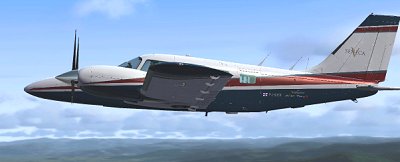
Tradewind Air Taxis PJ-SEX
For FSX/P3D ONLY
|
Piper PA-34 Seneca V HD ~ Carenado
The most successful six place light twin since its introduction, the Seneca is a twin engine development of the Cherokee Six.
Seneca development began when Piper flew a converted trimotor Cherokee Six, designated PA-32-3M, fitted with two additional 85kW (115hp) Lycomings O-235 on either wing. The subsequent twin engine prototype PA-34-180 Twin 6 first flew with two 135kW (180hp) Lycomings, while the definitive standard third Seneca prototype, the PA-34-200 Twin 6, first flew in October 1969 with fuel injected 150kW (200hp) IO-360s. Production deliveries of the initial PA-34-200 Seneca began in late 1971.
Handling and performance criticisms were addressed from the 1974 model year with the PA-34-200T Seneca II which introduced changes to the flight controls and, more importantly, two turbocharged Continental TSIO-360-Es. Piper originally planned that the follow-on PA-34-220T Seneca III would feature a T-tail, but these plans were dropped and the main changes introduced were counter rotating 165kW (220hp) TSIO-360s and a revised interior and instrument panel. Introduced in 1981, the Seneca III was replaced by New Piper's improved PA-34-220T Seneca IV in 1994 with aerodynamic refinements, axisymetric engine inlets and a revised interior.
The current PA-34-220T Seneca V was introduced in January 1997. It features intercooled turbocharged L/TSIO-360-RB engines which maintain rated power to 19,500ft, and seating for five, with a standard entertainment/executive workstation with extendable worktable and optional phone/fax. A sixth seat in place of the workstation is optional.
The Seneca was also built or assembled by other manufacturers, AICSA in Colombia, Chincul in Argentina (as the PA-A-34), Embraer in Brazil (as the EMB-810), and PZL-Mielec in Poland (as the M-20 Mewa, partly with PZL/Franklin engines).
Conversions are made by Seguin as the Princess, and by Robertson as the Super Seneca I and II.
|
|
Other Essential Files:
The payware Carenado
|
Repaints by JF
|
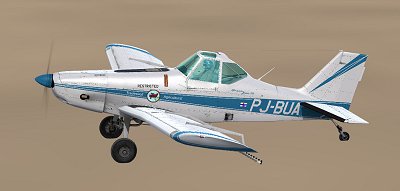
Tradewind Agricultural PJ-BUA
For FSX ONLY
|
Piper PA36_Pawnee ~ Alabeo
The PA-36 Pawnee Brave was designed in the late 60s at the company's Vero Beach facility as a larger aircraft than Piper's first purpose-designed agricultural aircraft, the PA-25 Pawnee, although of the same overall configuration.
The result of Piper research on PA-25 Pawnee operations, the first PA-36 prototype, the PA-36-260 Pawnee II, was powered by a 195kW (260hp) Lycoming O-540-E engine, and made the first flight on November 17, 1969. The Lycoming engine was later in the development program replaced by a 210kw (285hp) Continental Tiara 6-285 engine, and the aircraft became the PA-36-285. A second prototype had the same engine, and Piper decided to use this engine for the series production.
The PA-36 has a welded chrome-molybdenum steel tube fuselage structure with metal underskins and plastics side panels, and a sturdy overturn pylon is part of the structure. The wings have a conventional two-spar structure, with light alloy laminated spars, and light alloy covering, except for glassfibre leading-edges and wingtips. A hopper with a capacity of 30 or 38 cu.ft is in front of the pilot.
In mid 1972 the PA-36-285 received FAA approval, and in 1973 production got under way, while at the same time the name was changed from Pawnee II to Pawnee Brave.
As the Continental Tiara engine was quite problematic, Piper certificated a 225kW (300hp) Lycoming IO-540 powered version, the PA-36-300, which replaced the Tiara engined version on the production line from the 1977 model year. From the 1978 model year, the name Pawnee Brave was changed to Brave 300.
A more powerful version was available from 1978, powered by a 280kW (375hp) Lycoming IO-720 in a restyled cowling, as the Brave 375, and from 1982 the 300kW (400hp) IO-720 powered Brave 400 followed.
Pawnee Brave production ceased in January 1983
|
|
Other Essential Files:
|
Repaints by JF
|
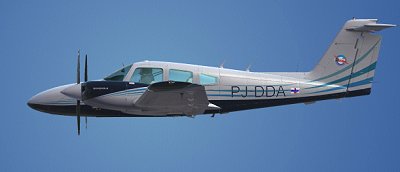
Tradewind Flying Club PJ-DDA
For FSX/P3D ONLY
|
Piper PA44 Seminole ~ Alabeo
The PA-44 Seminole was developed during the heyday of the GA industry in the mid to late 1970s but fell victim to the depressed market from the early 1980s plus the growing reliability and popularity of high performance big singles.
As a result it has been built in only fairly modest numbers. A contemporary of the Gulfstream GA-7 Cougar and Beechcraft 76 Duchess, the Seminole was conceived in part as a PA-30 Twin Comanche replacement, aimed at the self flying businessperson, plus the twin engine training market.
Developed from the mid 1970s, the Seminole is a twin engined development of the PA-28R Arrow series, with the Arrow's single engine replaced by two counter rotating 135kW (180hp) Lycoming O-360s, plus a new T-tail and semi tapered wings. The first flight of the prototype was made during May 1976, and production machines, designated PA-44-180, were delivered from May 1978.
The turbocharged PA-44-180T was introduced from 1980. Aside from turbocharged TO-360s, the Turbo Seminole introduced prop de-icing and an oxygen system. Just 86 PA-44-180Ts were built when Piper ceased production for the first time in late 1981.
Piper reopened the Seminole line in 1988, with 30 non turbocharged PA-44s built before Piper once more suspending production in 1990, due to its parlous financial position at the time. Once again the PA-44-180 Seminole is back in production, with manufacture restarting in 1995, although sales have been relatively modest.
Piper currently offers two avionics packages for the Seminole, a standard fit and an Advanced Training Group package. Interestingly the PA-44 is the only T-tail Piper currently in production, even though in the late 1970s most Piper aircraft had been modified to feature a T-tail.
|
|
Other Essential Files:
|
Repaints by JF
|
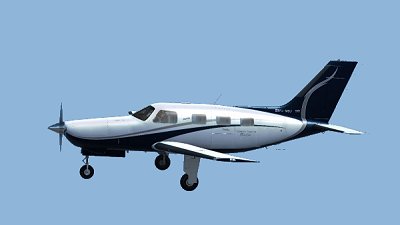
Tradewind BizJetz PJ-MBU
For FSX ONLY
|
Piper PA46_Malibu ~ Carenado
According to Piper the all new PA-46 Malibu was the first pressurised cabin class piston single. It promised to be one of the first of a new generation of light aircraft introduced from the early 1980s before recession and oppressive liability laws in the USA strangled the GA industry. Nevertheless, the PA-46 has sold relatively strongly.
Announced in November 1982, the Malibu was intended to compete against Cessna's pressurised P210 Centurion, plus older light business twins. Designed with the aid of CAD/CAM (Computer Aided Design/Computer Aided Manufacture), an unpressurized experimental prototype, the PA-46-300T, flew for the first time on November 30, 1979. The prototype for the first production model, the pressurized PA-46-310P, first flew in August 1982. Certification was awarded in September 1983, with production deliveries from that November.
Features of the first production model PA-46-310P included the specially developed turbocharged 230kW (310hp) Continental TSIO-520, a high aspect ratio wing, a relatively roomy cabin with club seating for four behind the pilot, a rear airstair style door, IFR avionics as standard, and cabin pressurisation.
The improved PA-46-350P Malibu Mirage, first flight December 21, 1987, replaced the 310P Malibu in production from October 1988. The major change introduced on the Malibu Mirage was the 260kW (350hp) Textron Lycoming TIO-540-AE2A, while other changes included a new electrical system and revised interior.
Since 1994 New Piper has made a number of minor improvements to the Malibu Mirage including to the brakes, autopilot and air-conditioning. In 1999 the Mirages gained the strengthened wing of the turboprop Malibu Meridian development, allowing an 18kg (40lb) increase in max takeoff weight. The Mirage is also offered with conventional and EFIS avionics packages. Production ceased temporarily in 2001 to allow Piper to concentrate on introducing the Meridian to production, but was later resumed. Production is continuing alongside the turboprop PA-46-500TP Malibu Meridian
|
|
Other Essential Files:
|
Repaints by JF
|
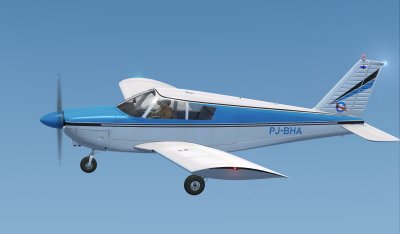
Tradewind Flying Club PJ-BHA
For FSX ONLY
|
Piper PA-28 Cherokee ~ A2A
The initial PA-28-150 and PA-28-160 Cherokees were introduced in 1961 as replacements for Piper's PA-22 TriPacer and Colt.
Unlike the PA-22 series the new PA-28 was a low wing design with metal construction. The prototype Cherokee was powered by a 120kW (160hp) engine, and flew for the first time on January 14 1960. Production aircraft were powered by either 110kW (150hp) or 120kW (160hp) engines and were delivered from early 1961.
From 1962 a 135kW (180hp) version was added to the lineup. The 127kW (235hp) flat six Lycoming O-540 powered Cherokee 235 was introduced in 1963, while the two seat trainer optimised Colt replacement PA-28-140 entered the marketplace in 1964. With these models the basic PA-28 lineup was in place (the retractable PA-28R and larger PA-32 are described separately).
Subsequent variants include the Cherokee B and Cherokee C, the 180D, 235C, 140 Flite Liner two seat trainer PA-28-140, -180F, -235E, PA-28-180 Cherokee Challenger and PA-28-235 Cherokee Charger, the PA-28-180 Cherokee Archer and PA-28-235 Cherokee Pathfinder, PA-28-151 Cherokee Warrior which introduced the new tapered wing that would become a feature of subsequent PA-28s, PA-28-181 Cherokee Archer II and PA-28-236 Dakota (the Cherokee prefix was later dropped for the Archer II and Warrior), the PA-28-161 Warrior II, PA-28-201T Turbo Dakota and PA-28-161 Cadet.
Small numbers of Warriors, Dakotas and Archers were built in the early 1990s. The PA-28-181 Archer III, which features a new, streamlined cowling, was introduced in 1994. The 1999 models gained new paint, improved interior and a new avionics package. The PA-28-161 Warrior III features a new instrument panel and was introduced in late 1994. Since 1995 Piper has had new owners, and the brand has enjoyed a strong resurgence.
|
|
Other Essential Files:
|
Repaints by JF
|

Tradewind Flying Club PJ-AZT
For FSX/P3D ONLY
|
Piper PA23 AZTEC F 250 ~ Alabeo
The origins of the PA-23 Apache (one of the first widely available GA twins and Piper's first "Indian") and the larger and more powerful Aztec lie in the early postwar Twin Stinson design.
Piper acquired the assets of Consolidated Vultee's Stinson Aircraft division in 1948, and inherited a design study for a modern four place light twin. Piper left the design dormant for a few years until 1952 when it built a prototype aircraft, cn 23-01, based on the Stinson design. The low wing four seat twin was powered by 93kW (125hp) Lycoming O-290-D engines, had fabric covering, fixed undercarriage and a twin fin tail design.
Unsatisfactory flight trials led Piper to substantially redesign cn 23-01, introducing first more powerful 100kW (135hp) engines, then increasing power to (110kW) 150hp, metal construction, retractable undercarriage and a conventional tail unit. The redesigned twin flew for the first time on March 2 1952. Production deliveries began in March 1954.
The first variant was the PA-23-150 with some detail changes in subsequent model years before production switched to the more powerful PA-23-160 in late 1958. The Apache G and H introduced a third cabin window. A subsequent Apache development was the PA-23-235 Apache 235, a lower powered development of the PA-23-250 Aztec, introduced in 1962.
The Aztec is an enlarged and more powerful development of the Apache powered by two six cylinder 185kW (250hp) O-540s, and Aztecs were first delivered from early 1960. The Aztec B introduced a longer nose and seating for six, the Aztec C fuel injected engines, the optional Turbo Aztec C was turbocharged, while the Aztec D, E and F and corresponding turbo models introduced detail changes.
A military version for the US Navy was the UO-1, later renamed the U-11A. Except for radio, oxygen and propeller anti-icing equipment, this model was similar to the civil Aztec. Twenty were delivered in 1960. Some other air forces used Aztecs in small numbers.
A special version for the UK market with a gross weight of 2265kg (4995lb) instead of 2360kg (5200lb) was the PA-E23-250.
Production of the Aztec ceased in 1982.
Several Apache conversions with higher-powered engines, extended nose cone, fully enclosed wheel doors, square tipped rudder, etc were available as the Seguin Geronimo, the Miller Jet Profile and the Wilson Jet Profile. Some aircraft were only partly modified.
A floatplane modification of Aztecs adding also an additional door is offered by Melridge Aviation and Jobmaster Company as the Aztec Nomad.
|
|
Other Essential Files:
Payware Piper PA23 AZTEC F 250 ~ Alabeo
|
Repaints by JF
|
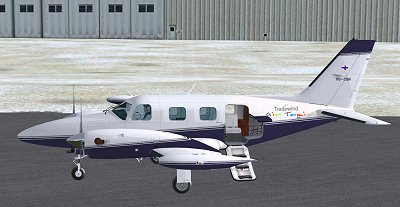
Tradewind Air Taxis PJ-CEN
For FSX ONLY
|
Piper Cheyenne I ~ Digital Aviation
The Piper Cheyenne family of turboprop corporate aircraft is based on the popular Navajo and Chieftain piston twins.
Although the first Cheyenne was not delivered until mid 1974, work on a turboprop version of the Pressurized Navajo dates back almost a decade earlier to the mid 1960s. The prototype of the Cheyenne flew for the first time on August 29 1969, but Piper had to redesign the flight controls to handle the increased loads on the airframe due to the higher speeds. Production deliveries were further delayed due to flooding at Piper's Lock Haven plant in June 1972.
Certification had been granted on May 3 1972, while the first production aircraft (powered by 462kW/620shp PT6A-28s) first flew on October 22 1973.
Piper introduced the lower powered (373kW/500shp PT6A-11s) and less expensive Cheyenne I in 1978, and renamed the original Cheyenne the Cheyenne II. Refinements to the Cheyenne I made in 1983, including more power at altitude, revised cowlings and interior, resulted in the Cheyenne IA.
Meanwhile the stretched Cheyenne IIXL had been introduced in 1979. Compared with the standard length Cheyennes, the IIXL was 61cm (2ft) longer, featured an extra cabin window on the left side, 180kg (400lb) increased max takeoff weight and 560kW (750shp) PT6A-135s. An improved IIXLa was planned, but did not enter production.
The further stretched and T-tail PA-42 Cheyenne III was also introduced in 1978, and is described separately.
|
|
Other Essential Files:
Piper Cheyenne I ~ Digital Aviation
|
Repaints by JF
|
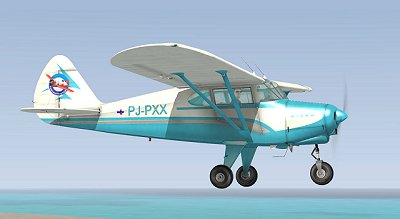
PJ-PXX - Tradewind Flying Club
|
Piper Tri Pacer ~ Lionheart Creations
for FSX
The Pacer and Tri-Pacer designs were Piper's volume selling four seaters from 1949 through to the introduction of the Comanche and Cherokee in the early 1960s, while the Colt was a two seat training derivative of the Tri-Pacer.
The original tail dragger PA-20 Pacer was introduced in 1949 alongside the two seat PA-18 Super Cub, and the prototype was powered by a 85kW (115hp) Lycoming O-235-C1 engine. The production aircraft had a 93kW (125hp) Lycoming O-290-D engine, and were available with a wooden fixed pitch propeller as the '125', and with a metal controllable pitch propeller as the '135'. In 1950 the PA-20 was also available with the 85kW (115hp) Lycoming O-235-C1 engine as the PA-20-115. The aircraft could be equipped with floats as the PA-20S. From 1952 the Pacer was powered by a 100kW (135hp) O-290-D2 engine as the PA-20-135. Production ended in 1954.
The tricycle undercarriage PA-22 Tri-Pacer initially augmented from 1950 the Pacer in production, powered by a 93kW (125hp) Lycoming O-290-D for 1951 and 1952, available with the same propeller options as the PA-20. From 1952 to 1954 the Tri-Pacer was powered by a 100kW (135hp) O-290-D2 engine, and in 1955 gained a 110kW (150hp) O-320-A2B engine and a higher takeoff weight, and a 120kW (160hp) O-320-B from 1958. For 1959 and 1960 Piper offered a lower spec less expensive version of the Tri-Pacer in the form of the PA-22-150 Caribbean.
The two seat PA-22-108 Colt was derived from the Tri-Pacer but had a less powerful 85kW (108hp) engine, lower maximum takeoff weight, no rear cabin windows, the removal of a rear door and less fuel capacity, but otherwise the two airframes were identical. Piper introduced the Colt to its lineup in late 1960, and the type remained in production for just over two years until the two seat Cherokee could be introduced. Colt production ceased in 1964 after almost 2000 had been built.
A number of PA-22s have been converted to PA-20 tailwheel configuration, for which a conversion kit was offered by Univair.
The Tri-Pacer and Colt were Piper's only high wing tricycle undercarriage aircraft, and the last in production to feature metal tubing and fabric covering construction. |
|
Other Essential Files:
The payware Lionheart Creations package
|
Repaint by JF
|
PJ-CAG
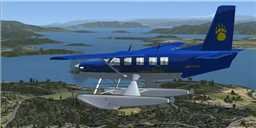
N493TA
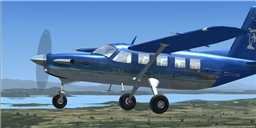
PJ-CAE
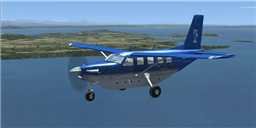
PJ-CAF
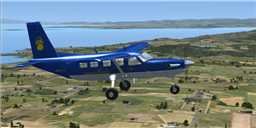
N491TA
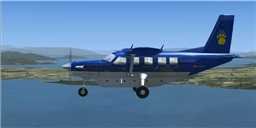
N492TA
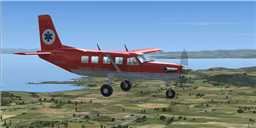
PJ-CAH
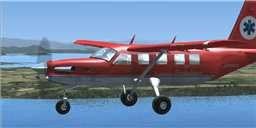
N494TA
FSX
|
Quest Kodiak ~ Lionheart
for FSX
The Kodiak is a high-wing turboprop-powered fixed-tricycle-gear all-metal aircraft suitable for humanitarian applications in unimproved areas; a skydiving version has been certified. Its cabin is not pressurized. The Kodiak bears a strong resemblance to the Cessna Caravan, but it is substantially smaller and lighter than the Cessna, intended more for the utilitarian market (although an executive interior, the "Summit package" with club seating, is planned for introduction in summer 2009).
Large contributors to the Kodiak's STOL performance are a fixed, discontinuous leading edge on the outboard wing and the popular, high performance Pratt & Whitney PT6A-34 turboprop engine (750 hp @ TO). The PT6 has a reputation for reliability. Variants of the engine have been in service since the 1960s.
Passenger seats in the Kodiak are track-mounted, making them easily removable when cargo is to be carried. It has standard access doors for pilot and co-pilot positions, with a large clamshell door in the aft fuselage for cargo loading or for access to the other 6 passenger positions (the lower half of the clamshell door has automatically extending/retracting steps).
- Typical price = $1,800,000
- Seats = 8 (1 Pilot, 7 Passengers)
- Engine = P & W PT6, 750 shp takeoff, 700 shp continuous @ 2200 rev/minute
- Propeller = Hartzell 96 inch diameter, four-blade, full-feathering, reversible
- Prop clearance = 19 inch
- Length = 33.4 feet
- Height = 15.4 feet
- Wingspan = 45.0 feet
- Wing area = 240 feet²
- Takeoff weight = 6,750 pounds
- Landing weight = 6,690 pounds
- Useful load = 3,100 pounds
- Useful load w/full fuel = 911 pounds
- Approx empty weight= 3,700 pounds
- Usable fuel = 320 US gallons/2,144 pounds
- S/L rate of climb = 1,540 feet/minute maximum
- Certified ceiling = 25,000 feet
- Takeoff ground roll= 760 feet
- T/O w 50' obstacle = 1,212 feet
- Landing ground roll= 915 feet without thrust reverse usage
- Landing w 50' obstacle = 1,681 feet
- Cruise speed = 185 knots maximum
- Range = 1,032 nautical mile @ 12,000 feet, 179 knots
- Endurance = 5.9 hours @ 10,000 feet, high-speed cruise
- Stall speed no-flaps = 77 knots
- Stall speed, flaps = 59 knots
- Maneuvering speed = 142 knots @ maximum weight
|
|
Other Essential Files:
The payware Lionheart Creations package
|
Repaint by Francisco Aguiar
|
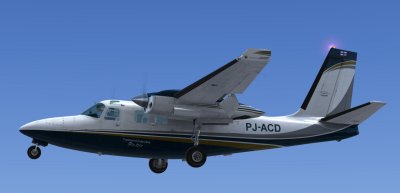
PJ-ACD - Tradewind BizJetz
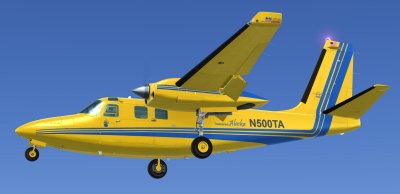
N500TA Tradewind Alaska (Utility)
Merlyn Products 320 HP Turbo System
|
Rockwell AC500S Shrike ~ Carenado
for FSX - P3D
The origins of this prolific series of twins lies with two former Douglas employees (one of whom was Ted Smith) who formed the Aero Design and Engineering Corporation in December 1944 after failing to interest their employer in a design they were working on.
Their original design was the six to seven seat L-3805, which first flew on April 23 1948. This aircraft formed the basis for the first Aero Commander production model, the 520, which seated five to seven people and was powered by two 195kW (260hp) Lycoming GO-435s. Production began in late 1951.
A total of 150 Aero 520 Commanders were built through to 1954. Subsequent development led to the more powerful 560 series (1954) with geared engines, the 680 series (1955) with supercharged engines, and the direct drive normally aspirated 500 series (1958). Variants, apart from the experimental 360, include the 560A which introduced the 25cm (10in) stretched fuselage that became the standard short fuselage length, the 560E which introduced the definitive wing span, the 720 Alti Cruiser pressurised development of the 680 and the later pressurised 680PF.
The 560 and 680 were joined by the stretched 680FL Grand Commander from 1962. The 500 was introduced to production in 1958 and was originally intended as a low cost model.
In 1967 North American Rockwell took over Aero Commander and the Grand Commander became the Courser Commander and the 500 became the Shrike Commander (gaining its distinctive pointed nose at the same time). The Shrike Commander was the last Commander to remain in production, manufacture ending in 1980.
The final piston powered model to appear was the Rockwell 685 Commander, which was a piston powered Turbo Commander.
In US military service, the designation for the aircraft was originally L-26, in 1962 renamed to U-4 (Air Force) and U-9 (Army). Two U-4Bs (ex L-26Cs), an Air Force version of the 680, were ordered by the USAF as presidential aircraft for President Dwight D. Eisenhower. They were used from 1956 to 1960 for short trips. They had the distinction of being the smallest "Air Force One", the first Presidential aircraft to have only two engines, and the first Presidential aircraft to carry the familiar blue and white colors. |
|
Other Essential Files:
The payware Carenado package
|
Repaint by JF
|
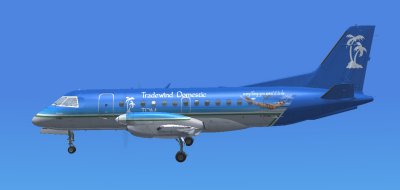
PJ-BIG 'Oualie'
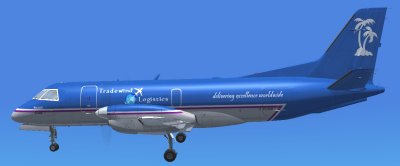
PJ-DOG 'Wadadli'
|
Saab 340 ~ FFS
For FS9
The Saab 340 proved to be a highly popular regional airliner that helped to pioneer the 30 seat turboprop class but slow sales in the late 1990s has forced Saab to cease production.
In 1979 SaabScania of Sweden and Fairchild in the USA reached an agreement to conduct joint feasibility and development studies on a 30 to 40 seat commuter airliner. The resulting SF340 design was launched in September 1980 with the aim of capturing 25 to 30% of its market. Within the 65/35 SaabFairchild partnership split Saab was responsible for the fuselage, fin and final assembly, while Fairchild was responsible for the wings, engine nacelles and empennage. The two companies selected the General Electric CT7 (a commercial development of the T700 which powers Sikorsky's S70 series of military helicopters) to power the new airliner.
The first of three SF340 prototypes first flew on January 25 1983, while the first production aircraft flew in early March 1984. US and European certification was awarded that June. From November 1 1985 Saab assumed overall responsibility for the SF340 following Fairchild's decision to divest itself of its aircraft divisions. Saab initially retained the SF340 designation but later changed it to 340A.
The first improved development of the Saab 340 was the 340B. More powerful engines improved hot and high performance, while other changes included a greater span tailplane, a higher max takeoff weight and better range. Deliveries began in September 1989.
The last development of the 340 was the 340B Plus, which introduced changes developed for the larger Saab 2000, including an improved cabin interior. The first 340B Plus was delivered in March 1994. Lack of sales and profitibility however forced Saab to cease 340 and 2000 production, with the lines winding up in 1998.
|
|
Other Essential Files:
The payware FFS package
|
Repaint by JF
|
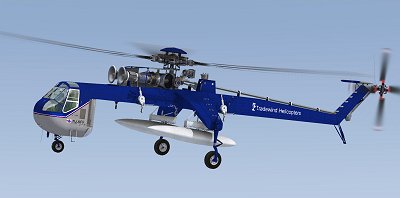
PJ-SFF - Tradewind Helicopters - Hoist CH-54
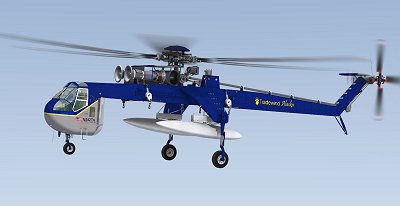
N542TA - Tradewind Alaska - Hoist CH-54
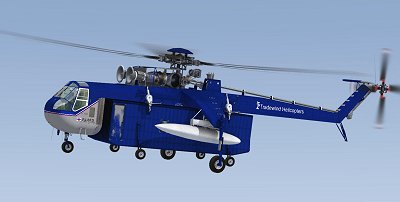
PJ-SFD - Tradewind Helicopters - Container CH-54
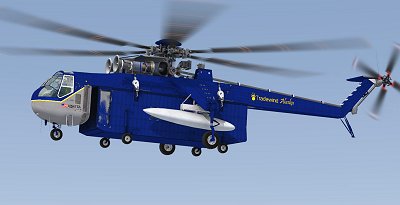
N512TA - Tradewind Alaska - Container CH-54
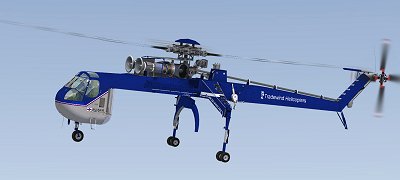
PJ-SFH - Tradewind Helicopters - Hoist S-64
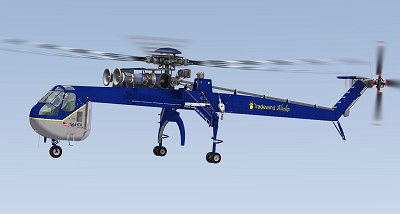
N641TA - Tradewind Alaska - Hoist S-64
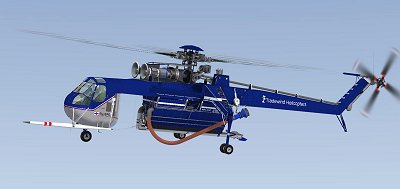
PJ-SFE - Tradewind Helicopters - Water Bomber S-64
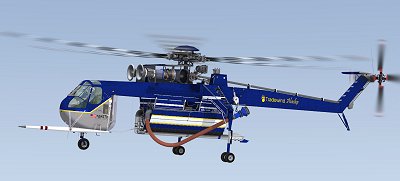
N642TA - Tradewind Alaska - Water Bomber S-64
DOWNLOAD ALL VERSIONS
|
Sikorsky S-64 Skycrane (CH-54) ~ Nemeth
for FSX
The Sikorsky S-64 Skycrane is an American twin-engine heavy-lift helicopter. It is the civil version of the United States Army's CH-54 Tarhe. The S-64 Aircrane is the current production version, manufactured by the Erickson Air-Crane company.
Under Sikorsky
The Sikorsky S-64 was designed as an enlarged version of the prototype flying crane helicopter, the Sikorsky S-60. The S-64 had a six-blade main rotor and was powered by two 4,050 shaft horsepower (3,020 kW) Pratt & Whitney JFTD12A turboshaft engines. The prototype S-64 first flew on May 9, 1962 and was followed by two further examples for evaluation by the German armed forces. The Germans did not place an order, but the United States Army placed an initial order for six S-64A helicopters (with the designation YCH-54A Tarhe). Seven S-64E variants were built by Sikorsky for the civil market.
Under Erickson
Originally a Sikorsky Aircraft product, the type certificate and manufacturing rights were purchased from them by Erickson Air-Crane in 1992.
Since that time, Erickson Air-Crane has become the manufacturer and world's largest operator of S-64 Aircranes and has made over 1,350 changes to the airframe, instrumentation, and payload capabilities of the helicopter. The Aircrane can be fitted with a 2,650-gallon (~10,000 litre) fixed retardant tank to assist in the control of bush fires, and it has proved itself admirably in this role.
S-64 Aircranes have been sold to the Italian and Korean Forest Services for fire suppression and emergency response duties. Those in the Erickson Air-Crane fleet are leased worldwide to organizations, companies, and Federal Government agencies for either short-term or longer term use in fire suppression, civil protection, heavy lift construction, and timber harvesting.
Erickson is manufacturing new S-64s, as well as remanufacturing existing CH-54s. Erickson gives each of its S-64s an individual name, the best-known being "Elvis", used in fighting fires in Australia alongside "The Incredible Hulk" and "Isabelle". Other operators, such as Siller Brothers, have followed with their Sikorsky S-64E, Andy's Pride. The Erickson S-64E nicknamed "Olga" was used to lift the top section of the CN Tower into place in Toronto, Canada.
|
|
Other Essential Files:
The payware Nemeth Designs package
|
Repaint by JF
|
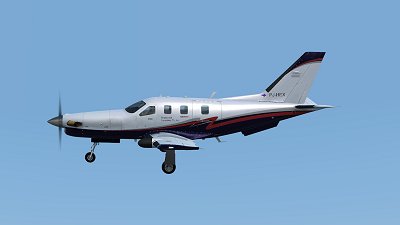
Tradewind Executive Bizjetz PJ-HEX
For FSX ONLY
|
Socata TBM850 ~ Carenado
In the early 1980s, the Mooney Airplane Company of Kerrville, Texas designed a six-seat pressurised light aircraft powered by a single 360 hp (268 kW) piston engine, the Mooney 301, which made its maiden flight on 7 April 1983.
Mooney was purchased by French owners in 1985, which resulted in talks between Mooney and the French company Socata to build a turboprop derivative of the 301. The result of these discussions was the TBM 700, which was much heavier than the 301 with more than twice the power, with a joint venture, TBM International, being set up in June 1987 between Mooney and Socata's parent company Aérospatiale to design and build the new aircraft. In the designation TBM, "TB" stands for Tarbes, the city in France in which Socata is located, the "M" stands for Mooney.
The TBM 700 is a single turboprop engined, six to seven seat low-wing monoplane of mainly aluminium and steel construction, but with the tail surfaces built of Nomex honeycomb. It has a retractable tricycle landing gear and is powered by a Pratt & Whitney Canada PT6A-64 engine delivering 700 shp (522 kW).
The first prototype TBM 700 made its maiden flight on 14 July 1988,[3] with French certification following on 31 January 1990 and US Federal Aviation Administration (FAA) certification achieved on 28 August 1990.
It was planned that two production lines be set up, one at Kerrville to cater for the American market and the other at Socata's factory at Tarbes to build aircraft for the rest of the world. A shortage of money resulted in Mooney withdrawing from the project in May 1991. The TBM 700 also comes in a cargo variant.
The TBM 850 is the production name for the TBM 700N, an improved version with the more powerful Pratt & Whitney PT6A-66D engine flat rated at 850 shp (634 kW).
The TBM 850 is limited to 700 shp (522 kW) for takeoff and landing, but in cruise flight the engine power can be increased to 850 shp (634 kW). This extra power gives it a higher cruising speed than the TBM 700 models, especially at high altitudes (due to the flat-rating). The outside appearance of the TBM 850 has remained the same as that of the TBM 700. The TBM 850 has a typical range of 1,520 nautical miles (2,820 km).
As of the summer of 2009, over 520 TBMs have been produced. The manufacturer expects to produce 450 units in the 2007–16 time period.[6]
Beginning with the 2008 model, the TBM 850 is equipped with the Garmin G1000 integrated flight deck as standard equipment
|
|
Other Essential Files:
The payware Carenado
|
Repaints by JF
|
|